
"We are almost historically painted a portrait..."
I know I am mortal and not created for long. But when I explore
stellar sets, my feet no longer rest on the ground,
I stand next to Zeus, eat the food of the gods and feel like a god.
Claudius Ptolemy
Institutskaya Dubna - 1962
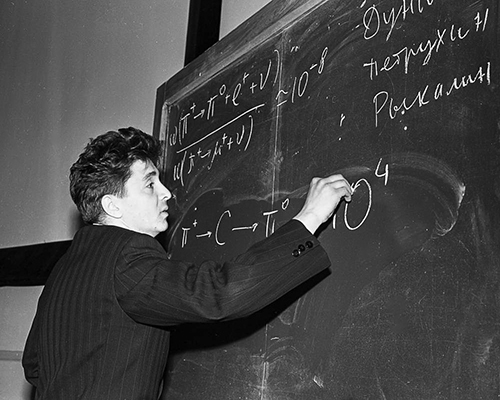
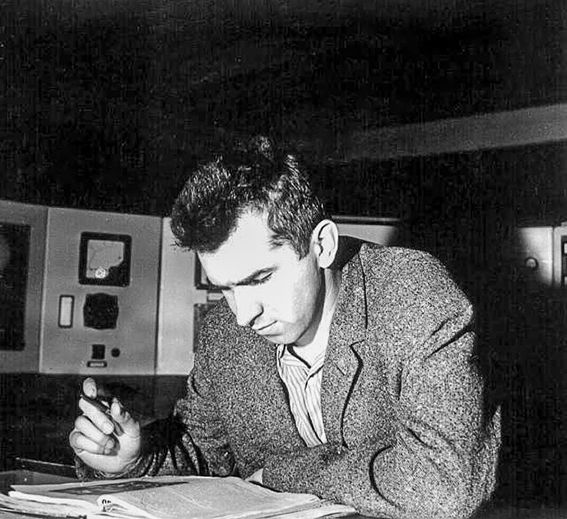
Yury Prokoshkin at the DLNP seminar. 20 April, 1962. Photo by P. I. Zolnikov
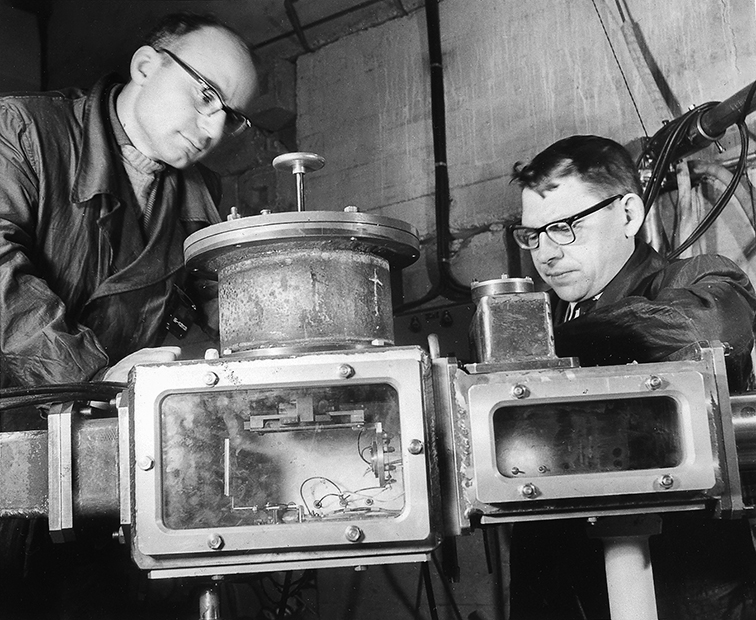
Co-authors of the discovery of proton radioactivity Gurgen Ter‑Hakobyan and Victor Karnaukhov
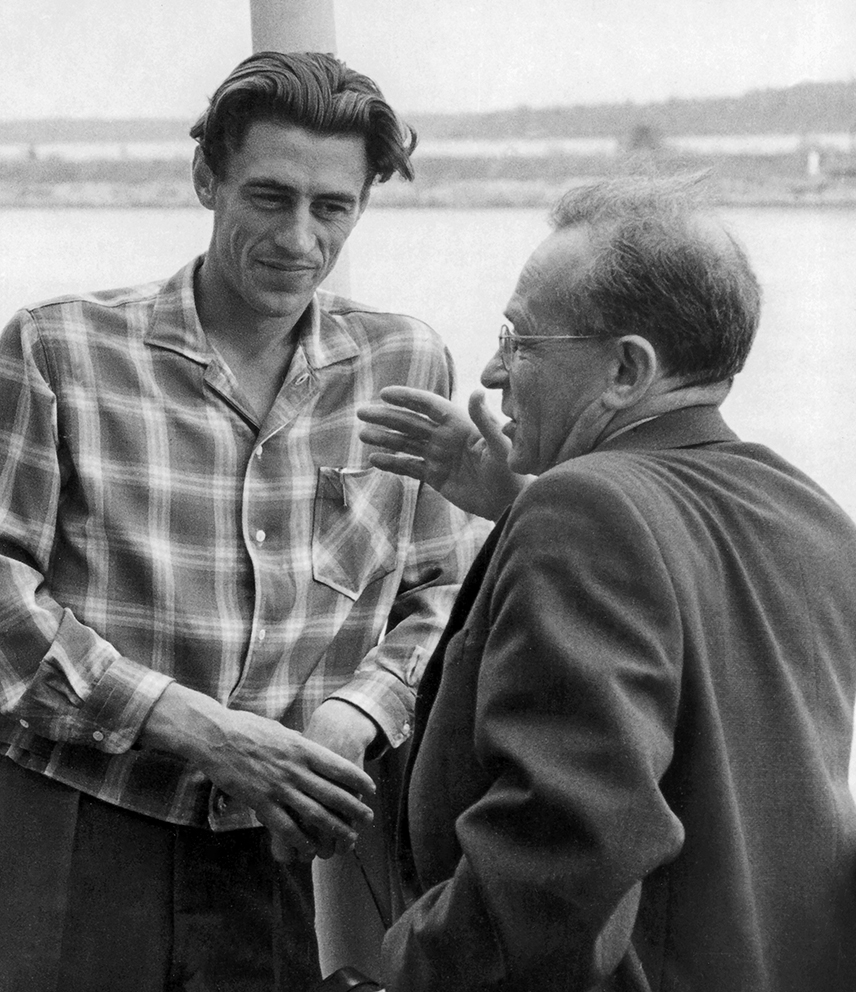
V. P. Sarantsev and V. I. Veksler. Vladimir Iosifovich has been thinking about plasma accelerators for energy of a thousand GeV for several years. The theory said that it was possible, and in 1962, Veksler organized a group headed by Vladislav Sarantsev
Among the documents about the Institute Dubna, the notebooks of Galina Nikolaeva in 1962 are of particular interest. The writer came to make a novel. She visited the laboratories of the Institute, attended seminars, delved into the essence of physical experiments, but most importantly, she talked with physicists and the recordings of these conversations reveal the image of our city of that time.
The writer was interested in "people from the forefront of science". At the time, that edge was particle physics. She was engaged in LHEP - they studied the very foundations of the universe, the structure of nucleons. The annoyance was caused by the low intensity of the beam, it was 50 times less than on the synchrotron at CERN, and 100 times than at Brookhaven. How to compete in such conditions? Young LHEP physicists, using the original technique of particle registration proposed by V. A. Sviridov, managed to increase the statistics of observed events hundreds of thousands of times! Maria Shafranova, a participant in the experiment and a co-author of the discovery, recalled, "V. I. Veksler rejoiced. Addressing V. A. Sviridov, he said, "If I had such results, I would sing a nightingale"...
Writer at the Laboratory of Theoretical Physics. Vladimir Kadyshevsky, a graduate student of Academician Bogolyubov, reports on the theory of discrete space‑time in the microcosm. The writer is perplexed: where does such restraint of the audience come from? After all, this is a revolution in science! Yes, Alexey Alekseevich? And Alexey Tyapkin patiently explains that coups in science are rare, scientists are characterized by healthy skepticism. "And in my novel, the report will be greeted with applause!" the writer replies palpably.
The image of a city of physicists similar to Dubna, an international scientific centre similar to JINR, increases, the heroes of the novel acquire characters. The main character (according to the original plan, the Soviet Marie Curie) acquires familiar features: this is the daughter of a major scientist, director of a large institute, and also a physicist. The writer is looking for her life partner, in collaboration who she will make a scientific discovery with in the novel.
The writer is pointed to Yury Prokoshkin. He is 31 years old, and he is already a doctor of sciences that is a rarity for an experimenter, and it does not happen often among theorists. Yury Prokoshkin is a co-author of two discoveries in 1962. One marked the beginning of mesochemistry in Dubna. And the other, as they would say now, is cooler: the beta decay of the pi meson was discovered by the Prokoshkin group, extremely rare, and one thing that they managed to see against the background of a great many other microcosm events, in itself became a great experimental success, but most importantly, one of the predictions of the theory of weak interaction was confirmed, and in the 1965, film "They work in Dubna", JINR Vice Director Ivan Ulegla called "experimental confirmation of the law of conservation of vector current of hadrons in weak interactions" one of the three main achievements of the Joint Institute.
Galina Nikolaeva is impressed, she decides to get to know this person better. From the memoirs of Yury Prokoshkin's daughter Irina Litvinova, "Rumors spread around the city that the writer expressed a desire to visit the family of some young physicist. The whole city was worried - who would she go to? There was a message that is coming to us. Prepared in a hurry... I, a six-year-old, was told to behave, to read the verse to my aunt, but in no case get off the couch. Playing the role of a "child in a young physicist's family" in this action, I simultaneously performed another responsible task - to cover the spring protruding outward in the center of the ancient sofa with my dress so that the writer, God forbid, would not sit on it. So, in the line of duty, tired of adult conversations, I fell asleep..."
The writer is talking with a former physicist who has found himself in a new field - the second secretary of the city party committee, comrade Mitin. The party secretary speaks clearly, fiarly, almost telegraph style: "Tyapkin is a bright mind, an outstanding personality. Soroko narrowly takes, but took up the problem - it will bring to shine!.." About physicists of the older generation - without any reverence, backhand: "Dzhelepov has clarity, accuracy. Veksler has one thing today, another tomorrow. Irresponsibility. Nobody deals with young physicists. The capabilities of the Laboratory are greater than the results..." About Dzhelepov: "He lives alone in Dubna, from morning to evening in the Laboratory, only he does not do work, part‑time. The accelerator operates fine. The success of the Laboratory is evident." About Meshcheryakov: "It is difficult to talk about this person, he has not come to terms with his new position. A thorn in the successor's side, a problem for the director of the Institute..." And again about Dzhelepov: "I call him to the party bureau. Once, another. He doesn't come. I come to him myself. He: "Why are you breaking into my office?! I didn't call you!.." He hinted at the sad experience of his predecessor. Since then, Dzhelepov has seemed to be changed..."
At first glance, the secretary of the city committee behaves imprudently, thoughtlessly, but this is not so. Everything is in the spirit of the times, so the party teaches, this is called principle. Still under the impression of the 22nd Party Congress, the era of stagnation is in the fog of the future.
“What is the role of the party organization?” the writer asks. Unexpected answer: "The main thing is not to interfere. If you don't interfere, it's already good. Scientists are jealous of interfering with their work. We decided to hear the question of the task of the FLNR staff to synthesize element 104. The Americans made element 101, we - 102. To get ahead, the government decided to build a multi-charge ion accelerator. While they were building, the Americans made element 103. If we do not make 104 - failure!
I say to Fleurov,
“We decided to hear you at the bureau of the city committee.”
He,
"I think it's inappropriate.”
“What do you mean "I think"? The city committee bureau decided.”
“I will not.”
“Georgy Nikolaevich, it is necessary.”
"And I refuse.”
“Come to the city committee, we will talk.”
“No time.”
"I call you as secretary of the city committee.
"I'm going to Moscow..."
I just want to say after Alexander Sergeyevich Pushkin, "But stubborn Galileo is right!"
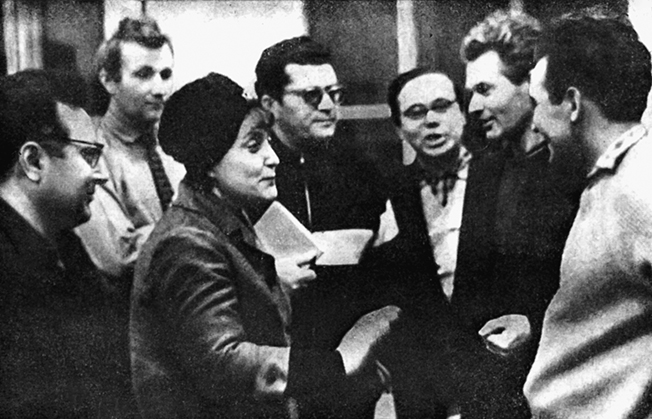
Georgy Nikolaevich can be understood. He's nervous. The classical theory of nuclear fission predicts the close end of the periodic table and 104 is not open. True, Georgy Nikolaevich himself does not believe in a very close end, but doubts still prevail: what if? He does not spare himself, spurs the rest. Work, work! Meanwhile, working with him is becoming more and more difficult, as one of his closest employees Vadim Vasilyevich Volkov admits (from the working journal of the first director of JINR)...
Galina Nikolaeva deliberately limited the idea of the novel to particle physics; her novel, never finished for reasons beyond her control, begins with the chapter "I Love neutrinos!" If the idea were wider, we would become the owners of her conversations with the staff of the Laboratory of Nuclear Reactions. There was something to be inspired and what to sing: just a few months after the discovery of the spontaneous fissile isomer, in the summer of 1962, physicists of FLNR discovered the first signs of proton radioactivity - a phenomenon that was talked about in the days of Rutherford. American colleagues from Yale University came to the same result but in Dubna, they managed earlier, the priority was with Dubna. The word "PR" was not yet in the Russian language, but what it was, Director of the Laboratory of Nuclear Reactions Georgy Nikolaevich Flerov knew very well.
The authors of the discovery were invited to television, newspapers wrote about them. Reading the essay "Difficult joy" - about a young scientist who is so passionate about his work that he does not even have time to enjoy the glory that has fallen on him, the hero of the essay Viktor Karnaukhov now and then made ironic remarks. But many years later, already at the age when wisdom comes to a person, he admitted that the author of the essay Elena Knorre, conveyed to the reader the main thing: a scientist is a person who always thinks about work. Developing this idea, Viktor Alexandrovich writes in the "Book of us": "This "difficult joy" is perceived as the end of a tedious climb to a steep mountain, when you want to sit on a stone, erase sweat from your face and finally look at the beauty around you. There are a dozen experimental results for the first time in my lifetime, and I know the cost to them. But perhaps, great joy is brought by "insights" when ideas of new experiments come, the original interpretation of the data obtained or another understanding of the already familiar. I have experienced this happiness eighteen times, you know these events single‑piece..."
P.S. In May 2007, completing a lecture on the first two discoveries of the Laboratory of Nuclear Reactions, Viktor Alexandrovich took from the portfolio the same "telescope of proportional meters" which proton radioactivity was discovered with and donated it to the JINR Museum. And to the question of one of the veterans "And have you kept it for so many years?" - in a warming voice replied, "So, this is my own, dear..."
Alexander RASTORGUEV