
Two significant dates
Today, on this occasion, we are printing fragments of articles published in our newspaper in different years.
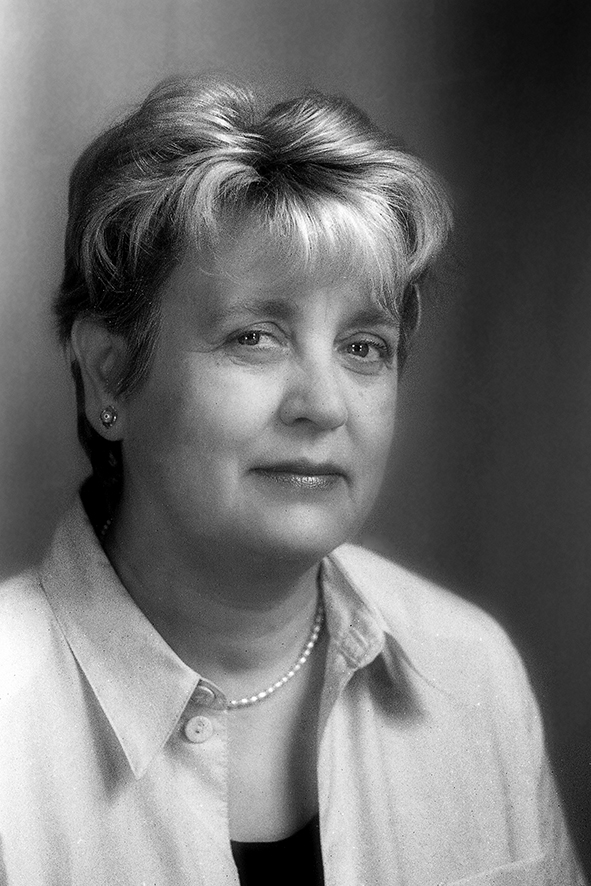
Scientist and teacher
From congratulations on the 60th anniversary
There are few people from all generations at the Institute that do not know Svetlana Petrovna Ivanova, one of the founders and permanent head of the JINR University Centre. A charming woman, a serious scientist with a European name, a qualified teacher, an energetic and successful leader has reached the point where a person has already learned the basic truths, knows what to do next, and is still full of energy to accomplish his plan.
For students and graduate students of UC, Svetlana Petrovna is ready to do everything possible and impossible, if there is a desire to study, work. However, the softness and warmth of the head of the UC go aside when she, a great worker, meets with indifference and laziness. Svetlana Petrovna perfectly understands that lectures and seminars are not the only methods in education. It is important to give the children the opportunity to work themselves, to see how their peers study and work in foreign universities and institutes, to give young people the opportunity to communicate and broaden their horizons. For this, international schools and courses, mutual exchanges of students from Poland, the Czech Republic, internships for students in Italy, Germany, CERN (Geneva) and other countries are held on the basis of the UC. The success of this side of educational activity is simply unthinkable without the efforts and abilities of Svetlana Petrovna. Every year, the University Centre receives grants and scholarships for undergraduate and graduate students. These are grants from the European Physical Society and Leonard Euler scholarships from the German Academic Exchange Service. Herself actively engaged in scientific research, S. P. Ivanova purposefully helps young people to enter the world of big science. Under her supervision, many theses were completed and more than one candidate thesis was defended.
As a true hostess, Svetlana Petrovna takes care of her home. This is exactly what you can call the part in the building of MLIT where the UC is located. Equipment, tables and chairs, boards and projectors are collected here bit by bit, and all this is contained in perfect order. The audience is pleased with the eye, everything works in computer classes, and a laboratory workshop has appeared. All the best and most modern should serve for educational activities, Svetlana Petrovna believes and does not get tired of convincing, knocking out and earning for the UC. You need to see how happy she is when the money has accumulated and you can buy computers, chairs and order furniture for classrooms and laboratories in our city (it is inexpensive and looks very decent). Well, if something else remains in reserve, then Svetlana Petrovna does not forget about symbols and souvenirs. Then branded T‑shirts appear - white, yellow - as a sign of belonging to the JINR UC.
It is impossible not to say about the side of Svetlana Petrovna's life that she considers, probably, the most important - about her family, daughters and granddaughters. She is not only a loving and caring wife, a happy mother and grandmother, she is also a real support and friend for all her loved ones without distinction of their age and degree of kinship.
I would like to wish Svetlana Petrovna good health, success in the implementation of new creative plans and of course, love and support of loved ones, friends and colleagues.
N. V. Antonenko, R. V. Jolos, A. V. Kulikov, N. A. Rusakovich,
A. N. Sissakyan, T. A. Strizh, V. I. Furman
No. 23, 2001
First decade
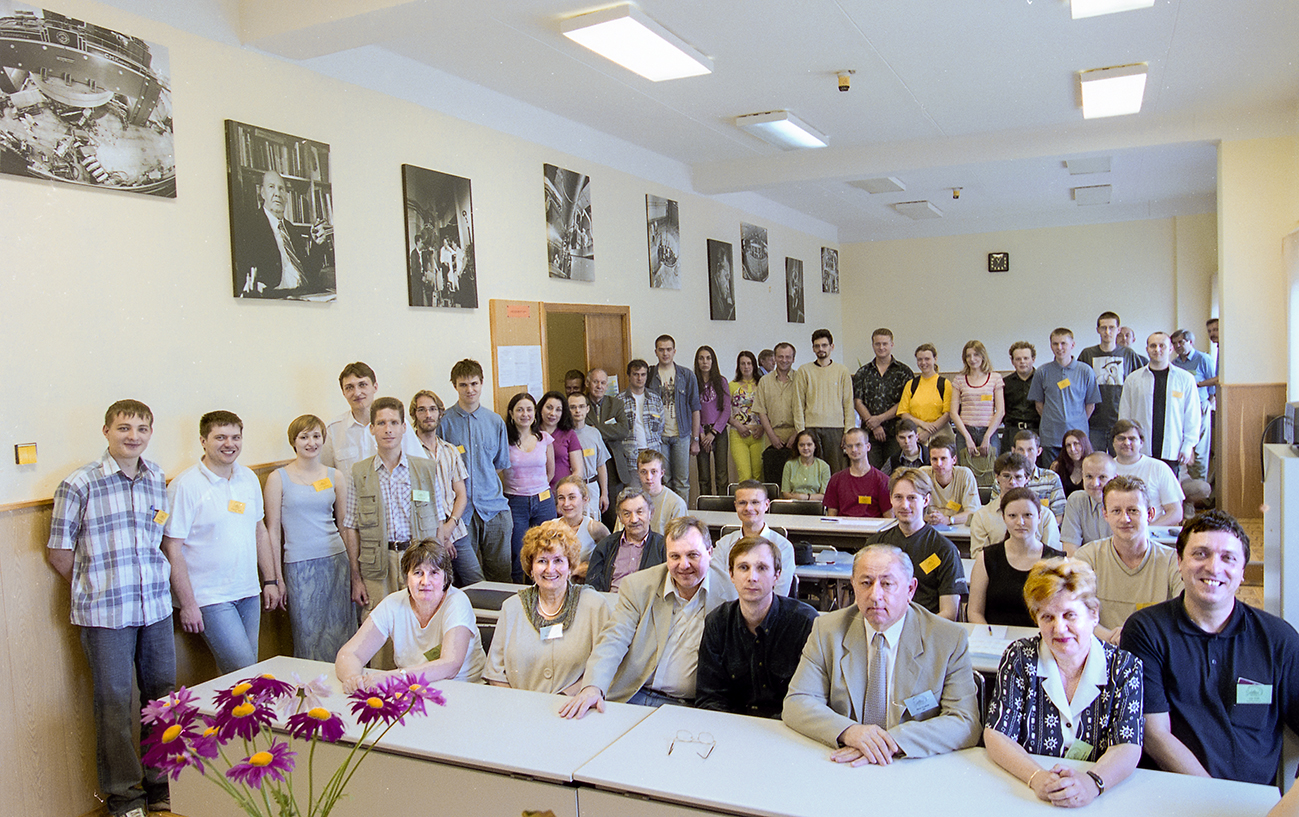
In his welcoming speech, JINR Director Academician Vladimir Georgievich Kadyshevsky praised the quality of training of specialists at the University Centre. For JINR, the influx of young people is very important, since the average age of employees is 50 years. "What would I wish for you?" he addressed students and graduate students. “The main thing is that in those years when you will work, there will be another revolution in physics, so that new ideas will replace the old ideas and you will participate in it... Several times in the history of the development of physics, the illusion arose that physics had exhausted itself, but nature again and again challenged scientists. And now, quite recently, work has appeared on the anomalous magnetic moment of the muon. The results of the experiment indicate a discrepancy with the predictions of the Standard Model. I wish you to have troubled times in your life, and I also wish you health, go in for sports, because only a healthy person can work 20 hours a day."
JINR Vice Director Professor Alexei Norayrovich Sissakyan congratulated everyone. He emphasized the importance of youth training for JINR and thanked everyone who ten years ago had supported the idea of establishing UC on the basis of the Institute and began to actively participate in the educational programme. First of all, this is Directorate of MEPhI, Physics Department of Moscow State University, Physics and Technology. "I want to thank you young people for going to work in physics," he said to the students. "It will give you great moral satisfaction. I wish you a sense of humor under any circumstances, and also luck."
No. 11, 2001
Twenty years in the field of education
Vladimir Nikitich Belyaev, Dean of the Faculty of Experimental and Theoretical Physics, Moscow Engineering Physics Institute:
“... Of course, the role of Svetlana Petrovna Ivanova and her husband Igor Nikolaevich can hardly be overestimated - at any time of the day or night they could be approached... Svetlana Petrovna came to the departments, sought solutions, worried, rushed with the employees, drew diagrams, hung posters, organized all these schools, excursions, but everything was not easy. This process is invisible from the outside, but requires a lot of power, energy, and dedication. This is a large, complex amount of work.
And the fact that the CP decided to include the activities of the UC in the basic areas of JINR was the most important step, but it was taken because there was a result already in 1997 and 1998: here it, young people, came, graduate school earned... Today, try to open graduate school somewhere in a scientific centre - no, you can do it only at a university.
UC is a good idea and well implemented, and the fact that it develops is very pleasant and important. How many disputes there were - but the case moved and now continues, young people appear, good sensible employees, of course, there are fewer of them, there is no stream that used to be, but, nevertheless, they are.
... It's nice to see that UC lives. No wonder they once broke spears.
No. 3, 2011
How it all started
Viktor Lazarevich Aksenov, FLNP Scientific Leader:
“The University Centre is undoubtedly a great achievement of JINR and talking about it, of course, is pleasant.
... And it all began in 1961. Immediately after the establishment of JINR, its first director, Corresponding Member of the USSR Academy of Sciences D. I. Blokhintsev, with the support of the Director of the Lomonosov Research Institute of Moscow State University, Academician S. N. Vernov, began to found the University Centre in Dubna, to say in a modern way. An educational building and a hostel were built on Leningradskaya Street. On the completion of construction, the Minister of Higher and Secondary Education of the RSFSR V. N. Stoletov issued an order (No. 628 dated 30.08.1960) on the organization of a branch of the Research Institute of Nuclear Physics of Moscow State University in Dubna and on the allocation of the necessary funds. After that, Rector of Moscow State University I. G. Petrovsky issued an order (No. 140 dated 06.03.1961) on the beginning of the school year from 1 September, 1961.
The students of the Physics Department of Moscow State University began to come to Dubna, starting from the eighth semester of each academic year, to specialize and perform theses. Many leading JINR scientists took part in lecturing and implementing practical exercises in laboratories. Soon, students of universities in Russia and the republics of the USSR, and then the Member States, joined the students of Moscow State University. As a result, JINR has become a significant centre for training specialists in the field of nuclear physics and particles in the Member States. Capable young people from all over the country were eager to get here. An important role was played by the atmosphere of science and creativity created by the great scientists of JINR that had a great influence on everyone who came to this wonderful place. The students were met by S. P. Ivanova, associate professor of the Blokhintsev department, and many, including the author of these notes (I arrived in Dubna for a diploma in January 1970), are grateful to her for her care and help. All this was important for JINR, since a department of future leading scientists and leaders was formed from among young teachers and students.
So, 60 years ago, the JINR personnel training model was determined and began to be implemented on the basis of the branch of the Research Institute of Physics and Technology of Moscow State University that served as a branch of the Faculty of Physics with the educational part, the organization of students' lives, others. Everything that follows is the evolution of this model, successful or not quite at some stages, depending on the conditions of existence.
On 16 January, 1991, a joint order No. 28/33 of the USSR State Committee for Public Education (Chairman G. A. Yagodin) and the USSR Ministry of Nuclear Energy and Industry (Minister V. F. Konovalov) was issued, in which Moscow State University and MEPhI were approved by universities for targeted training of specialists for enterprises of the Ministry of Nuclear Energy and Industry, and it was ordered to organize training for students of Moscow State University and MEPhI a number of areas...
The educational process in Dubna began on 1 September, 1991 with MEPhI students at the branch of the Research Institute of Nuclear Physics of Moscow State University in two areas - radiobiology (Head, Corresponding Member of the Russian Academy of Sciences E. A. Krasavin) and condensed matter physics under my supervision. In 1992, an order was issued for the Research Institute of Nuclear Physics of Moscow State University (06.07.92 No. 220) that formulated measures for organizing the work of the University Centre of Moscow State University and Moscow Engineering Physics Institute at JINR on the basis of the Branch of the Research Institute of Nuclear Physics of Moscow State University. All this happened with the active participation of the Director of the Branch T. V. Tetereva. The staff headed by her successfully coped with the increased influx of students, the organization of schools and conferences. In the first few sets of MEPhI students from the department of Yu. A. Bykovsky (solid state physics) there were very strong ones. Students from other universities showed up. After about ten years, the original personnel problem for FLNP was resolved. Today, our graduates are Doctors and Candidates of Sciences, some of them head sectors and departments. At this time, Krasavin had already organized a department at Dubna University and moved there. My department of neutronography was opened at Moscow State University, and in Dubna, on the basis of the Research Institute of Nuclear Physics of Moscow State University, two departments of Moscow State University began to function again. The configuration actually returned to the original Blokhintsev model, and the University Centre of Moscow State University and MEPhI was no longer needed.
Another thing is JINR, in which the structure of the UC in modern conditions turned out to be completely adequate. The reproduction of previously worked out forms of work was undertaken by S. P. Ivanova with the support of Academicians V. G. Kadyshevsky and A. N. Sissakyan (at that time Director and Vice Director, respectively). As a result, in 1993, the UC itself was established as a structural unit of the Institute (JINR order No. 316 of 29.04.93). This order approved the staffing and membership of the UC Council, chaired by A. N. Sissakyan. S.P. Ivanova was appointed Director. In 1997, the CP entered educational activities into the JINR Charter.
No. 5-6, 2021