
From first-generation computers to supercomputers
Ending. Beginning in No. 38 of 10.09.26
In 1972, G.I. Zabiyakin told me that he was leaving for Moscow and that he should hurry up with the defense of his thesis. I already had plenty of publications, I prepared my thesis quite quickly and defended it. At the initiative of N. N. Govorun, I was offered the position of Deputy Director of LCTA for research that was held by G. I. Zabiyakin. I worked on it, as expected, for two terms - from 1973 to 1983. From the very beginning, M. G. Meshcheryakov and N. N. Govorun provided me with great help and support. The work was varied and quite complex. Then, in my 33 years, I did not have any scientific and organizational experience working with a large staff. I faced new scientific tasks, cooperation with public organizations, party work. Before being appointed to this position, I was admitted to the CPSU, since Deputy Director of the Laboratory was supposed to participate in the work of the party committee of the Institute, where many serious issues were discussed, including the construction of a new LCTA building. M. G. Meshcheryakov and N. N. Govorun, being Corresponding Members of the USSR Academy of Sciences, took an active part in the work of the Academy, thereby involving LCTA in its activities. In particular, this made it easy, if necessary, to establish and strengthen relations with numerous academic institutions. In the USSR Academy of Sciences, there was a Council for the automation of scientific research and Mikhail Grigorievich immediately attracted me to work in it. The representatives of other JINR Laboratories also took part in the work of the Council. The Council discussed issues of automation, standardization of electronic equipment, recommendations for industry and others. It allowed LCTA to keep abreast of plans and trends in the development of automation tools and to use this information for further development of the Laboratory.
It happened that together with Mikhail Grigorievich I went by car to Moscow. The trip was long and conversations with him always turned out to be very interesting and useful. Many years ago, when I was a member of the editorial board of the LCTA newspaper “Impulse”, I was asked to interview M.G. Meshcheryakov about his presence at the atomic bomb tests on Bikini Atoll. It is known that Mikhail Grigorievich was a bright, artistic person, in an unofficial setting, he spoke fascinatingly, with humor. At my request, he took off his glasses, rolled his eyes to the ceiling and said, "Young man, come to me in ten years! Now is not the time to talk about such events." Then, the information about the tests was still classified and Mikhail Grigorievich, brought up in the harsh conditions of the Atomic Project, strictly followed the rules. And only much later, on one of these trips, I finally heard some details of this story: the USSR was not officially invited by the United States to test atomic bombs on Bikini Atoll. M. G. Meshcheryakov went there as a member of the UN Supervisory Committee. Before the trip, he took etiquette lessons, which a lady of advanced years from pre-revolutionary representatives of high society was invited for. Among other things, she explained what devices to use and how to properly cut the lobster. According to Mikhail Grigorievich, he was given about $3,000 (at that time a lot of money) for equipment and necessary expenses. Upon his return, as expected, Mikhail Grigorievich presented a detailed report, attaching a copy of the film about the tests to it and kept the second copy that he managed to obtain.
From him, I heard the history of the construction of the city of Dubna. The wooden railway bridge over the Sestra River burned down and the supply of construction was threatened. M.G. Meshcheryakov early in the morning went to Moscow to L.P. Beria that oversaw the construction. From him with a secret package and accompanied by security, he went to the Minister of Railway Transport. The minister learnt about the contents of the package, implied that everything was clear to him and the visitor was free. Mikhail Grigorievich stayed in Moscow on other matters and when he returned two days later, the new bridge was already standing on the site of the burned out one. It turned out that since pre-revolutionary times, railway bridges had been built from standard spans and a stock of such spans was stored in a warehouse. They were brought in and quickly installed.
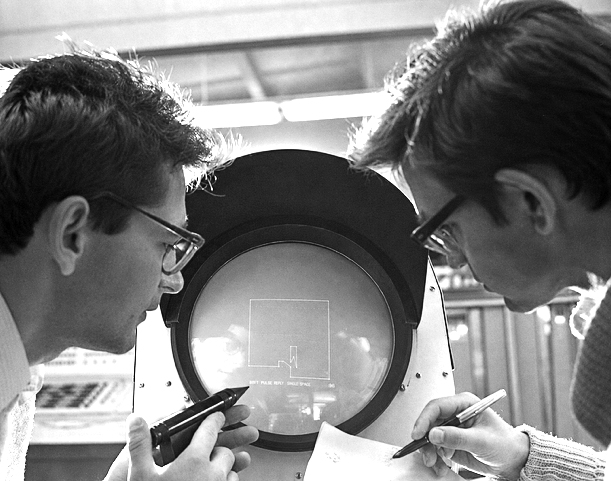
M. G. Meshcheryakov increased the work on computer technology at JINR to a new level. He organized the Commission on Computing and appointed me as its secretary. This Commission coordinated the acquisition of computing facilities for all laboratories. Thus, a unified policy was ensured in the development of JINR computing tools. The Department that I oversaw as Deputy Director, consisted of three sectors: scanning machines on a CRT cathode ray tube (Sector of V. N. Shkundenkov), semi-automatic systems for measuring photographs from bubble and spark chambers (Sector of I.V. Skryl) and the development of hardware for graphic and microprocessor systems (Sector of V. I. Prikhodko). LCTA was focused not only on the internal tasks of the Institute. We tried to spread new knowledge and technology to other organizations. Such as, CRT machines were used in aviation to measure photographic film with flight information. Semi-automatic measuring systems were used to measure photographs of lunar craters. Soviet satellites obtained many high-quality images of the visible and far side of the moon and these photographs had to be processed. As a result, together with the P.K. Sternberg State Astronomical Institute, based on our measurements, for the first time in the world, a complete catalog of moon craters with a diameter of up to 10 km was compiled. Graphic systems developed in LCTA were introduced in dozens of Russian organizations.
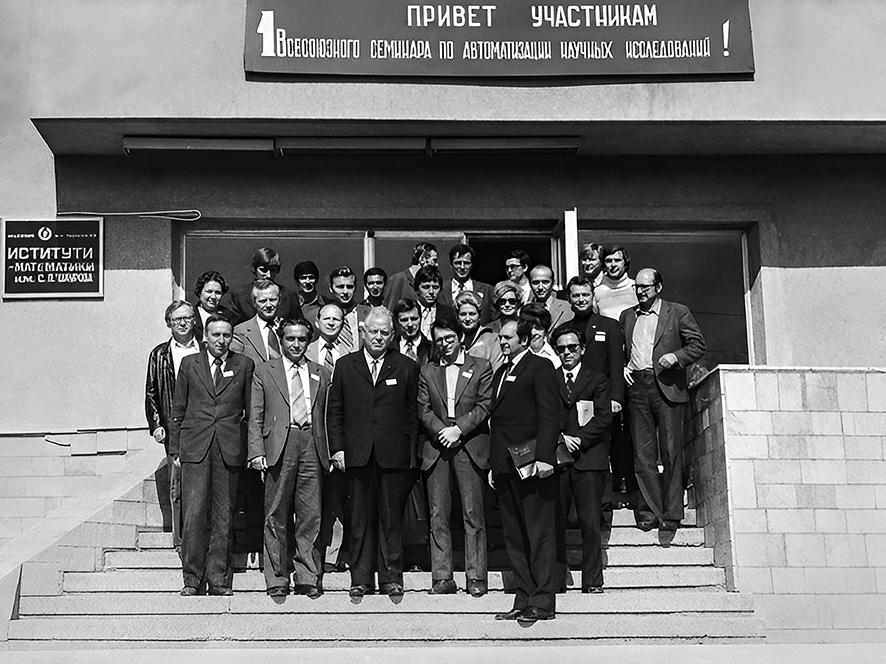
An important part of the life of the Laboratory consisted of scientific schools. As a lecturer, I regularly took part in them. The organization of such schools was at a high level: a serious educational part was united with an interesting social programme. So, for example, in 1974, another school was held in a sanatorium near Tashkent. Local organizers took care of the school participants, providing the territory with the sellers of watermelons, melons, kebabs and everything that usually turns a strict scientific setting into an almost resort one. The listeners, one might say, had a split personality: on the one hand, important scientific information, on the other, the appetizing smell of barbecue. And all this gave the school a special flavor! At the end, a bus tour to Samarkand and Bukhara was organized for school participants. And on departure, local colleagues handed each participant a box of fruit. At Sheremetyevo, our boxes were first mistaken for smuggling but then they figured it out. So, this school was remembered not only by lectures.
The new building of LCTA became, one might say, a man-made monument to M. G. Meshcheryakov. The project was unique: machine rooms with high ceilings, air conditioners, well-thought-out infrastructure. And this inheritance proved useful many years later: there is where to place new equipment and staff. Mikhail Grigorievich was a very kind person. For all the complexity of his life path, at times, he had an almost childish smile. But at the same time, he was decisive, demanding and knew how to achieve results. He brought up character in me and taught me to make difficult decisions, not to be afraid of problems and not to postpone their solution. I am also very grateful to Nikolay Govorun, who I constantly communicated with and that helped me in many matters. He had excellent relations with Director of the Institute, Academician N. N. Bogolyubov that allowed quickly meeting important organizational issues. I remember the story with my former employee that went to work in Kamchatka, at the Institute of Volcanology. When there was a need to develop automation, he turned to me. I consulted with N. N. Govorun and we decided to prepare a letter from Director of the Institute of Volcanology addressed to Director of JINR N. N. Bogolyubov. Govorun signed it with Bogolyubov, the resolution was something like this: "To provide possible assistance to Laboratory Directors". Laboratories found opportunities to allocate equipment and a fairly powerful computing laboratory was established in Kamchatka to help volcanologists.
An important part of my future work consisted of personal computers (PCs). The widespread development of PCs began after IBM released the first PCs with an open architecture in 1981. It meant that other firms could repeat IBM's architecture in their developments without a license. I was immediately interested in this area. I did not miss computer exhibitions in Moscow, followed new models, measured their performance - from the simplest to the most complex. In parallel, I measured the performance of EU computers, since these were our main machines that operated in other laboratories. The results showed that personal computers are beginning to catch up with large machines in computing capabilities. Of course, large computers had more RAM and more complex internal organization, but the trend was clear. I was interested in these results at LTP and was invited to speak at the seminar. After that, it was decided to make a project of a network of personal computers for LTP (KRAST project). I enthusiastically and quite quickly developed its foundations, LTP Directorate approved the project. It was 1987 or 1988. We could not buy personal computers directly from IBM, they were supplied by one of the Malaysian companies which I was familiar with from exhibitions. Then, the widespread distribution of PCs in JINR began, including Bulgarian production: they were not very powerful, but cheap. And for mass implementation, this is also an important quality.
Once at CERN in the late 1980s, I studied how work with PCs was organized there. There were thousands of them and centralized service was required. CERN met this problem: new versions of software and new software products could be simultaneously downloaded to all computers. With this knowledge, I returned to Dubna and an idea arose: why shouldn't our programmers participate in such work? Thus, the cooperation of LCTA with CERN in the field of personal computers started. Cooperation also developed in the area of support and development of special software for automating the control of physical facilities and data accumulation. The positive experience did not go unnoticed. The employees of other CERN divisions began to contact us, including those, related to the development of a new LHC accelerator and its control systems. By that time, our group at CERN had increased to about 30 specialists. We were engaged in designing the components of the accelerator and operational equipment, testing its sections, developing software to control the accelerator, including in emergency situations. The work was very interesting. When the first beam was obtained in 2008, LHC Project Leader Lin Evans sent a letter of thanks to JINR Directorate.
Enthusiasm reigned in LCTA from the very beginning. Even routine work was done with a twinkle. I talked a lot with programmers and engineers. This communication was in a creative atmosphere and with the desire to get the best result. The same atmosphere was in the laboratory as a whole. The main principles of the Laboratory, laid down by M. G. Meshcheryakov and N. N. Govorun, are preserved today: the acquisition and use of the latest computer technology, the training of young personnel, wide international cooperation. The rapid increase of the computing power of the Laboratory occurred during the period when V. V. Korenkov became Director of LIT. It was then that the Govorun supercomputer, capable of meeting the most complex problems at the world level, was installed and later, developed in the Laboratory. Today, the power of the MLIT Computing Complex is measured in petaflops and the RAM - in terabytes.
Success is largely determined by young personnel. In any specialty, I would advise young professionals to look around and focus on new things. This sense of the new, the lack of fear of getting involved, the willingness to expand knowledge in neighboring or completely new areas is a very valuable quality. It helps to make both life and career interesting. Today, there are many areas that are changing the world: artificial intelligence, quantum computers, digital sovereignty. Even while doing your specialization, you need to show interest in what is happening nearby. Sometimes, exactly what is nearby turns out to be the main thing in the future.
In the anniversary year of the laboratory, I wish MLIT employees to follow the traditions laid down by the founders: to stay on top of modern technologies, to develop cooperation with external organizations and to transfer their experience to them, to focus on the training of young scientific and engineering personnel. I am sure that new successes await the Laboratory ahead.
Dear MLIT employees! Let the 60th anniversary of the Laboratory become a new starting point in your work, keep the enthusiasm of the pioneers in the implementation of creative plans, interesting projects and bold ideas. Good luck!
Olga TARANTINA, Photos from the archive of Alexander KARLOV