
ARIADNA: from basic science to future technologies
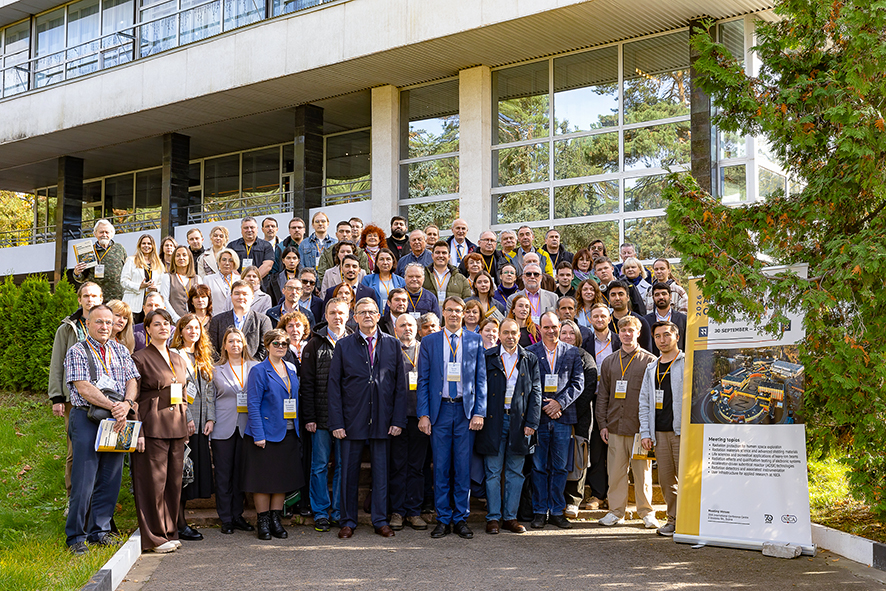
In less than five years since the founding of the ARIADNA Collaboration, the applied research meeting at the NICA Complex in Dubna has become a major event that sets the vector for development in a number of implemented research areas using heavy ions of high energy. At this discussion platform, participants present their vision of the most relevant areas of practical use of ion beams, develop inter-institute relations and conclude agreements on joint scientific and technological developments required to meet common problems.
For two days of work, about 200 scientists and specialists from 42 organizations from 10 countries, including Azerbaijan, Algeria, Armenia, Belarus, Vietnam, India, Kazakhstan, Uzbekistan, Turkey and South Africa, took part in the meeting that harmoniously united the face-to-face format with video conferencing. An important aspect of the event was the participation of heads of a number of institutes and research and production companies, as well as heads of large divisions of member organizations and partners of the ARIADNA Collaboration.
The key topic of the meeting was the scientific programme of organizations cooperating with JINR in terms of implementing applied research at the NICA Complex.
The event was opened by JINR Vice Director Vladimir Kekelidze that made a welcoming speech to the participants and emphasized the demand for the infrastructure of the NICA Complex by the wide scientific community. "The programme of our meeting shows a wide range of areas of our work: from radiation biophysics and testing of electronic equipment for the space industry to research of new materials, the development of detector systems and the prospects for the use of accelerator technologies in nuclear energy. Our common task is to consistently move to a well-coordinated programme of applied research at the NICA Complex with the beginning of regular experiments on beams of accelerated ions," Vladimir Kekelidze said.
Deputy Head of the Department of Research and Innovation of VBLHEP Oleg Belov made a report on the status of the ARIADNA Collaboration, in which he outlined the basic areas of work of organizations cooperating with the NICA team in the applied research and also provided information on the membership of the Collaboration and the number of its participants.
In the plenary section, a message was made about the development of promising radiation-protective materials for the space industry and their testing on charged particle accelerators, presented by a young scientist from Algeria Moussa Hossin on behalf of the team of co‑authors of the Institute of Biomedical Problems of the Russian Academy of Sciences and JINR.
Pavel Chubunov, Deputy Director of the Scientific and Technological Centre No. 1 of the Research Institute of Space Instrumentation JSC that is the leading organization of the Roscosmos State Corporation in the field of control and ensuring the resistance of the electronic component base to the effects of space radiation, spoke about the problems of using NICA Complex beams for testing space electronics.
Anton Popov, a representative of the Institute of Theoretical and Experimental Biophysics of the Russian Academy of Sciences, made a report on the first experiment in radiation biophysics, carried out using the infrastructure of the NICA Complex and opening a new milestone in the history of the development of this megascience project.
Boris Loginov, representing the National Research University MIET and PROTON Plant JSC, spoke about unique developments in the field of probe microscopy for analyzing radiation defects of materials in real time during irradiation at the NICA Complex.
ADSR Project Leader Michaela Paraipan (JINR) presented a report on the status of the development of the LETASUR lead target and the concept of using light cores in experiments to ensure maximum energy efficiency of nuclear physics systems controlled by the accelerator.
Vladimir Zherebchevsky, representing the scientific group of St. Petersburg State University, spoke about advanced detector technologies used in the ARIADNA programme to estimate the charge composition of ion beams.
The plenary section ended with an award ceremony for employees of several scientific groups that had made a decisive contribution to the implementation of the ARIADNA Collaboration experiment programme and had helped in the development of user infrastructure for applied research. Thus, the participants of the BM@N experiment Mikhail Kapishin, Semen Piyadin, Sergey Novozhilov, Alexander Makankin, the employees of the Sector of Radiation Medicine and Biology of DNA DLNP Alexey Agapov and Gennady Mitsyn, Deputy Chief Engineer of VBLHEP Sergey Anisimov, a senior engineer of the Sector of Power Electronics of DPET VBLHEP Mikhail Meshenkov were awarded Honorary Diplomas of the ARIADNA Collaboration.
At the breakout sessions, the representatives of collaborating institutes and universities made reports on the implementation of work within the framework of government tasks focused on research using the infrastructure of the NICA Complex. The participants also considered plans for future experiments on heavy ion beams of the NICA Complex, including those submitted by the organizations intending to join the ARIADNA Collaboration in the near future.
A meeting of the Council of Cooperating Organizations was held in the format of a round table that was attended by directors and heads of scientific groups of institutes cooperating within the ARIADNA Collaboration, as well as authorized representatives of partner organizations. The participants discussed strategic issues of the development of collaboration, the presented information on the capabilities of the NICA Complex at major scientific and scientific-organizational events, as well as aspects of international cooperation in the main areas of applied research at the NICA Complex. Focus was on the organization of ARIADNA events aimed at partners from JINR Member States.
During the meeting, the participants learnt about the research infrastructure of the NICA Complex. During the tour, they visited the collider, the Superheavy Element Factory and the building of the MPD experiment - the first point of meeting the beams and registering the products of nuclear collisions of particles. The participants expressed great interest in the technological potential inherent in the infrastructure which the NICA Complex was founded with and expressed hope for the use of the constructed assembly lines to meet a wide range of applied problems.
During the two-day meeting, the participants more than once emphasized the need to ensure the earliest possible access of cooperating organizations to implementing experiments at all currently established stations for applied research.
The ARIADNA Collaboration is currently the main generator of ideas for carrying out original and innovative experiments on the beams of the NICA Complex that allow to completely unleash the potential of the developed facility of the "megascience" class for applied science. In this regard, the representatives of leading institutes and universities expressed their hope for taking into account their proposals when preparing schedules for future experiments at the NICA Complex, especially for work at stations that allow obtaining ion beams with energies of the order of several hundred MeV/nucleon.
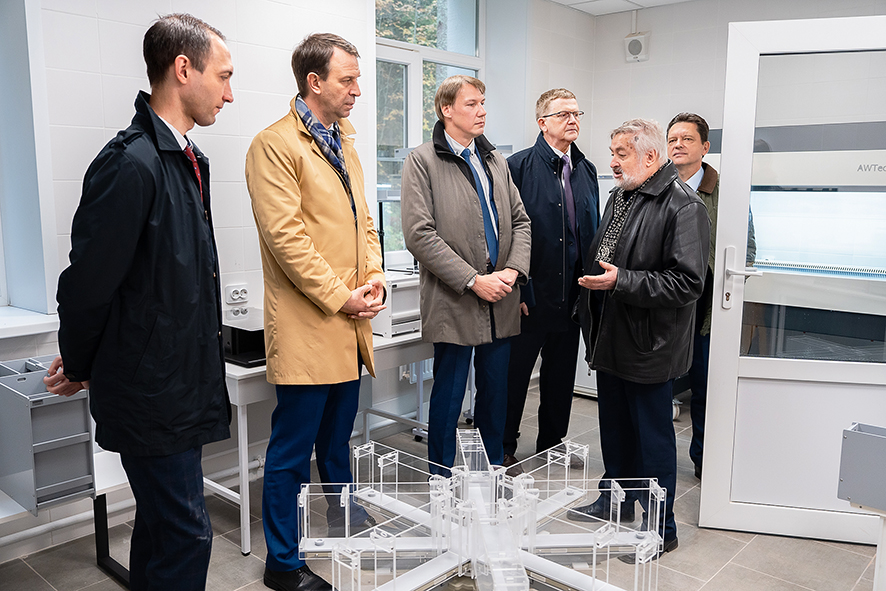
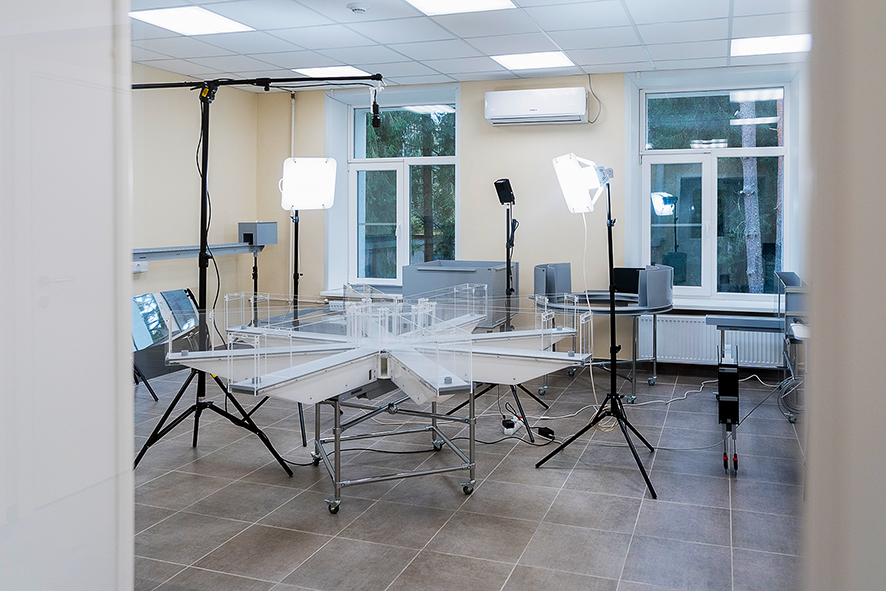
In the margines of the meeting, the delegation of the Institute of Biomedical Problems of the Russian Academy of Sciences, headed by Director Oleg Orlov, paid a working visit to the updated building of this Institute, located on the territory of JINR. The initiative to renovate the premises was discussed back in 2021. Currently, the building has been repaired and commissioned. During the meeting, the grand opening of the building of the IBMP RAS in the coming days was announced.
The results of the meeting showed that ARIADNA today is becoming one of the key mechanisms for turning the unique capabilities of the NICA Complex into a popular tool for applied science. Uniting scientific staffs, engineering teams and industrial partners, the collaboration develops its own agenda of experiments and at the same time, creates an international community of users around NICA. The next stage is the transition from the development of individual initiatives to the systematic implementation of the research programme, in which the NICA team and ARIADNA are called upon to take a leading position in applied research. It is here that the fundamental capabilities of the megaproject are directly continued in technology, new materials, space research, life sciences and nuclear energy, turning into a practical result for science and society.
Meeting Organizing Committee, photos by Elena PUZYNINA and Olesya CHEPURCHENKO