
Realm of math: play, interest and discovery
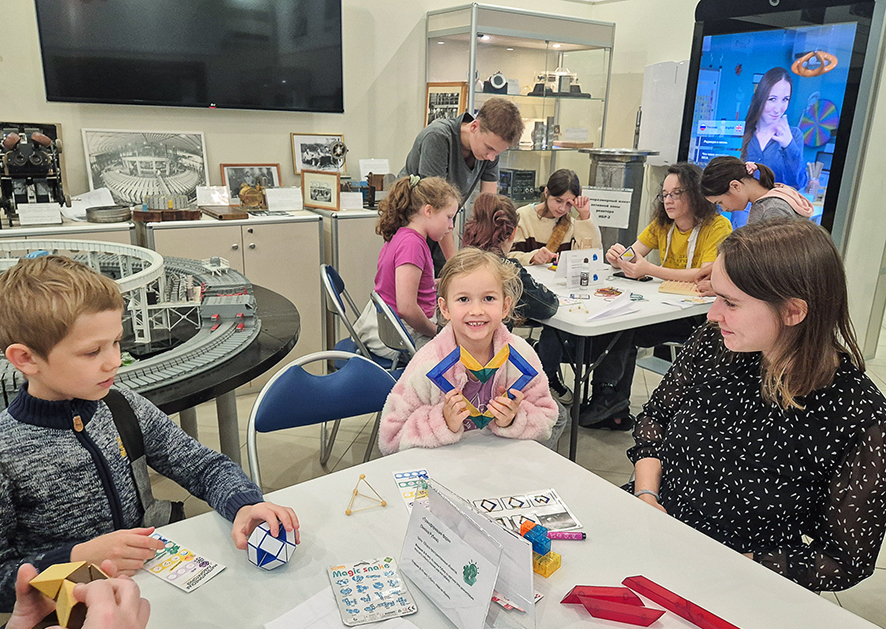
"Mathematics is the queen of all sciences," Carl Friedrich Gauss said. And the approach to it should be special. Not ceremonial, but exciting, fun, so that there is still joy from participation and a desire to meet more than once. It is for this purpose that the JINR Museum for one day became the epicenter of children's thought, logic and real scientific excitement. The Future Scientists’ Club, functioning at the Museum, with the active support of the staff of the Universal Library named after D. I. Blokhintsev, held an hours-long interactive event "Mathematical laboratory".
The main hypothesis of the organizers - mathematics can be exciting was completely confirmed experimentally. The researchers were 80 children aged 6 to 11 years.
The projects of the Future Scientists’ Club are implemented with the aim of introducing children to science in a lively, playful way, long before the appearance of complex school formulae and exams within the school curriculum. Here, young participants try themselves as researchers: they set experiments, solve non-standard tasks, design, observe and ask questions. The Club brings together inquisitive children, their parents, young and experienced mentors - museum staff, volunteers and scientists that help children to believe: science is not boring, but really exciting.
And it is especially important because mathematics is not just a school subject. This is the universal language spoken by all modern science and our Institute is no exception. Accelerator physicists are engaged in calculations, simulations, statistics and topology on a daily basis. Without mathematics, it is impossible to discover a new particle, to process the data of experiments, or to build a theory. That is why, it is so important to captivate children with mathematics as early as possible - not with dry examples in a notebook, but through play, an experiment and the excitement of search. Perhaps (and this was the calculation), one of today's participants in the "Mathematical laboratory" will become a JINR scientist and will move big science.
In the meantime, we played math. At the start, each participant received a personal record, after which they were given complete freedom of action. For four hours, more than 30 gaming and experimental stations worked in four specialized scientific zones, where science met with curiosity.
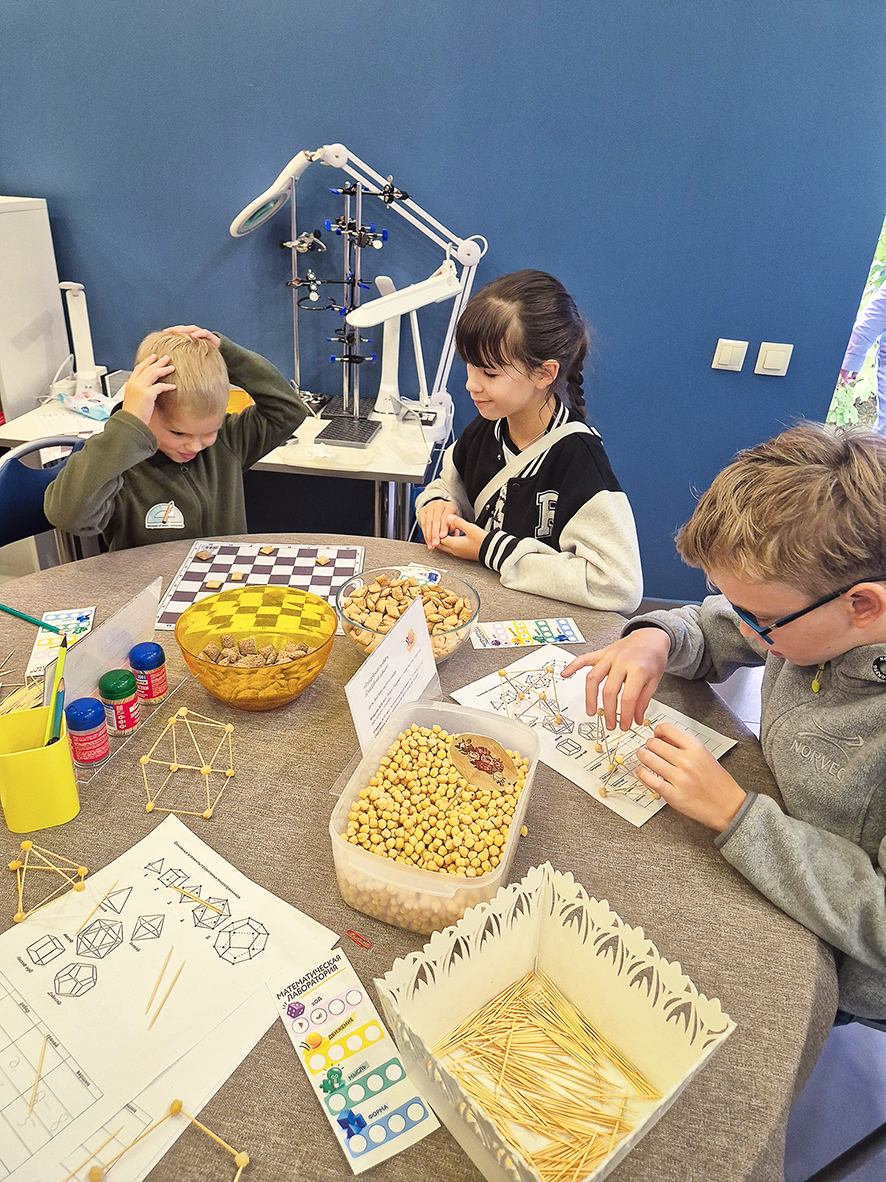
Geometry reigned in the sector of spatial modeling: the children tamed the elusive Mobius ribbon, comprehended the secrets of topology and learned to fill space with complex figures (they played Pentamino and Tangram), developing spatial imagination.
The sector of logic games was focused on the development of algorithmic thinking, here, you could hear how "brains creak" - the participants challenged the legendary Hanoi Tower and Rubik's snake, tested logic for strength with the cunning tasks of old man Fur and the game masters, solved cunning cryptographic ciphers and equations with shifting matches.
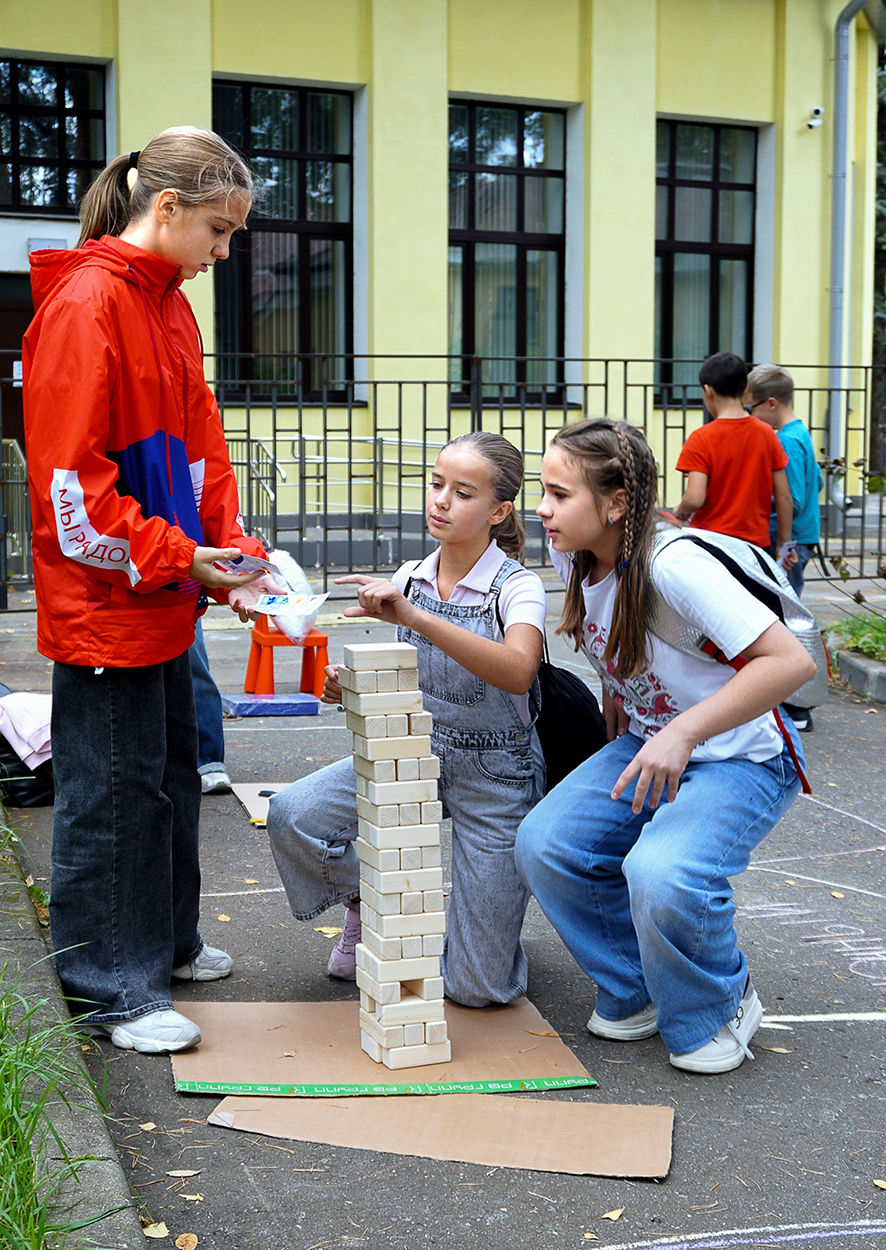
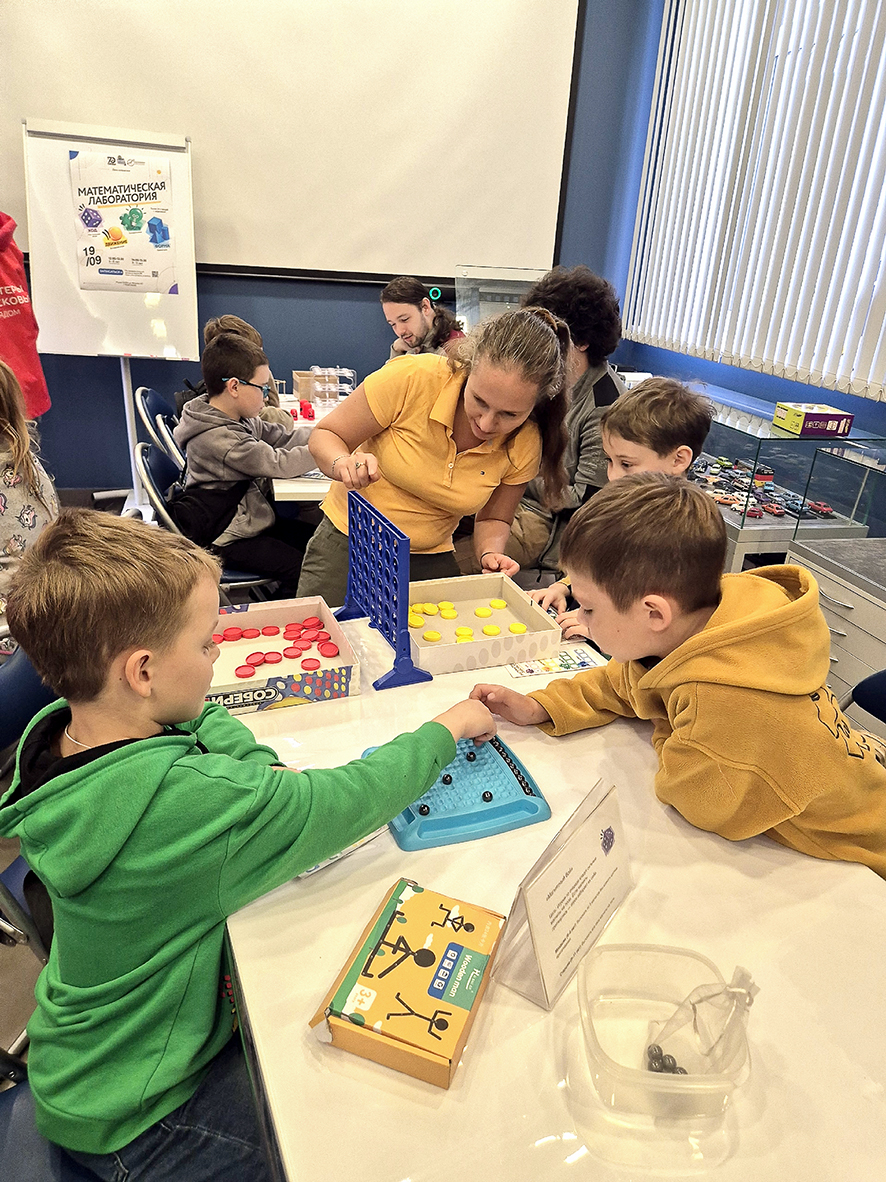
In the sector of board games, hot express fights "Set", "4 in a row," "Speed caps", voluminous tic-tac-toe were in full swing - a real test of memory, concentration and strategic thinking. And at the landfill of applied mathematics, science came out into the fresh air: on the street, children launched paper planes exactly in the "top ten", jumped along coordinate grids, built a giant "Jenga" and played a large-scale "Drum".
For points earned in honest intellectual battles, all the participants were awarded memorable and tasty prizes. Among them were many children and grandchildren of JINR researchers that in turn, came to support young researchers and themselves were involved in the gameplay with great interest.
The organizers of the Museum Director Anastasia Zlotnikova and an employee of FLNR and the Museum Irina Egorova thank:
- young scientists for active participation, sharp mind and spent energy;
- parents and volunteers, without whose help a major project would not have been held. It's great that a significant part of the leading volunteers were schoolchildren from the Youth Centre “Initiative” and the Universal Library that with great pleasure joined the process and expressed wishes that the mathematics lessons at school were just that - informative, exciting;
- the team of the Universal Library that presented the event with a bright design of posters, notes, prizes and ensured the work of creative stations;
- students of the Faculty of Applied Mathematics of the Moscow Institute of Physics and Technology in the person of Taisiya Zlotnikova that started her research career at the Future Scientists’ Club 12 years ago and today, has assumed an important part of methodological support, preparation and conduct of the most difficult topical tasks;
- Family and Childhood Centre “RostOK” for work at the stations “Tangram” and “Nikitin squares”.
The event was held for children, but no less valuable are the reviews of parents that were the hosts of the sections:
Nina Kalashnikova: "I really liked playing games, I want more! In the meantime, I was leading, my children were happy to rush with records at all stations and would have rushed more if the event had not come to an end. Thanks to all the organizers, great Saturday time!"
Anna Kuzmina: "I thank everyone involved in such a wonderful event! It was interesting not only for children, but also for their parents (that managed to get among the lucky ones). Please, hold a similar event for adults. And of course, children will wait for new meetings within the walls of the JINR Museum!"
But the best reward for the organizers was the emotions of the children. The children did not want to leave - many went through the stations in the second round and the real excitement of the researchers burned in their eyes. "When else, is it possible every weekend?" - this question sounded most often and for the sake of it, perhaps, it was worth starting this whole holiday of science.
Event Organizing Committee, Photos by Anastasia ZLOTNIKOVA and Anna BEZBACH