
Art-stretching for physicists
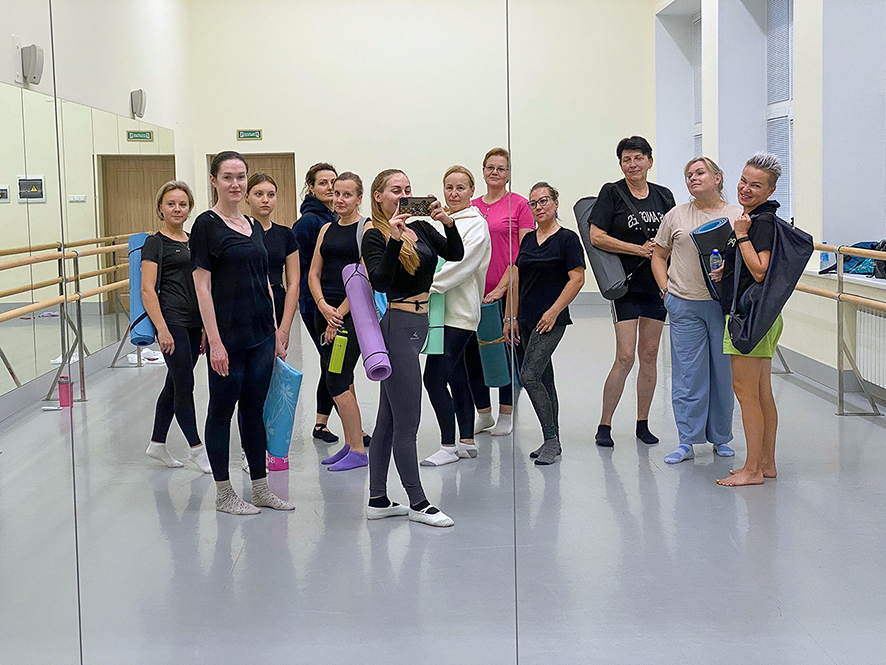
The programme includes exercises that directly affect the speed of thinking, focusing, that is important when working with formulae and calculations; the ability to hold in memory complex concepts such as quantum mechanics, relativity, others.
Classes improve the ability to quickly switch between tasks - this is useful in parallel solution of several equations, analysis of experimental data, interdisciplinary research (physics + mathematics/chemistry/biology).
The idea of developing this area arose from Ekaterina Stepanova, Head of the Cultural and Mass Sector of the Cultural Centre "Mir". The synthesis of several professions and formations played a key role.
Ekaterina Evgenievna is a teacher‑choreographer with more than five years of experience, graduated from the Ostankino Higher School of Cinema and Television with a degree in Theater and Film Actor (workshop of Evdokia Germanova) and has a higher pedagogical education received at the VEGU Academy. This accumulation of knowledge and skills is a great advantage for heading an Art‑stretching Studio.
It was important to develop a training programme in such a way that the Studio participants could maintain a balance between intensive mental work and quality of life. It definitely helps to prevent mental burnout, restore focus for further work and "let go" of the unresolved task in order to take a fresh look at it.
For a physicist, such physical activity is not just a concern for health, but a tool to increase professional efficiency. It accelerates the solution of complex problems and prolongs a scientific career. We talked about the nuances and intricacies of the classes with Head of the Studio.
Ekaterina, let's first determine for readers what art-stretching is and how it is fundamentally different from classic stretching or yoga?
- Art-stretching is my author's technique that includes several types of stretching: classical that we met in textbooks, artistic, where beautiful and elegant movements and stretching with yoga elements are performed.
How did the idea come to open this studio and how is it useful and interesting primarily to JINR employees, who mostly visit it?
- The idea came from a combination of useful and pleasant, from the desire to offer girls engaged in intellectual work a way not only to maintain physical shape, but also to relieve emotional stress. For JINR employees, our classes are an opportunity to switch from routine tasks, gain new communication experience, develop plastic and self‑confidence. A creative atmosphere helps to reduce stress and body clamps.
You have been a leader of a group in the Cultural Centre for two years now. Let's evaluate - what physical and creative qualities does art-stretching develop?
- Classes develop flexibility, coordination, posture, strengthen the muscles of the whole body. Creatively - this is emancipation, the development of imagination, the ability to work with emotions, increasing self‑esteem.
And what do the participants say? Does it help to switch from work tasks and "reboot" the brain? How do classes affect their activities?
- Participants note that after training there is a feeling of lightness, vigor, fatigue goes away, there is a surge of strength and inspiration, and at work, ideas come by themselves.
Do such activities help to fight chronic fatigue syndrome that is often found in researchers?
- When the brain boils and in thoughts of commotion, physical activity is not just advice from a brochure on a healthy lifestyle, it is an emergency measure! This is a way to physically shake off the suffocating stress that shackles the shoulders and presses on the chest. This is not about records, but about the return of control. About not losing yourself in this endless race for discoveries and truth. Physical activity is the foundation on which your endurance is built. This is the same anchor that will prevent your ship from crashing on the rocks of burnout.
Do you think art‑stretching contributes to improved focusing and the ability to do long-term mental work?
- Yes, stretching directly contributes to it since several mechanisms of influence on the body are launched - improving blood circulation, reducing muscle tension, increasing serotonin levels.
Can training stimulate creativity and help in finding non‑standard solutions to scientific problems?
- Kneading the body, we unravel the ball of thoughts. Stretching itself will not turn you into a genius and will not bring insight to you. But it is like setting up an instrument before a concert, when you remove the clamps in the muscles, you involuntarily weaken the mental vice. The body, freed from the shackles of a sedentary lifestyle, is felt easier, and with it the mind is liberated. It is in this state of physical freedom that cognitive flexibility is born. This is the very ability to "think outside the box" when the brain, freed from routine and stress, begins to grope for non-obvious relations and see a solution where there used to be a blank wall. You're not just looking for the answer - you're changing the angle of view itself. I always advise - so that this effect is maximum, do not focus on one thing. Create a symphony of stimuli for your brain. Combine smooth yoga that teaches focusing, with explosive cardio energy that accelerates blood, and power loads that require extreme focusing. It is in this variety, in the constant change of tasks for the body, that your thought learns to be truly flexible, fast and tireless.
Ekaterina, for sure, art-stretching classes increase the level of serotonin and endorphins that affects the motivation for scientific work...
- Yes, classes have a positive effect on the emotional state and can affect motivation to activity, including scientific work.
Are there investigations on the effects of such activities on cognitive function in people in intellectual professions?
- Moderate loads stimulate neurogenesis, increase the level of BDNF (protein associated with the development of neurons), optimize stress reactions that contributes to resistance to mental loads and increase productivity. There is no data on the effect of stretching on cognitive function in people of intellectual professions, but the general trend of investigations indicates the potential benefit of physical activity for maintaining cognitive performance. Therefore, we are happy to invite JINR employees to join the art-stretching group at the Cultural Centre “Mir”.
Interviewed by Member of the Union of Theater Workers of the Russian Federation
Eleanora YAMALEEVA,
Photo from the archive of Ekaterina Stepanova