
Scientific reviews and collaborative projects
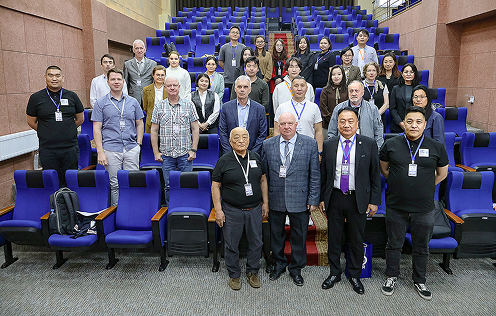
The scientific programme turned out to be rich, the JINR delegation presented nine reports on research carried out in VBLHEP and BLTP. The meeting was opened by Academician of the Mongolian Academy of Sciences Ts. Baatar, a member of the JINR Scientific Council. The meeting participants were also welcomed by Academician J. Davaasambuu, Director of the Institute of Physics and Technology of the MAN. The meeting was attended by the President of the Mongolian Academy of Sciences S. Demberel (by the way, perfectly speaking Russian).
JINR delegation reports highlighted the prospects for experimental physics at the NICA Accelerator Complex (A. A. Baldin), a review of observed effects in relativistic nuclear physics from the highest energies to the NICA energies (O. V. Rogachevsky), new projects on the derived beams of the NICA Accelerator Complex (S. V. Afanasiev), reports were presented on the dissociation of relativistic nuclei in emulsion experiments (A. A. Zaitsev), a theoretical description of low-slope systems (S. G. Bondarenko). Of particular interest among Mongolian colleagues was the programme of applied research in the test zone of the SPD detector of the MARUSYA facility (S. A. Chetverikov) and at the SHINE station (V. A. Kukharev). The SHINE station project, developed at the Institute of Physical and Technical Problems (Rosatom) under the supervision of A. A. Smirnov, will be commissioned at the NICA Accelerator Complex in December, 2026. Focus was on new approaches to the processing and interpretation of experimental data on relativistic nuclear interactions (A. A. Baldin, E. G. Baldin) accumulated using bubble chambers. These data obtained at JINR basic facilities are successfully processed in Ulan Bator, Tashkent, Dubna. The reports of the Mongolian colleagues concerned the analysis of multiple particle birth in relativistic collisions (C. Baatar), thermodynamic properties of particle birth in pC- and pp- interactions (M. Sovd), fragmentation of flying nuclei in SS interactions (J. Shinbayar), two scales of 4‑pulses in π‑C interactions (B. Otgongherel), supersymmetric corrections (T. Lhagvazhav).
In the process of discussing the reports presented, the President of the Academy of Sciences, Academician S. Demberel proposed expanding cooperation with the teams of Academician Ts. Baatar and Academician of RIA A. I. Malakhov that is aimed at experiments on the NICA Accelerator Complex.
Note that all residents of Mongolia over 40 years old - scientists, people on the streets and traders in the market speak Russian well. Younger generations are more likely to choose English as their foreign language. Reports and discussions in working groups at the meeting were mainly in English.
The visit to Mongolia made a vivid impression on all members of the JINR delegation. Ulaanbaatar airport greeted us by raising the national flag of Mongolia. Goodwill and calmness of people, cleanliness on the streets of Ulan Bator, mixing of modern and traditional clothes, music, decorations, many young people and children around, countless buildings under construction and round white yurts between them - all this is modern Ulan Bator. The population of Mongolia is small, about 3.5 million people, of which almost half live in the capital. The number increases annually by at least ~ 1.5%. 1 June is Mother's Day in Mongolia. Throughout the week of our stay in Ulan Bator, the President of the country personally presented the orders of "Maternal Glory" of the 2nd degree (if there are more than four children in the family) and 1st degree (more than six children) to 12 thousand women in Mongolia in the central square of the capital. The only foreigner who was awarded this order is Olga Gandbold (her father‑in‑law works at BLTP JINR).
Mongolia is currently a booming country. The capital of Mongolia is quickly built up. At the beginning of this year, the Institute of Physics and Technology moved to a new building specially rebuilt for it as part of a whole academic town with laboratories and living quarters. Despite the lack of large physical facilities at the Institute, there are well-equipped laboratories of electronics and photonics, magnetic materials and others, research is underway in the field of creating and adapting to the current conditions of solar energy and a department of theoretical physics is organized. Students of Mongolian State University practice, defend PhD in many scientific centres of the world. There are Mongolian students in JINR laboratories as well; it seems important to develop and to maintain this tradition.
Mongols love their country, remember and honor their history. The historical museum in the centre of Ulaanbaatar contains interesting information about ancient Mongolia. There is also a huge gilded statue of Genghis Khan. In general, Genghis Khan is a modern brand in Mongolia. There is Genghis Khan Square, Genghis Khan Hotel, cafes, shops and all the good things are named after him. Not far from Ulan Bator, a colossal monument to Genghis Khan was erected on horseback, inside the monument there is a staircase to the observation deck, where you can see the characteristic Mongolian landscape from - greenish steppes, treeless hills, small rivers flowing from them, sometimes white spots of yurts and herds of horses.
We also saw one of the largest Buddha statues which the temple was built around. Our visit coincided with the annual Buddhist festivities attended by monks from Tibet. It should be stated that the Mongols are mostly not very religious, although they are friendly to any religions and beliefs and are not averse to spinning drums with "prayers for all occasions".
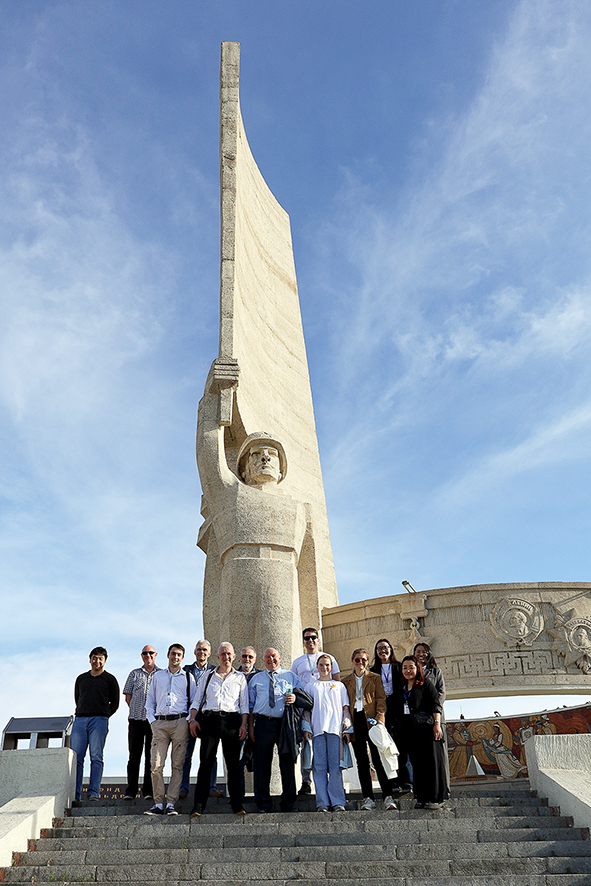
We were very impressed by the monument in memory of the Soviet and Mongolian soldiers who had defended the world from fascism in 1941‑1945. Mongolia is a country whose help to the Soviet Union during the Great Patriotic War is difficult to overestimate. During the war years, when its population was only about 800 thousand people, the country sent us 800 thousand horses, one for each inhabitant of the Mongolian People's Republic. Unpretentious and hardy, they carried cargo and wounded, guns and ammunition during the war years. In addition, the fraternal people of Mongolia sent to the Soviet Union, that fought against fascism, boots, overcoats, stew and much more.
As the lecturer of the Genghis Khan National Museum, opened in 2022, explained to us, the roots of our peoples and cultures are closely intertwined. We will always remember that Mongolia has been a founding country of JINR since 1956 and has been contributing to the development of our Institute for 70 years.
Anton BALDIN