
Unique documents and informative lectures
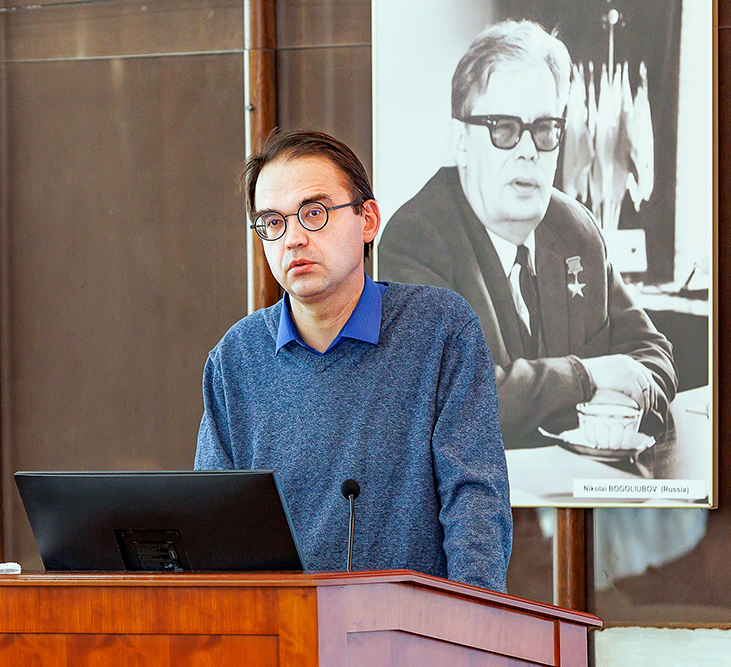
Your lecture was the first in the series "Meridian of interaction" and it was a story about CERN. How was the topic chosen? Why is this, for example, not a story about JINR, what was important and that you wanted to tell?
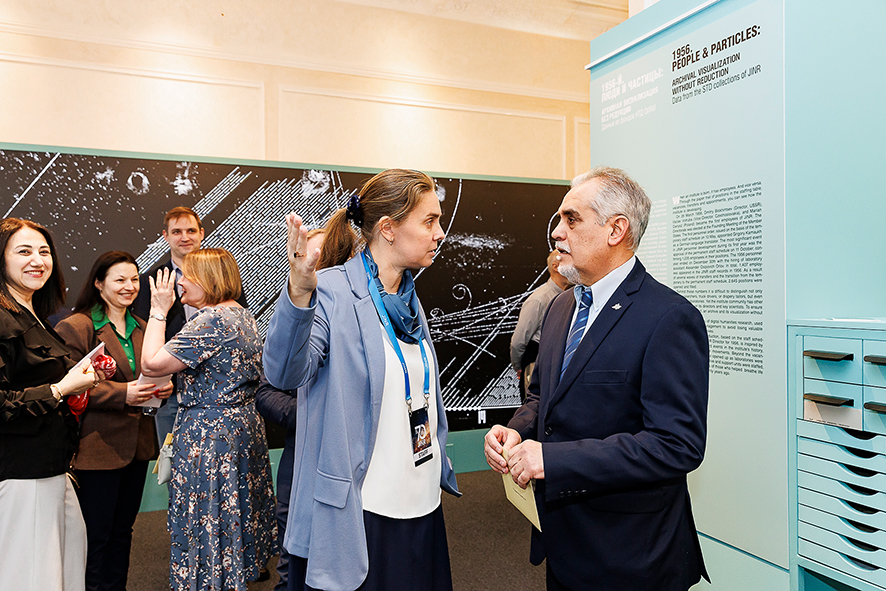
- Here, it is important that the series of lectures were not delivered but were addition to the exhibition "First Star: Birth of a New Interaction." The goal of the series is to better immerse visitors in context: not everyone is well aware of the details of the distant 1950s of the last centuries.
For example, from the very beginning, JINR has been compared to CERN. Two international organizations involved in nuclear research - they really have a lot in common. However, JINR of the 1950s of the last centuries is often compared with modern CERN - the world‑recognized leader in high‑energy physics. I wanted to talk in a lecture about exactly how CERN appeared and how the first years of its activity took place. As for our Institute, the entire exhibition was dedicated to the establishment of JINR.
How was the lecture programme drawn up in general, how were the participants and topics selected? There are so many different areas: history, forestry, cars, philosophy. How did the idea come about and how did you manage to unite them with each other?
- The lecture programme was composed by Galina Orlova that in fact, came up with the mentioned exhibition. It is difficult to formulate any single goal of the lecture programme and each listener learned something different in the lectures. However, all lectures have one thing in common - they focus on changes in the world and especially in Soviet society in the mid‑1950s, when JINR was established. It allows us to consider the advent of our Institute not in some sterile conditions, but in close relationship with other events and trends in the USSR and in the world as a whole.
In the process of working with archives, reports and an exhibition dedicated to the 70th anniversary of the Institute, what new and interesting have you learned for yourself? Maybe facts you didn't know about, maybe, they were unexpected angles of known issues.
- Indeed, quite a lot of interesting things were found. For me, for example, the materials that were selected by the employees of the Centratomarchive turned out to be very valuable (this is the archive of the Rosatom corporation, where, among other things, the documents of the Ministry of Environment and the First Main Directorate are stored). Although the history of the Soviet Atomic Project over the past 30 years has been quite fully studied and published a huge body of documents, the main emphasis for obvious reasons was placed on the history of the creation of nuclear weapons, and high‑energy physics and the developement of accelerators were in the shadows. It turned out that there is also a lot of interesting things - how research programmes were justified, how decisions were made on the construction of huge accelerators, what difficulties arose in organizing research and finally, a very interesting topic - these are projects that failed for one reason or another.
In the archive of the Russian Academy of Sciences, documents were found on the organization of the meeting, as a result of which the Joint Institute was established. Very detailed - with correspondence, programmes and estimates, transcripts of speeches and finally, meeting materials translated into eleven languages. The list of participants in the meeting revealed many previously unknown names - statesmen and scientists from future Member States. It took a separate work to find additional information about them (this is how the file cabinet appeared that may have become one of the most interesting objects of the exhibition). In addition, the documents on the special session of the USSR Academy of Sciences on the peaceful use of atomic energy turned out to be very interesting materials, at which, apparently, the first proposal for the establishment of the Eastern Institute was made.
Of course, photo and film materials from the archives of RIA Novosti and the Russian State Archive of Film and Photo Documents. Films-chronicles about the establishment of JINR have been known for a long time and they are easy to find on the Internet. But for the exhibition, the digitization was done with high quality that allowed us to see details that had previously escaped attention, distinguish faces and attribute many participants.
It is impossible not to note the unique documents from the personal archives of the first Director of JINR D. I. Blokhintsev and Director of INP M. G. Meshcheryakov thst were kindly provided by I. D. Blokhintsev and D. V. Abisheva. The most interesting ones got to the exhibition, but, of course, not all.
The archive of the UN European Office found interesting documents on the organization of the 1955 conference on the peaceful use of atomic energy in Geneva. Unfortunately, the documents themselves did not get to the exhibition - they had to select the most important one. But the information gleaned from them came in handy.
Finally, we also found a lot of materials. Thanks to the enormous help and support from a group of funds for scientific and technical documentation of JINR, it became possible not only to restore the roll-call list of JINR employees of the "first convocation", but also to demonstrate a completely wonderful album about the synchrocyclotron of the future DLNP and unique documents of 1956 showing how the Institute was established. It is clear that this is also only the tip of the iceberg.
Laboratories did not stand aside either. Employees of the Electrotechnological Department of DLNP not only saved the laboratory log of the first years of the synchrocyclotron, but also kindly agreed to transfer it to the exhibition. The drawings of the technical design of the synchrophasotron, transferred to LHEP, unfortunately did not get to the exhibition due to the dilapidated state that requires special careful treatment. But of course, by the 70th anniversary of the launch of the synchrophasotron, it will be necessary to find a way of showing that does not jeopardize their safety. These are unique materials that deserve a separate exhibition.
As you can see, here we are talking not only about one or several excellent lectures but for example, about a full‑fledged book about the early history of our Institute. It would be a very fascinating read, better than any detective.
As for me, most of the materials listed for me were new and in some ways seriously adjusted my ideas about how JINR was established.
The organization of events was in partnership with Galina Orlova. Tell us about this collaboration, please.
- We met Galina Orlova in 2023 at a conference where I was asked to talk about JINR. This was followed by a joint work at the Russian State Archive of Literature and Art, where we deciphered the workbooks of the writer G.E. Nikolaeva with recordings of conversations with physicists in Dubna in the 1960s.
Galina is a historian, teaches at the Higher School of Economics and specializes in "nuclear anthropology". That is, in the history of nuclear physics, she is more interested not in physics and technology, but in the union between science and the people who make it. She is especially fascinated by the period of the 1940‑1950s when in addition to purely military applications, a "peaceful atom" began to appear in nuclear physics, the veil of secrecy gradually began to subside, and at the same time social processes in the USSR led to a phenomenon that we, with the light hand of I. Ehrenburg, know as a thaw. Galina has many years of experience in studying the history of Obninsk. Dubna, like Obninsk, is rooted in the Soviet Atomic Project, but various specializations (accelerators and reactors) and especially the international dimension that appeared after the establishment of JINR allow us to look at this period from a different perspective.
Then there were the archival practices of HSE students, the Archival Impulse school in 2025, a wide programme of research interviews, and, finally, this exhibition. It is important to note that it was Galina who first raised the question of founding the Historical Archive at JINR as a research unit and was able to convince Directorate of the Institute of its importance and necessity. Now the Historical Archive functions and in just a year of its work a collection of 20 funds covering more than 20 m3 was collected. The number of documents will continue to grow as new collections are accepted for storage. At the moment, employees of the JINR Historical Archive work with documents of D. I. Blokhintsev, the first Director of JINR, the Nobel winner and the first Director of FLNP I. M. Frank, the founder of FLNR G. N. Flerov, the first Director of the Museum of History of Science and Technology G. L. Vardenga, the Spa and Resort Hotel “Dubna” in Alushta, photo archive of A. K. Kuryatnikov and others. Also, the JINR Historical Archive collects a fund of oral interviews and memoirs from people associated with the history of the Institute. During the existence of the archive, more than 70 audio files of conversations with JINR employees and veterans, as well as with their family members, were recorded. The total duration of records exceeds 130 hours.
As for the distribution of responsibilities, everything is simple. Galina knows and understands the social side of nuclear history better than me and me - accordingly, physical and technical side. Therefore, here we complement each other and scientific interests are very close. And everything else can be described by the well-known answer of I. Ilf and E. Petrov to the question "How do you write together?"
Will a similar format of covering a topic or era from different angles continue for projects in the future?
- The exhibition was dedicated to the 70th anniversary of JINR. Therefore, it is this exhibition that is a one-time event. I will add from myself that the exhibition turned out to be quite difficult and it was not easy to assemble it in such a short time.
The exhibition once again demonstrated that the Institute has a great demand for its own history. Therefore, in one form or another, this work, in my opinion, is worth continuing. Maybe not so major, but regularly. And not only in the form of exhibitions, lectures or, say, historical archival circles, but also research itself. After all, if we ourselves do not write our story, who will do it? The anniversary year is the right time to think about these issues, too.
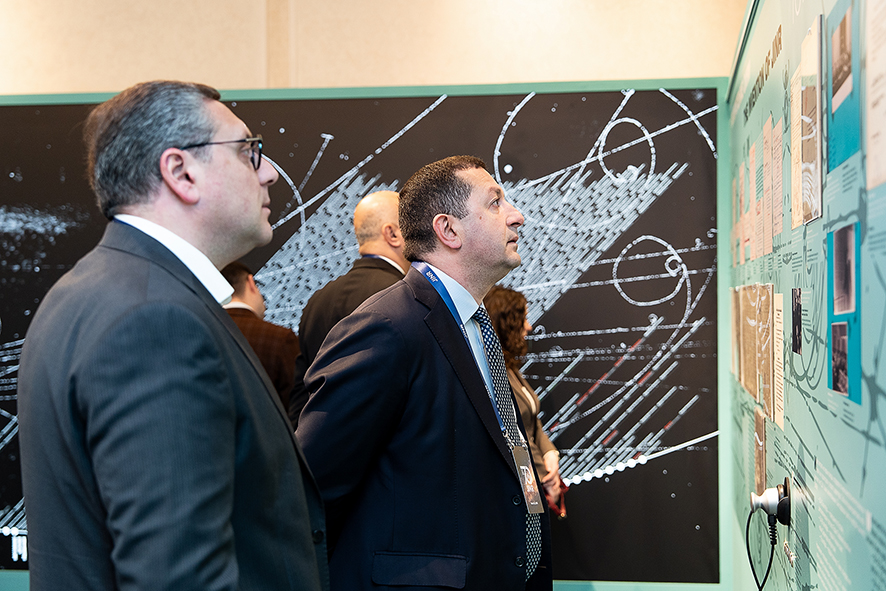
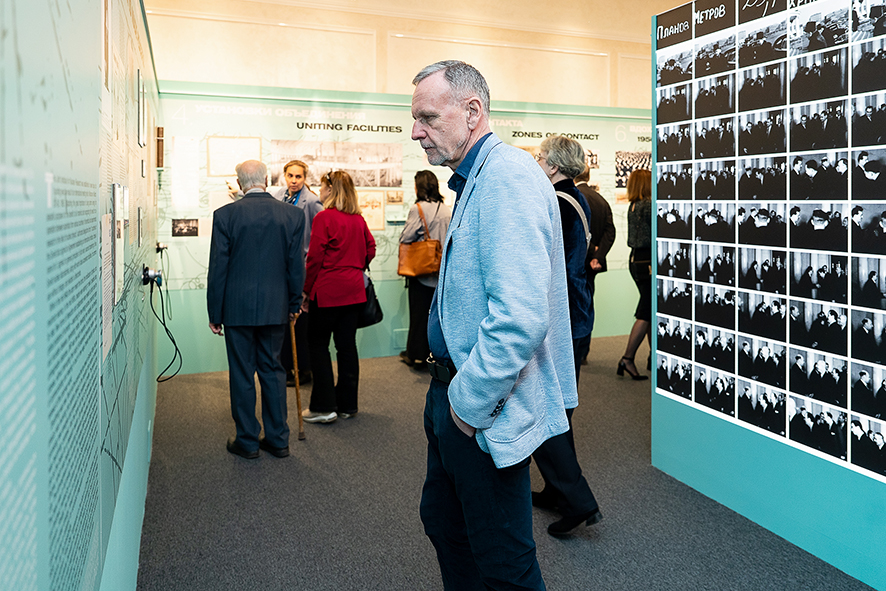
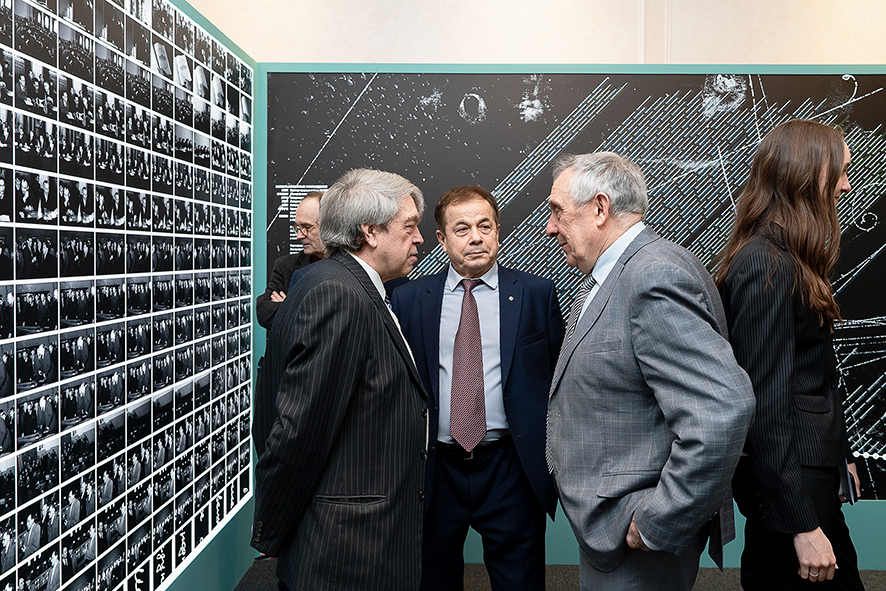
Upcoming lectures from the series “Meridian of interaction”:
18 June - Elena Tverdyukova "Freedom on wheels: Soviet motorization between ideal and reality";
2 July - Galina Orlova "Physicists or Archimedes of interaction. Language, vision and epistemic virtues for a world that reassures".
Article by Maria KARPOVA, photos from the opening of the exhibition
by Olesya CHEPURCHENKO and Elena PUZYNINA