
Precious traces, testimonies
and voices of participants
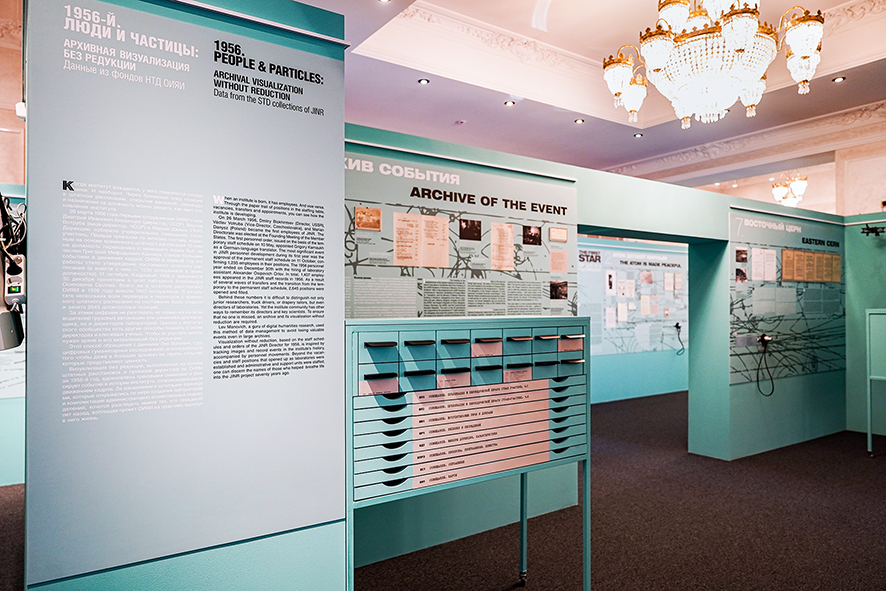
The unique exposition that has been open in Dubna since 26 March, offered visitors an original look at the establishment of an international scientific centre, in the genealogy of which we can distinguish the trace of peace initiatives in the use of atomic energy, scientific internationalism and the thaw period. The curatorial group collected archival documents from a dozen central, departmental and family archives of the founding scientists of JINR, manuscripts, photo, audio and video materials that became vivid evidence of the era. For the first time, the guests of the exhibition were able to see not only the order for the Ministry of Secondary Engineering on the declassification of work on accelerator facilities and the transformation of the secret Hydrotechnical Laboratory into the Institute of Nuclear Problems, but also the administrative schedule of the first Director of JINR Dmitry Blokhintsev that was inventing a new institute in the margins of his workbook. An important feature of the project was its bilingual format: thanks to the duplication of texts into English, the history of the birth of the research centre in Dubna was also available to visitors from other countries.
Galina Orlova, the curator of the exhibition, a researcher of Soviet atomic culture and the coordinator of the joint historical and archival initiative of JINR and the Higher School of Economics, notes that over the three years of cooperation, the exhibition has become the largest, most complex and effective way to unite the efforts of physicists and historians,
"The concept of the exhibition is inspired by a track shot from Blokhintsev's photo album and the realization that in the transition from studying forces to interactions, physicists have invented a new way to do big science together. In the short time that the anniversary dictated, we managed not only to collect precious traces, testimonies and voices of the participants in those events, but also to create experimental objects that balance on the verge of archival art, cultural analytics and digital humanities that made the invisible moments of JINR's birth visible. Without the trust and support of JINR Directorate, the shoulder of designers Natalya Zyumchenko and Leonid Shilovsky, the participation of partners from JINR and the contribution of HSE students, this exhibition would be a pipe dream. Thank you for the incarnation and again happy anniversary of all those involved!"
Summing up the work of the exposition, Anastasia Zlotnikova, Director of the JINR Museum of History of Science and Technology, emphasized that the exhibition was a significant event for the Institute - both in its extent and in the depth of work with historical sources.
"The enormous work of our entire team went to find and receive unique documents from the archives. Many of them saw the light for the first time,” Anastasia Zlotnikova said. “To do it, we extensively worked with historians, external experts, heirs of outstanding physicists and organizers of science. It is important to note the colleagues from the Institute, who this exhibition would not have been held without: Deputy Chief Scientific Secretary Alexey Zhemchugov, Head of the JINR Historical Archive Elena Malaya, Museum colleagues K. E. Kozubsky, I. D. Blokhintsev and N. S. Kavalerov, a group of funds of scientific and technical documentation in full force headed by E. V. Lobko, translators, colleagues from laboratories and services of the Institute. Graduate students and students of the Higher School of Economics provided great assistance in preparing the exhibition." According to A. E. Zlotnikova, during the exhibition, more than thirty excursions were held for various auditoriums - from schoolchildren and students to JINR veterans, representatives of Russian and foreign scientific institutes, employees of the Ministry of Foreign Affairs. Excursions were performed for delegations of English‑speaking employees of the Joint Institute, including specialists from Egypt, Vietnam, others. Director of the Museum also spoke about the further fate of the exhibits, "We hope that most of the materials will find their place in the new designed museum space, in which, one of the halls will be dedicated to the history of the establishment and functioning of JINR as an international centre. So, the great work we have done will still serve the Institute."
Ksenia Surikova, the lead curator of the cultural experience design bureau Pitch, visiting the exhibition, emphasized that all components of the exposition, including interactive boxes with documents, video installations and archival audio recordings with the voices of scientists, allowed to create a full‑fledged immersive effect. According to the expert, unique, sometimes accidentally found artifacts help to take a more comprehensive look at the history of science. "The exhibition perfectly shows the international importance of the Institute, as well as its rootedness in world processes. When you see the background and union of society and science, the role of JINR and its individuals is much more prominent. Through all this, an era literally appears," Ksenia Surikova commented.
Finisage ended with a curatorial tour of Galina Orlova. The exhibition is over but the parallel lecture programme "Meridian of interaction," timed to coincide with this anniversary event and expanding its context, goes on. And by the end of the year, the authors of the exhibition promise to release a catalog.
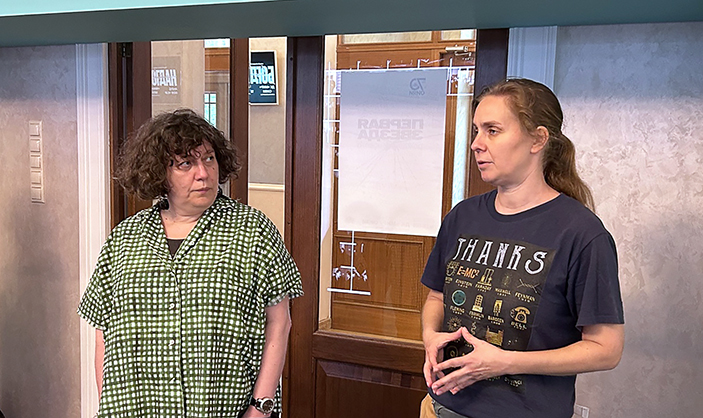
Galina Orlova and Anastasia Zlotnikova
Maria KARPOVA, Evgeny BRAGIN