
Seminar? Talk? Concert?
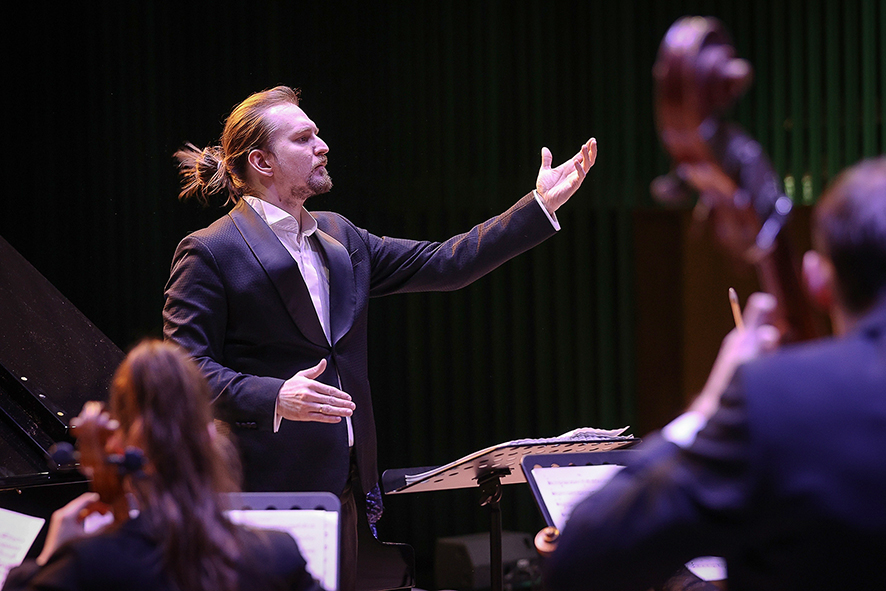
He, together with Margarita Pospelova (piano), illustrated the theme of his performance "Vivaldi has a secret code and they have been trying to decipher it for 300 years" by performing two parts from the concerts "Winter" and "Summer" of the cycle "Seasons".
"It's very nice to see you here," Sergey greeted everyone. “I want you to feel free, as if we were talking at home over a cup of tea. It seems to me that music and science are very similar, both of which are incredible beauty. Science is a creative process, sometimes, insights come to you, there are also random discoveries. All this is the result of enormous daily efforts and divine providence." Talking about Antonio Vivaldi, Sergey stated his creative fertility - over 500 concerts were written by the maestro, of which not all have reached us. Of the popular opus "Seasons", only four out of twelve concerts are performed. They love performers and his sonatas, they are often included in programmes and recorded in studios. S. Pospelov believes that Vivaldi had insights, in another way "this beauty cannot be explained, how it is impossible to explain the formation of the Universe".
Answering the question about the availability of little‑known compositions by Vivaldi for performers, Sergey answered positively, while stating that there was a gap between them and "Seasons". Comparing the musical heritage and styles of Vivaldi and I. S. Bach, the speaker called the music of the latter highly spiritual and the musical language - requiring strict performance that I do not want to change. And each musician performs Vivaldi in a slightly different way. Although Bach himself allowed improvisation, but the musician‑performer only after he fully revealed Bach's "formula" can only afford an "afterword". And at Vivaldi, according to Sergey, "you can improvise everywhere and not feel that this is blasphemy. Vivaldi is not dull classic, you feel that he was the same living person." Each performer brings something different to Vivaldi's compositions and his musical education allows him to improvise more or less.
Sergey was interested in the question of right‑handers and left‑handers among musicians. There is no problem for left‑handed guitarists - you can create an absolutely identical instrument under your left hand (we all remember left‑handed Paul McCartney and his guitar – O. T.). With the violin - everything is much more complicated, the maestro showed on his unique instrument the work of the master Andrea Galliano in 1754. At least, you can't remake a finished violin for a left‑handed person, if only because the upper deck is ground out of a spruce board so that the fibers of the tree expand in the direction from the upper strings to the bass ones. In general, left‑handed people are retrained in childhood, and everything is going well for them, but, according to Sergey, they will never extract from the violin the incredibly pleasant sound that right‑handed people get.
Sergey also liked the question of the work of the conductor - the sacrament of managing the orchestra. The difficulty is that you need to manage living people that cannot be forced, but you can only ask to do something, but for this you need to have authority. Of course, the difficulty is in the great responsibility. He remembered the performance on 9 May last year by the Dubna Symphony Orchestra of the Leningrad Symphony No. 7 of D. D. Shostakovich at the stadium of school No. 2 with a composition of 100 people. "If one of the hundred faked, who is to blame? Conductor!" Sergey exclaimed. "The conductor should have intelligence, musical taste, then any text can be played interestingly," S. Pospelov stated. "But there are canvases (Sergey more than once called musical works canvases - O. T.) that cannot be performed without a conductor." It turns out that it is important what instrumental specialty the conductor has in the basis of his education, it makes a difference in the perception and interpretation of compositions, as a result, the orchestra sounds different. The violinist is good in this regard - the strings make up half of the orchestra and when the conductor hears and understands the music, the spiritualists begin to treat him differently. A good orchestra can perform many compositions without a conductor, it is enough for him to set the pace. It is believed that the orchestra sounds brighter for young conductors, and stricter for older ones. "When you listen to recordings of the same work made with different conductors, you get the feeling that these are different compositions," Sergey said.
Answering a question about the principles of choosing the first violin in the orchestra, Sergey said that rotation is a useful thing, and sometimes, an instrument of disciplinary action. So did his teacher, Professor E. D. Grach, in whose student orchestra Sergey played, arranging a psychological shake‑up for relaxed violinists from the last row, transplanted them into the first row. According to the musician, this is very effective.
Sergey also spoke about M. L. Rostropovich, from whose Fund for Cultural and Humanitarian Programmes he received support. "I was at his last concert, where Mstislav Leopoldovich conducted and the violinist Viktor Tretyakov soloed. Rostropovich was a brilliant man."
He brilliantly demonstrated all the techniques and touches that violinists use in modern music, including flagolets and double flagolets (we even heard the crackle of firewood burning in a fire), and the great Paganini came up with them all. "He worked all his life and said that the violinist should remember that God speaks to him with the language of his instrument," S. Pospelov said. He told about the strings and the bow. The latter uses natural white horsehair, and if you use bleached black, the sound is tougher.
And the musician was also asked: what is his mission? "I'm not playing for myself," he replied, "it's important for me to get a response from the audience. I'm not saving myself. I always play like the last time, as Professor Grach told me. As a student, I did not understand him, now, I understand."
The participants of the seminar, whom I would like to call the audience, expressed their emotions with friendly applause after each answer. Sergey Pospelov was also pleased with the meeting, he thanked for the interesting questions, and the format of the meeting itself prompted him to hold a similar one in the Cultural Centre “Mir” before the concert of the symphony orchestra. The meeting ended with the performance of "Melody" by P. I. Tchaikovsky.
Olga TARANTINA