
The alphabet that united nations
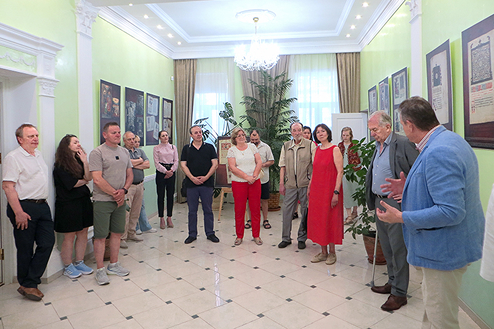
Opening the exhibition, Head of the Bulgarian community at JINR Hristo Dimov recalled that for the first time the Day of Slavic Writing and Culture was celebrated in the Russian Empire in 1863, the millennium of the creation of the Slavic alphabet by Saints Cyril and Methodius. Last year, on the same days, a photo exhibition dedicated to the Russian‑Turkish war was held at the Scientists’ Club, the victory of Russia in which liberated Bulgaria from the Turkish yoke. "Today's exhibition is dedicated to the Cyrillic alphabet that today communicates many peoples, including Muslims," H. Dimov said. As a merit of the Bulgarian people and its political elite, Hristo emphasized that the Glagolitic alphabet and Cyrillic alphabet were preserved and protected from attacks by Western preachers who used Latin. He expressed gratitude to JINR Directorate for organizing the event, and to the artist Anastasia Zlobina for help in preparing the exhibition.
JINR Vice-Director Latchesar Kostov, in turn, thanked the Bulgarian community, as well as the Bulgarian Cultural Institute in Moscow, with the support of which, together with the Embassy of the Republic of Bulgaria in the Russian Federation, it became possible to organize this exhibition. "The main thing is that on the eve of 24 May, the Day of Saints Cyril and Methodius, we all celebrate this wonderful holiday together, we remember the great deed that they accomplished," L. Kostov said. "This holiday is a reason for pride among all Slavic peoples, for everyone's desire for new knowledge."
JINR Chief Scientific Secretary Sergey Nedelko thanked the Bulgarian Commonwealth of the Institute for everything they do. "Such holidays are important for all JINR Member States and what reason to get together is an event of cultural life, acquaintance with national cuisine or something else is a matter of the second."
Tatyana Strokovskaya also congratulated everyone on the holiday, stating that as a result of the works of Cyril and Methodius, all Slavs understand each other. "It was a unifying work, it fully meets the JINR motto "Science unites peoples," she highlighted.
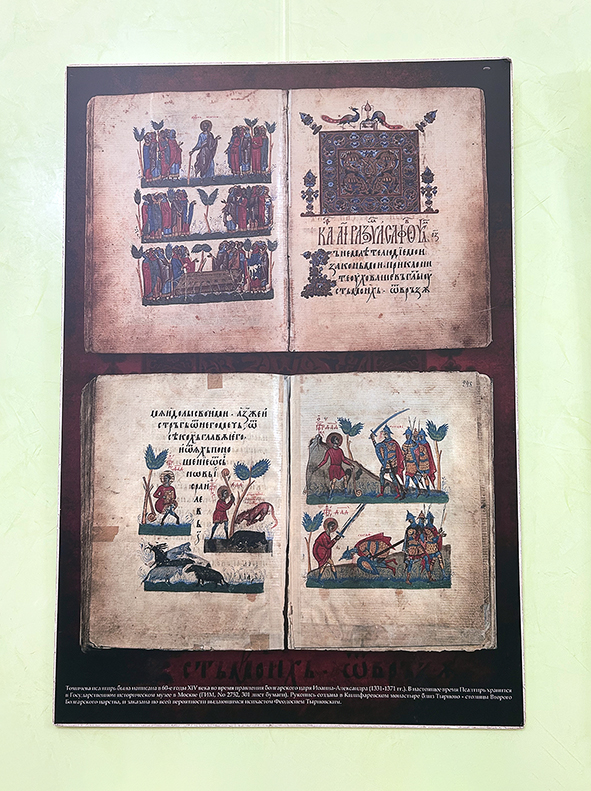
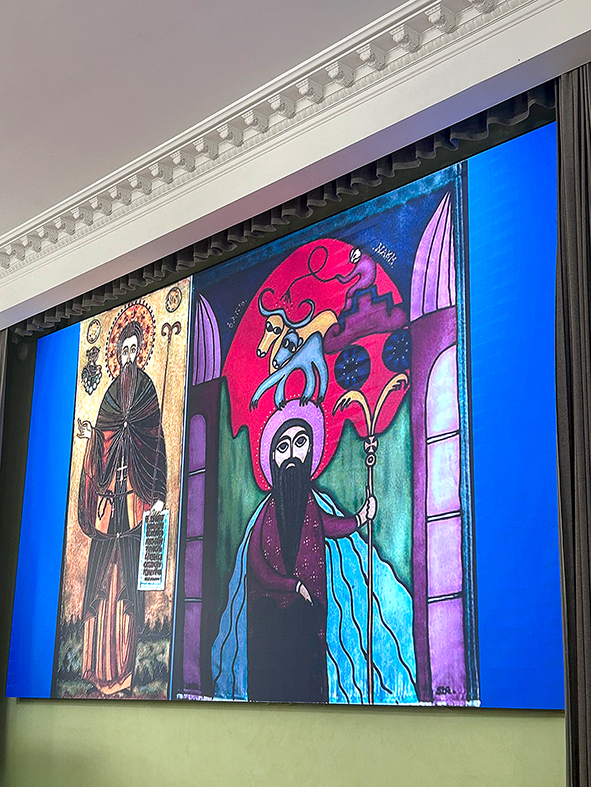
At the exhibition, you can learn about the photographs of Ivo Khadzhimiliev, who captured fragments of handwritten monuments, icons, color miniatures and ornaments from books, as well as to learn a lot of interesting things from the explanations to the photographs taken by Bulgarian researchers A. Dzhurova and V. Velinova. For example, Damaskin Studit's "Words and Teachings" became a particularly popular work of the 17th‑18th centuries. It explains his many surviving lists with rich illustrations. Despite the fact that with the advent of printing, the practice of writing books by hand in the 18th‑19th centuries begins to disappear, in Bulgaria, it persists throughout the 19th century. Or the fact that after the capture of Tarnovo by the Turks in 1393, some of the outstanding Bulgarian scribes are sent to Russia, Vlaho‑Moldavia and Serbia, the period of decline of a large part of the Bulgarian book centers begins. From the information from the exhibition and lecture, we learned that some Bulgarian handwritten monuments are today stored in the Historical Museum in Moscow and other Russian museums, the British Library in London. The exhibition featured a photograph of three pages of one of the most famous Bulgarian manuscripts, decorated with 69 miniatures - the only surviving list of World History compiled by the Byzantine writer Konstantin Manasiy. Since 1475, it has been kept in the Vatican Library. One of the miniatures of the manuscript depicts the baptism of Russia.
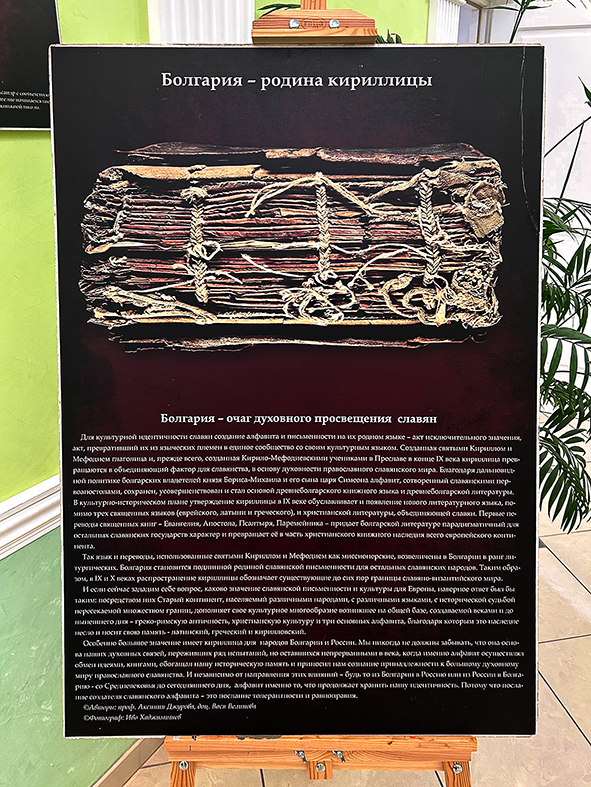
In the annotation to the exhibition, Bulgarian researchers write, "The creation by Saints Cyril and Methodius of the Glagolitic alphabet and above all, the Cyrillic alphabet created by their students in Preslav at the end of the 9th century turns into a unifying factor for Slavism, into the basis of the spirituality of the Orthodox Slavic world. Thanks to the far‑sighted policy of the Bulgarian rulers of Prince Boris (Mikhail) and his son Tsar Simeon, the alphabet created by the Slavic chief apostles has been preserved, improved and became the basis of the ancient Bulgarian book language and ancient Bulgarian literature... The Cyrillic alphabet is especially important for the peoples of Bulgaria and Russia. We should never forget that it is the basis of our spiritual ties that have survived a number of trials, yet have been unbroken for centuries..."
"This year marks 1163 since the beginning of the Slavic Christian civilization by Cyril and Methodius," Tatyana Evgenievna began her speech. "This phenomenon made the Slavic language official and united the Slavs."
Methodius and Cyril (before the schema - Konstantin the Philosopher) carried out the task of educating the Slavs together with a group of students, associates and followers. In the Slavic historical, cultural and Christian tradition, they began to be called Sedmichenniki. "In 862, the Moravian prince Rostislav wrote to the Byzantine emperor Michael III that his people rejected paganism, but did not have teachers who would" in our native language reveal to us the true Christian faith, "immersed us in the distant history of T. E. Strokovskaya. - The response to this request was the arrival of brothers Cyril and Methodius in Great Moravia. Why did the Moravian ruler turn to Byzantium? Since antiquity, the Byzantine Empire has retained a love of science and respect for education. In Christian Byzantium, the type of teaching based in the Greco-Roman system continued to be used: classical sciences were studied in educational institutions, and teaching was conducted according to textbooks created in the Hellenistic era." It is important, she noted, that education, which had a secular character, in Byzantium was available not only to the upper strata - the imperial family and noble dignitaries, it could be received by different classes, including slaves. Primary education was given at the age of 7‑9, when they learned to read, write and speak Greek. The average was obtained by the age of 20‑25, since education was divided not by class, but by the degree of mastery of certain subjects. This system was later replicated by the Slavic-Greek-Latin Academy and the first seminaries of the Russian Empire.
It was possible to study in Byzantium in one of the schools or when communicating with a mentor on the principle: from teacher to student. It was this system that the Slavs inherited. Although it is also borrowed from antiquity, from the schools of Aristotle and Plato. The creators of the Slavic alphabet also received a good education, they were part of the intellectual elite of Constantinople. Cyril and Methodius instilled in their students their attitude to education. A group of like‑minded people gathered around them, according to researchers, by its nature representing a properly organized school in the spirit of Byzantine scientific circles with a certain system of cooperation and distribution of literary labor. It was then, according to a number of scholars, that the idea of creating a Slavic alphabet arose, and the students of the holy brothers participated in this process from the very beginning.
In 858, Photius, a scientist and diplomat, patron of Constantine the Philosopher (Cyril), became the Patriarch of Constantinople. He sends the brothers on a mission to the Khazar Khaganate. As Tatyana Evgenievna emphasized, the Khazar Kaganate allowed them to preach in all lands subject to the kaganate. Then, as the "Tale of Bygone Years" tells, they included the lands of the glades around Kyiv, that is, Cyril and Methodius preached in future Russian lands. On the way to Khazaria, the brothers stopped in Kherson, where they discovered the relics of the holy martyr of the first centuries, Pope Clement. Cyril and Methodius brought them to Rome, solemnly handed them over to the Pope, thanks to which they began to enjoy great authority from him. During this period, there was a struggle between Rome and Constantinople for new Christians. Slavic states and especially Bulgaria, in search of the spiritual foundations of their statehood, tried to adhere to such a course in order to remain equidistant from both Rome and Constantinople. Cyril's diplomatic talent made Pope Clement the patron saint of Slavic enlightenment. The speaker also highlighted the unifying mission of Cyril and Methodius, who visited many Slavic lands.
In 868, Pope Adrian II consecrated Slavic books and ordained some Sedmieslienians from Christian lands as priests and deacons. After the death of Cyril, Methodius is sent as a papal legate to lead the church of the Moravian Slavs. In 882, Methodius and his associates began translating books from the Bible into Glagolitic. After the Latinization of Moravia, they have to flee to Bulgaria that has become a refuge for them. Sedmichenniki were gladly received by the Bulgarian prince Boris. And here, T. E. Strokovskaya emphasized, the sequence of state steps to build a Slavic civilization is important. Boris's desire to enlighten Bulgaria in Slavic writing, to expand Slavic worship became part of his state programme.
Concluding her speech, Tatyana Evgenievna outlined the first steps of the Slavic alphabet in the Slavic lands, "Slavic writing and books were created as a result of scientific work at the request of the Moravian Slavic prince Rostislav in the Byzantine Empire by two Greeks Methodius and Constantine (Cyril) under the patronage of the Patriarch of Constantinople Photius, received approval and blessing in Rome from Popes Adrian II, propagated by a multi-ethnic group of Sedmichennikov. Among them was the closest student of the Solunsky brothers, presumably, a Bulgarian, Clement, he became a bishop in Bulgaria and left a new version of the letter, as well as an extensive literary heritage preserved in Macedonia in the Glagolitic alphabet and transferred to Russia after baptism in the form of Cyrillic."
Today, the Day of Slavic Writing and Culture is celebrated not only in Bulgaria and Russia. On 5 July, the founders of the Slavic alphabet Cyril and Methodius are honored annually in the Czech Republic at the state level. This holiday is included in the church and civil calendars, yet, Tatyana Strokovskaya emphasized, both the Czech Republic and Slovakia write and read the Slavic word in Latin.
Olga TARANTINA,
Photos by the author and Maria KARPOVA