
46 years ago
No. 21 (2510) 28 May, 1980
Work on the reconstruction of the LNP synchrocyclotron gains more and more pace. Still yesterday, in the spacious main hall of the first building, freed from old equipment, it became cramped from the equipment of the new one: the coils of the electromagnet of the F facility take their place, pole tips are welded to the upper yoke of the magnet, the hall is preparing to receive the chamber of the future accelerator.
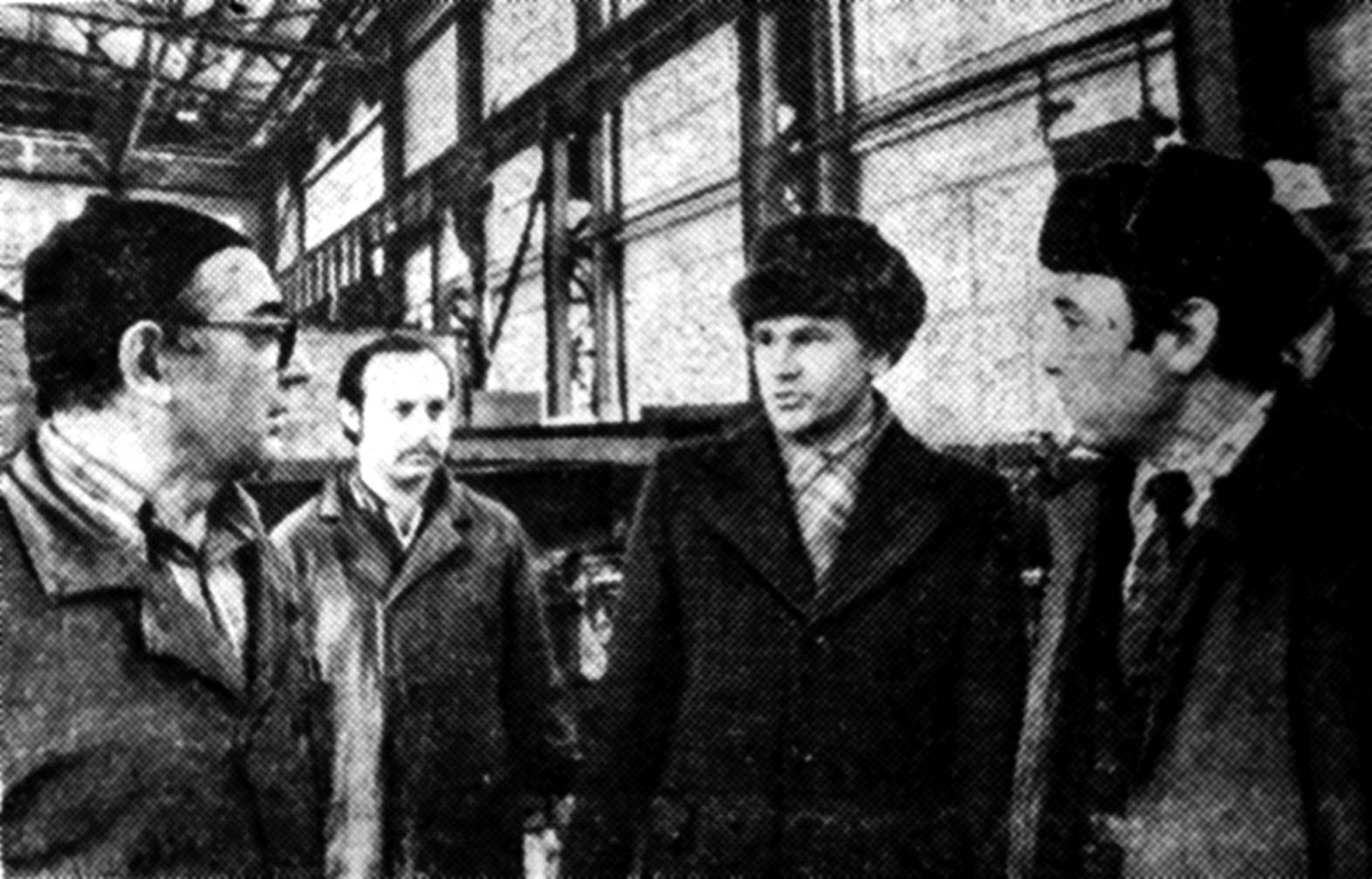
N. I. Semenov, S. N. Anikin, V. V. Dmitriev and A. N. Bulatov are deciding on the preparation of the magnet winding sections of the F facility for installation
***
The cryogenic electron-beam ionizer "Crion‑2" was developed in LHEP to experimentally meet a complex of problems concerning the production and investigation of the properties of deeply ionized atoms.
"Our research has shown that the electron beam ionization technique, a research area that originated at JINR and is developed by the world's leading laboratories, develops successfully. JINR still maintains a leading position among other institutions. It allows us to set the production of beryllium‑like xenon as the nearest task at the Crion‑2 facility. We relate the achievement of one of the ultimate goals in the future with the solution of this problem - the production of uranium nuclei," Head of the Sector of LHEP E. Donets said.
***
According to Head of the Department of LCTA V. Bezrukov, the computer fleet is updated. Big tasks are facing the staff this year. It is necessary to complete work on the development of a terminal network based on BESM‑6 and ES‑1010 computers. The employees will require considerable efforts to ensure the stable operation of the equipment. It is planned to replace the BESM‑4‑1 computer with ES‑1033 (with a capacity of 180 thousand operations per second) in the PUOS‑SAMET system. To increase the performance of JINR CICC in future, a new computer ES‑1060 with a million operations per second was purchased. These machines will be installed in the new laboratory building and the department staff is preparing for their installation and commissioning.
***
"A new type of detector was developed at DNAM for experiments in the field of high‑energy physics. Most of the experimental data in particle physics is given by experiments on accelerators. Now physicists are preparing to start working on accelerator facilities with an energy of about 109 electron volts... Therefore, an important stage in the development of the technique is the development of new coordinate detectors with a higher spatial resolution.
The successful completion of the research was preceded by the hard work of a large staff of DNAM employees that developed the facility nodes and participated in the sessions on the accelerator. The names of V. Chalyshev, L. Svetov, N. Zinin, Yu. Kondratyev should be highlighted, whose investigations developed proportional chambers. In the manufacture of accurate wire electrodes, we were greatly helped by V. Pugachevich, an employee of LHEP, Honored Rationalizer of the RSFSR.
Investigations have shown that proportional chambers with cathode reading of data have a great future and their use will significantly expand the possibilities of the experiment."
From an article by Head of DNP Sector L. Barabash
***
Every year, a group of Bulgarian employees of the Institute celebrates Cyril and Methodius Day - a holiday of Bulgarian education and culture, Slavic writing and the Bulgarian press. Bulgarian employees of the Institute and their families gathered at the Cultural Centre “Mir” for the holiday. Elka Zlateva dedicated her speech to the origin of Slavic writing and the development of culture in Bulgaria.
31 years ago
No. 20 (3306) 28 May, 1997
For the first time in Dubna, the National Conference on the Use of X‑ray, Synchrotron Radiation, Neutrons and Electrons for the Investigations of Materials – XRSNE’97 is held. The Conference addresses a wide range of issues, covering structural analysis and computer simulation of structure; spectrometric techniques and structural electronography; synchrotron radiation and neutron sources; hardware, methodological and software experiments.
***
At the JINR Museum of History of Science and Technology, the guests of the twin city of La Crosse were greeted by JINR Vice Director Professor Ts. Zylov and the Institute Chief Scientific Secretary V. Zhabitsky. Professor V. Nikitin and Museum Director G. Vardenga spoke about the outstanding scientists who laid the foundations of the International Scientific Centre in Dubna and about some of the problems that JINR physicists are working on in collaboration with their American colleagues. The delegation of the twin city visited the Laboratory of Nuclear Reactions and the University Centre.
Columnist Irina LEONOVICH,
Photo by Yury TUMANOV