
Union of science and arts
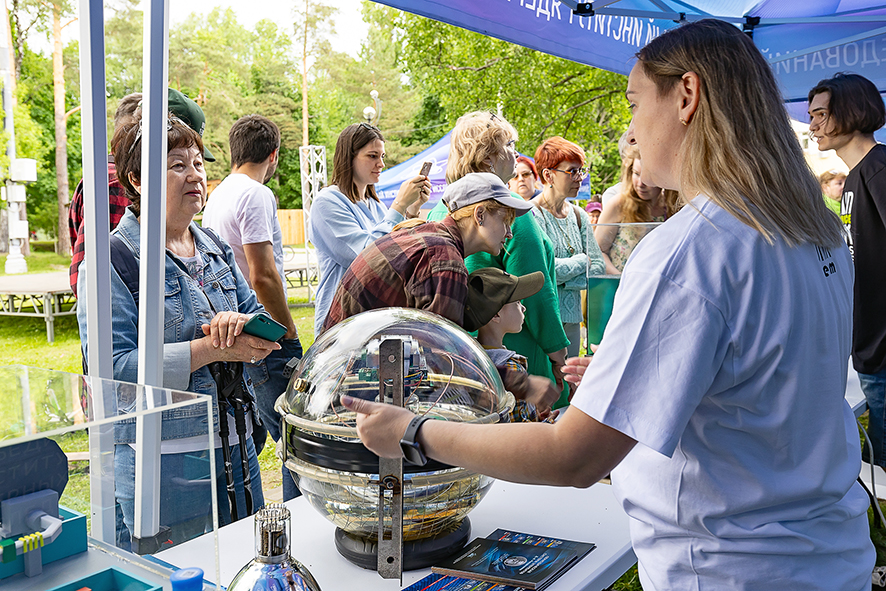
Everyone could hold in their hands a fragment of an iron meteorite from M. Kapralov's table (LRB), "I'm talking about what we are engaged in the astrobiology sector," Mikhail says, "what samples we study, what unearthly samples we find. You can look through the book on astrobiology and the atlas of microfossil "Meteorite Orgey". I also talk about the search for water on Mars - FLNP participated in the development of a detector for the rover, with the help of which they search for water under the Martian surface. We study carbonaceous chondrites; it is in them that unearthly microorganisms are found. There is nothing in the iron ones, but you can hold a bench copy of the meteorite in your hands."
FLNP employees are located in the neighborhood, various mussel leaves laid out on their table attract attention. Konstantin Vergel (FLNP) commented, "In our environmental projects we have studied mussels. The South African Institute has asked us to investigate the contamination of the water in which they are grown. In South Africa, mussels are very actively used for food. They selected mussels from different parts of the bays in which they are grown, and at the reactor we estimated their elemental composition. Pavel Nekhoroshkov will tell you more about the results.
We also carry out research with biomonitor mosses. Last year, we collected samples in the Moscow Region, implemented their element analysis, here, we show pollution maps: if we talk about Dubna, then our air is quite clean - for many elements it is not polluted. If you look at the region as a whole - in territories further than 50 km from Moscow, pollution is at the background level. The eastern part of the Moscow Region is dirtier than the western. The eastern part is Elektrostal, Mytishchi, Balashikha, where there are many factories, there are many industries outside the Moscow Ring Road that have been withdrawn from Moscow, all of them pollute the air. We carried out similar investigations in the Tver, Yaroslavl, Vladimir Regions, our colleagues from Tula collect mosses for research, earlier we studied air pollution in the Ryazan Region, Udmurtia, and today, some projects implemented in the Far East."
Pavel Nekhoroshkov (FLNP) said that the project for the investigation of mussels is currently carried out, every few years, water samples are brought to the Laboratory from the cargo ports of South Africa, where the water is very polluted - all the maximum permissible concentrations of elements for food products have been exceeded.
“And in mussels?” I ask Paul.
“Yes, we find the excess right in the soft tissues of mussels. Although after 2022, there is a decrease in the concentration of elements - either this is a post‑like effect, or they are working to improve the environmental situation. We calculated the risks of consumption, and it turned out that 200‑300 grams of mussels per week can be consumed even from contaminated areas without health risks. That's about 15 mussels a week. Residents of South Africa eat clearly more, and the main problem is certification, since it is not known where the seafood that is bought in the store is brought from. We also made an interesting conclusion: often mussels accumulate high concentrations of different elements in clean zones, where there is a large flow of elements as a result of the removal of river water into the sea. Mussel - filter, it collects suspension from water. Now, our colleagues have studied the orientation of mussel shell crystals using the SCAT diffractometer on the IBR‑2 reactor. They consist of two main minerals - calcite and aragonite. We tested the idea that in dirty places the sinks would not be very strong or malformed. It turned out that this is not so, each species of mussels forms crystals in the right way, regardless of whether they grew in a clean or dirty area.
Together with his granddaughter, V. G. Matveev studied all the stands and shared his impressions, "This is a wonderful event. I am surprised - they organized it right in the open air, laboratories talk about their experiments. My granddaughter Marishka was very interested, she loves to carry out experiments at home, and then her eyes flared up, she cannot come off. There is still a telescope here, a wonderful thing, now let's go and see the sun."
About why the Festival is called JINR Vibe, I ask Anastasia Sushchevich, Head of the Information Support Group for Social Initiatives of the UC:
- This is youth slang, the state of mind is called vibe. "My vibe, not my vibe" means a favorable atmosphere for me or not.
In such a way, you wanted to attract young people to the event, didn’t you?
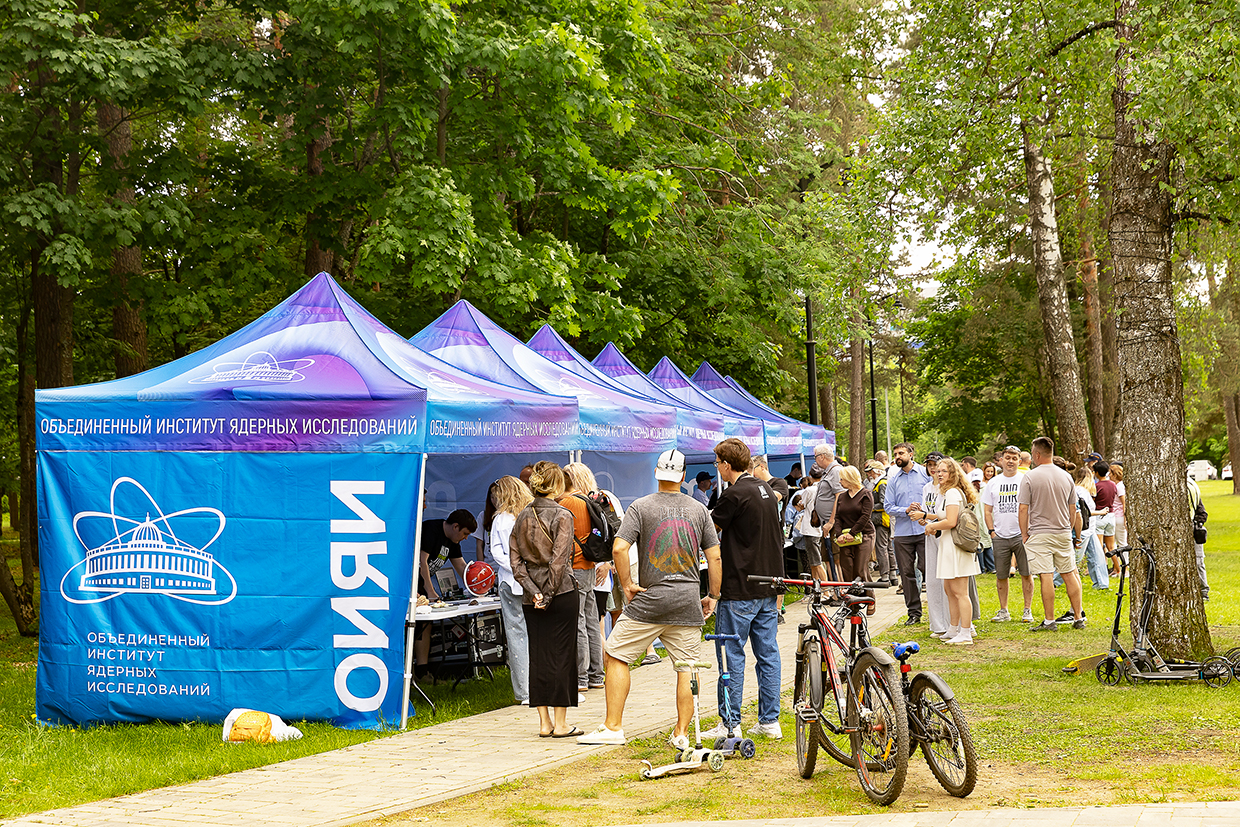
- It was done for the townspeople, and the youth name was invented, because we are trying to attract young people to science, so that young boys and girls from 15‑16 to 25‑30 years old are imbued with the spirit of science, and the rest of the townspeople learnt about the research that is carried out at JINR. Many do not know, for example, about the Baikal project, come up and wonder: are we doing this ourselves? They do not know about proton therapy at the medical and technical complex.
Is the UC the organizer of the Festival?
- The UC is technical performer and main author of the idea of a scientific festival, assistant to the chief scientific secretary Varvara Fufaeva - organizer of its musical part. Today, art will be united with science. We travel with such a membershup in Russia and even in the Member States - at universities we talk about the science that JINR does, show mock-ups of facilities. We also tell that JINR participates in collaborations in different countries. Over the past six months, we have visited Minsk, Petropavlovsk‑Kamchatsky, Vladikavkaz with this membership of laboratory staff, with these models and demonstration facilities. Prior to that, we took the exhibition to Tashkent (Uzbekistan) and Arkhangelsk. We constantly try to inform a wide audience about JINR results that can be proud of.
***
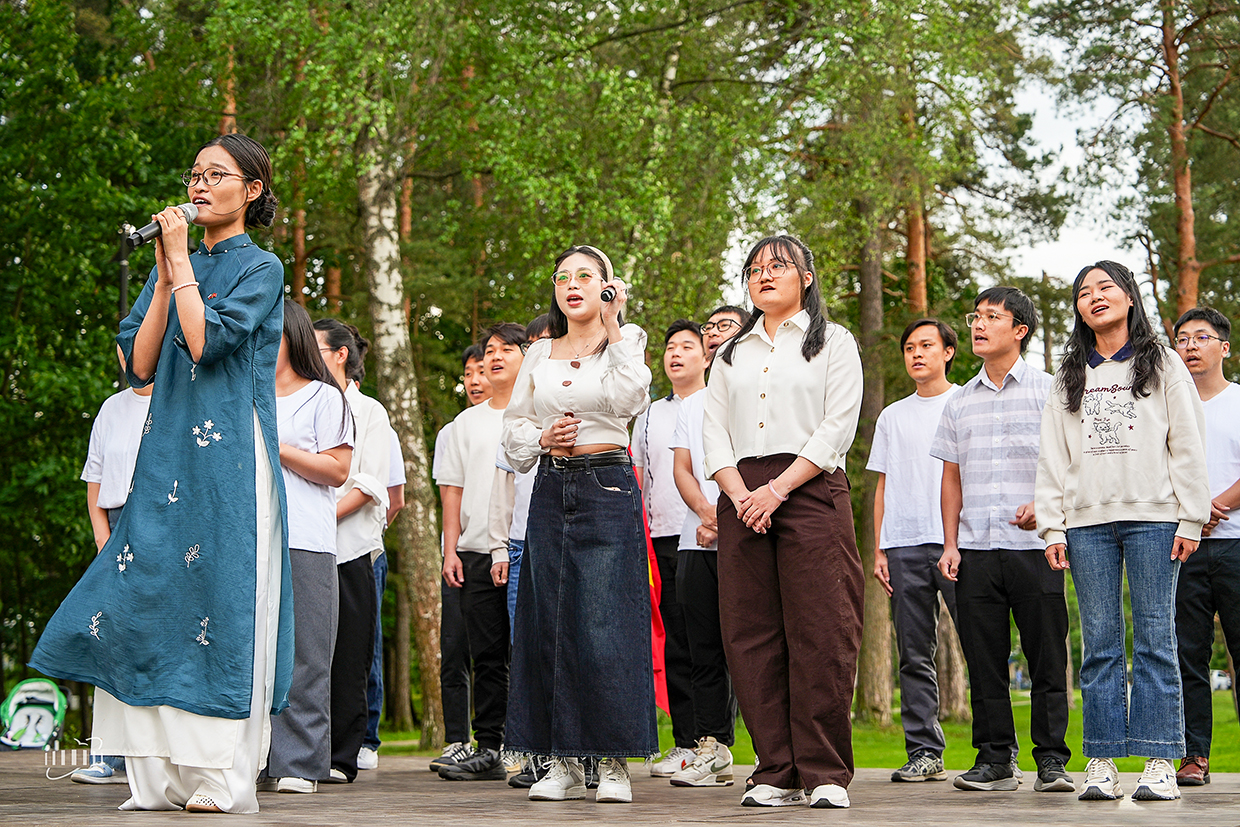
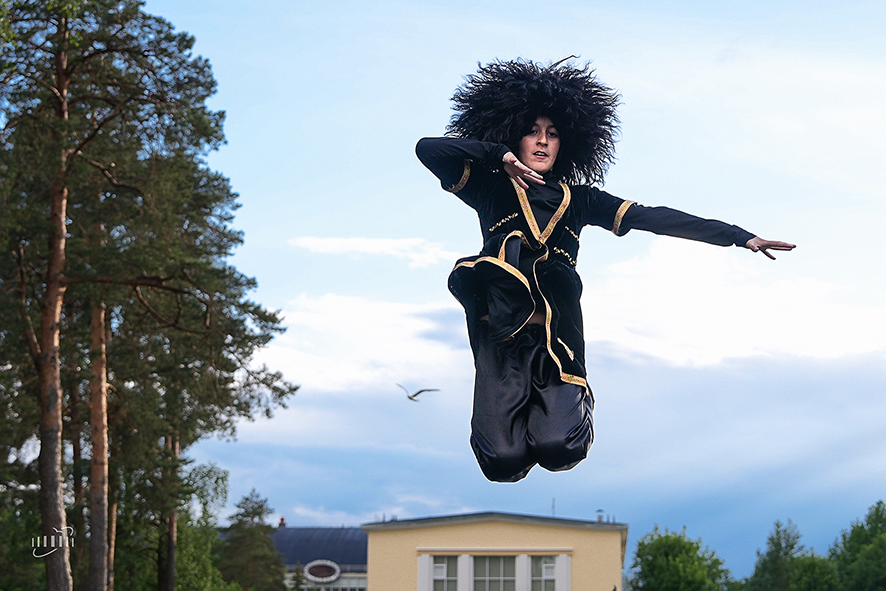
Within the framework of the Festival, a concert of dance groups of Dubna and Moscow was held, vocal and dance performances were presented by employees from the Member States of the Joint Institute and members of their families. Armenian, Belarusian, Vietnamese, Georgian, Cuban, Mongolian, Russian, Serbian, Indian, Chinese and Mexican musical compositions sounded.
A bright frame for the Festival was the exhibition of macro photographs "The world underfoot" by Andrey Shabalin (FLNP), located on one of the paths along Molodezhnaya Polyana.
Olga TARANTINA,
Photos by Elena PUZYNINA and Olesya CHEPURCHENKO