
Fairy and Dragon Children

The Socialist Republic of Vietnam is located on the Indochina Peninsula. The current territory of the country, reminiscent of the English letter S, was formed by the beginning of the 19th century, before that Vietnam included only the territory of the modern Vietnamese north. The problem of overpopulation in the 14th century encouraged southward progress. Southern lands were conquered, including those belonging to Cambodia. Territorial expansion is one of the reasons why Vietnam is a multinational state. 54 nationalities live on its territory, but the titular nation of Vieta, or Kini, make up the vast majority - 86% of the population. Despite its small area, it is a densely populated country with more than 100 million people.
Today, Vietnam is on the list of new industrial countries. From an agrarian country to an industrial power, it has turned in just the last four decades. Agriculture currently accounts for 12% of the GDP structure. The republic is the world's second largest exporter of coffee and is one of the three largest rice exporters in the world.
Where the history of Vietnam begins
There is a myth about the origin of the nation that is taught in all Vietnamese schools and that is necessarily addressed when studying language and culture. Once upon a time there was a half‑dragon named Lak Long Kuan, whose mother was a water dragon, the daughter of the lord of Lake Dongting, and his father was the youngest son of the Chinese emperor. And then one day, Lak Long Kuan met a beautiful mountain fairy named Au Ko, who could turn into a bird. From their union, a bag was born in which there were 100 eggs, of which 100 ancestors of the Vietnamese people appeared. However, the dragon and the bird belonged to different elements and could not get along together, and therefore parted. 50 children followed their mother to the mountains, from them came the small nationalities of Vietnam. 50 others followed their father to the sea, the titular nation descended from them.
According to legend, from the eldest son of Lak Long Kuan and the fairy Au Ko, the first dynasty took place on the historical timeline adopted in Vietnam with the ruling dynasties - the Hung Vyong dynasty.
This legend is part of the cultural code and allows two conclusions. The first is that the public consciousness of the Vietnamese people is mythologized. Even the scientific elite, historians, Communist Party leaders do not have a conflict between mythologized history and an objective view of reality. No one aims to find confirmation of this legend or, conversely, to refute it, because this could shake cultural foundations. Myth and reality get along well in the picture of the world of Vietnamese citizens.
The second thing that this legend testifies to is the importance of the concept of family. The whole nation, including small peoples, is perceived as one family. This concept is confirmed in the language. Vietnamese does not have a universal pronoun "You" which to address any person with. In a communication situation, you constantly have to reproduce the family model. For example, referring to a man who is older than you in age, you can say "older brother", "uncle", "grandfather... Someone who is younger is addressed with the words "younger brother", "nephew", "grandson". There is a universal pronoun "I" but it is used extremely rarely - for example, when a person gives an interview to a journalist on television. In all other cases, you should call yourself depending on the context, taking into account the gender, age and status of the interlocutor. It is not hard to guess what the attitude towards individualism is in a culture whose language does not have a universal pronoun "I". Vietnam is one of the most collectivist countries in the world.
As part of China
An important factor that influenced the development of Vietnamese identity is the period of "northern dependence" on China that lasted almost the entire first millennium of our era. The Vietnamese more than once revolted against the Chinese, sometimes, they managed to gain independence and hold it for several years or even decades. Unlike many other peoples assimilated by China, the Vietnamese were able to maintain a cultural identity.
The history is known by the Ching sisters, who in 40 AD led an uprising against the Chinese invaders. Finally, the Vietnamese commander Ngo Kuen was able to expel the Chinese from the country in 938 AD that established the independent Vietnamese dynasty of Ngo. Researchers believe that the Vietnamese managed to maintain their cultural identity in the face of a constant threat of assimilation from China due to the structure of the Vietnamese community that in many respects was autonomous that is reflected in the popular proverb "The emperor's decrees are inferior to the customs of the village". The state here did not deal with a separate family, as in China but with the entire community team.
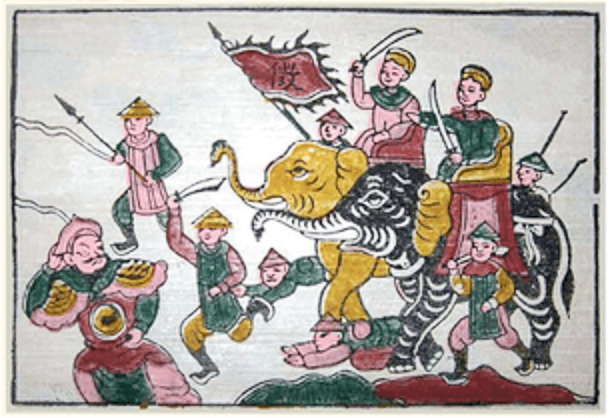
The uprising of the Ching sisters, depicted in the painting in the technique of folk painting "dongho". Source: Wikipedia
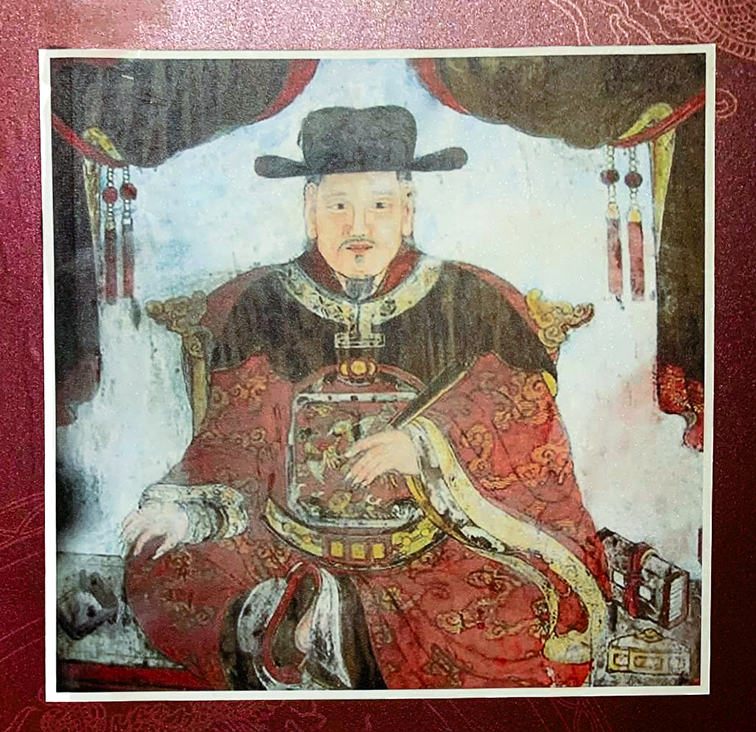
Winner of competitive examinations in 1463 Luong The Vinh. Photo by O. Trunova at an exhibition at the Thanglong Imperial Citadel in Hanoi
China's cultural footprint
However, Vietnam also suffered significant cultural influence from China. In particular, the Confucian value system was borrowed with the concept of filial piety. The younger ones should read the older ones. Descendants must honor ancestors. Everyone should know their place in the social hierarchy. The concept of filial piety was built into the cult of the family that already existed in the Vietnamese tradition.
Also, after Vietnam gained independence, a hierarchical model of state structure was borrowed from China. According to Confucian ideas, the emperor is vested with power from Heaven, and subordinates must unquestioningly follow his orders. Following the example of China, Vietnamese rulers began to call themselves emperors.
Before the Chinese conquest, Vietnam had no written language of its own. It should be stated that Chinese and Vietnamese are not related. The ancient Chinese language became the language of scholarship in Vietnam and until modern times, played the same role in this country as Latin in medieval Europe but only a narrow circle of Confucian scholars owned it. To master hieroglyphics, you had to devote your whole life to learning from an early age.
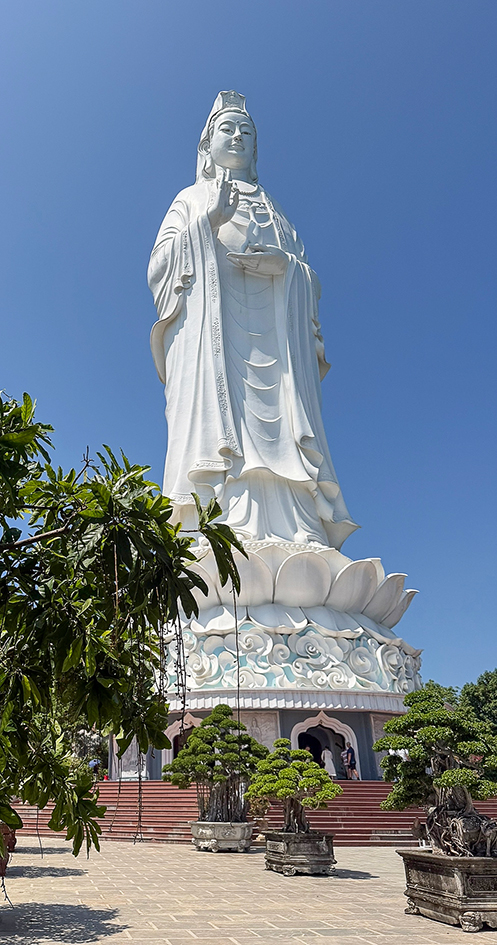
Kuan An statue. Photo by A. Myalkovskaya
The institution of Confucian competitive examinations was also borrowed from China. Anyone could take them, regardless of origin, but for this, it was necessary to know the ancient Chinese language - Wenyan - and the books of the Confucian canon that made up the curriculum. Sometimes, entire villages sponsored one gifted child with the hope that he could win an honorary degree in exams and bring fame to his native land. The reward for those who distinguished themselves in exams was a high official position. But it was extremely difficult to pass competitive exams: they were held every few years, included three levels, out of thousands of participants, only a few became winners.
The first Confucian Quoc Thu Zyam University ("School of Sons of the Fatherland") was founded in Vietnam in 1076, earlier than the first university in Europe. One of the towers of the Kuok You Zyam complex is depicted on a banknote of 100 thousand Vietnamese dongs.
Together with Confucianism, components of Taoism and Buddhism were borrowed from China as a single complex. All of them formed into a single worldview, dividing the spheres of influence among themselves. Thus, Confucianism regulated the sphere of social and family relations. Buddhism was responsible for the sphere of spiritual practices and beliefs. Components of Taoism borrowed from China included practical magic, traditional medicine and fengshui.
The consequence of the millennial "northern dependence" was that Vietnam, although located in Southeast Asia, is included in the range of Chinese culture, and not in the sphere of influence of India, like neighboring Cambodia, Laos or Thailand.
Cult of ancestors
The teachings that came from China were superimposed on the core of Vietnamese identity - the cult of ancestors that Vietnamese scholars define as a feeling of gratitude to the deceased family members for their merits, as well as the belief that ancestors continue to live in another world and will help living descendants while observing rituals and rituals.
The cult of ancestors functions at different levels: at the level of the family, community and the entire state. As a rule, in every Vietnamese house, regardless of religion - from Buddhists to Catholics - there is an altar of ancestors. In 1964, the Pope gave special permission to Vietnamese Catholics to install family altars, because for Vietnamese it is very important. On the altar there may be photographs of ancestors, fruits are placed there, dishes that the family will eat, flowers, tea, water.
The worship of ancestors at the community level took place in a community house that served both as a place of administrative decision-making and as a place of veneration for the spirits of those people who distinguished themselves during their lifetime in front of the whole village. The Vietnamese believed that local heroes would patronize the village even after death, if their cult was sent.
There are also patron spirits of the entire nation: for example, great generals who expelled Chinese invaders from Vietnam, or great rulers. Every year in April, a nationwide holiday is celebrated - Memorial Day of the Hung Kings. This year, the general secretary of the Communist Party To Lam, who also recently holds the post of president of the country, ignited incense in the main temple dedicated to the rulers of the Vietnamese semi‑mythical dynasty and thereby sent the cult of ancestors at the state level.
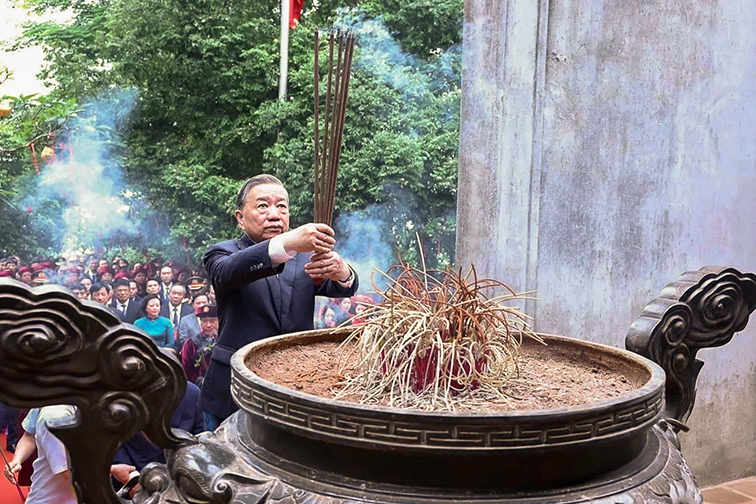
To Lam is burning incense at Hung‑vyong Temple in Futho Province on 26 April, 2026. Source: www.vietnam.vn
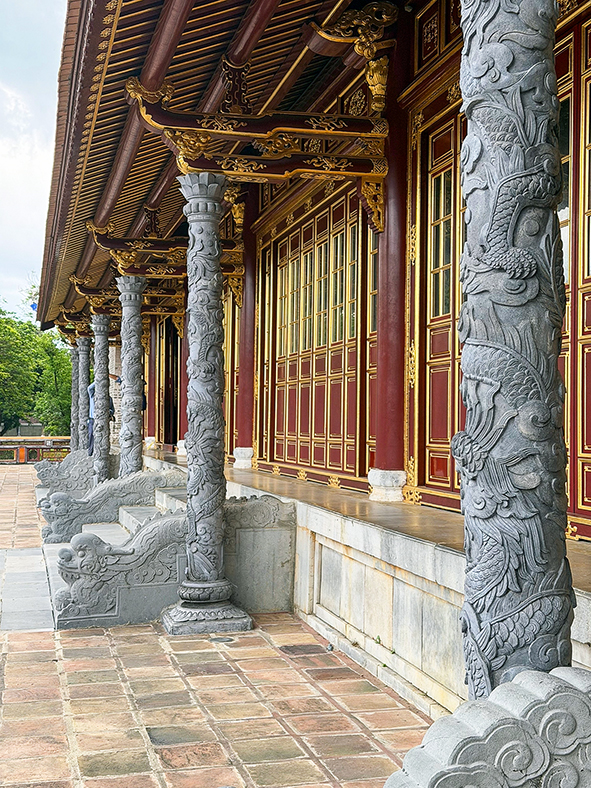
Imperial citadel, the city of Hue. Photo A. Myalkovskaya
Romanization of writing
In the 17th century, thanks to Jesuit monks, Christianity began to spread in Vietnam. As in neighboring countries, missionaries began to attempt to create Latinized writing for the Vietnamese language. By that time, Vietnam already had its own writing "nom" based on Chinese hieroglyphics, adapted to record the Vietnamese language. However, Latinized writing was much easier to learn and therefore more convenient and effective for preaching (for the same reason, later, in order to overcome the problem of mass illiteracy, Ho Chi Minh popularized Latinized writing). In 1651, the French missionary Alexander de Rod published the "Eight‑Day Catechism" in which he outlined the foundations of Christian teaching in parallel in Latin and in Vietnamese Latin. The work of Alexander de Rod is considered the first work written in Vietnamese Latinized writing "kuok nga".
For a long time, the Latin alphabet was not in demand in Vietnam - it was used only in a narrow circle of Vietnamese Christians. However, the situation changes dramatically towards the end of the 19th century, when Vietnam becomes a French colony.
Ending in the nearest issues.
Article by Maria KARPOVA