
Mysteries, achievements and practical
use of cosmic rays
Cosmic rays are protons and nuclei the energy of which extends to 1020 eV that is significantly higher than the particle energy achieved in Earth accelerators. Despite the fact that more than 100 years have passed since the discovery of cosmic rays, their origin has not been fully understood. In recent years, gamma astronomy and neutrino astrophysics have played an important role in the search and research of astrophysical reproaches of particles.
The topics of the Conference include discussions of both these fundamental issues related to the origin of cosmic rays and the effect of cosmic rays on atmospheric processes and climate.
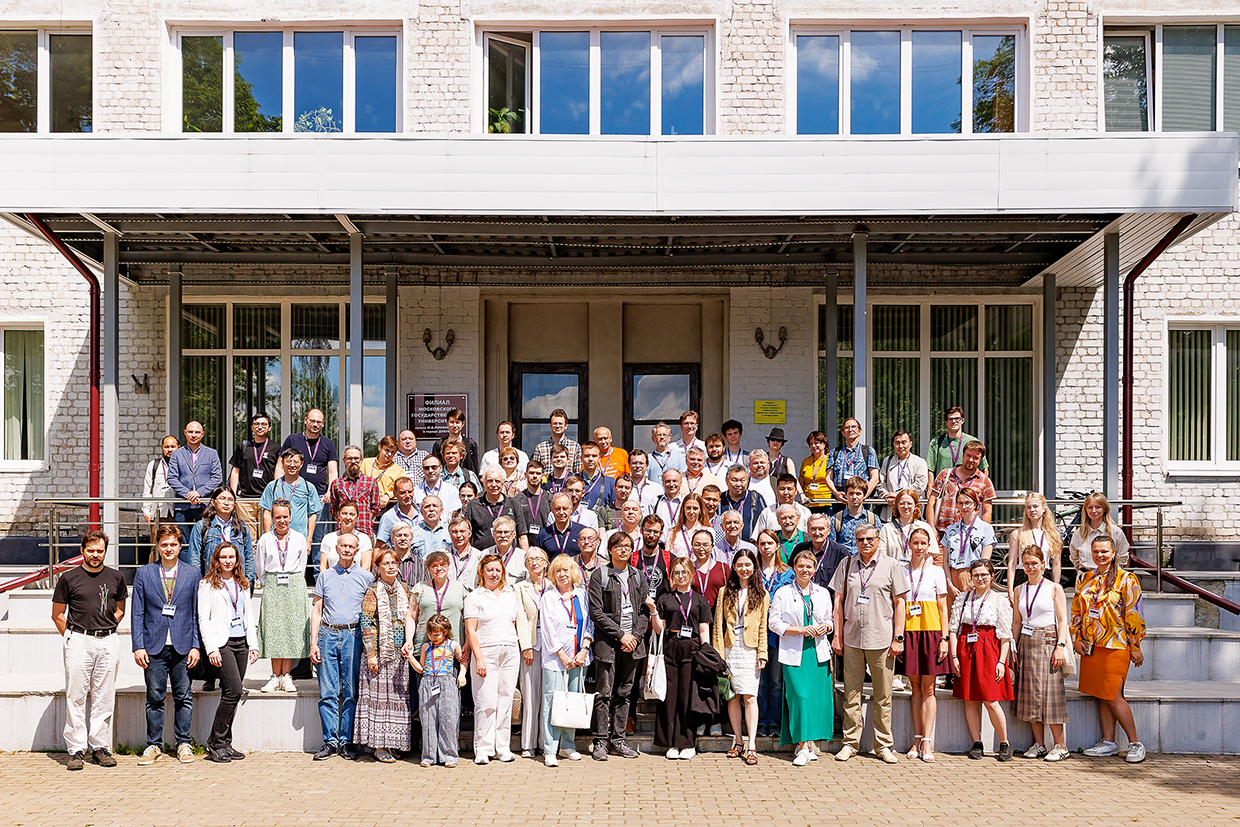
The organizer was the Joint Institute for Nuclear Research. Scientific events and meetings were held at the Dubna Branch of Moscow State University named after M. V. Lomonosov.
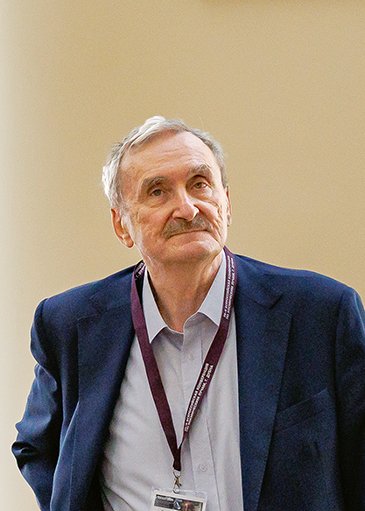
We talked to Chairman of the Programme Committee, Professor of the Research Institute of Nuclear Physics of Moscow State University Leonid A. Kuzmichev and a chief researcher at NRNU MEPhI Anatoly A. Petrukhin, long‑term participants and organizers of the Conference.
Tell us about the history of RCCR, please. This year marks the 39th Conference, I want to remember the origins.
L. K.: The first All-Russian Conference on Cosmic Rays was held in 1962 in Yakutsk. The initiative to organize belongs to Academician Sergey Nikolaevich Vernov, a leader in this area. Later, it was called All‑Union and was held in various cities of the USSR. Unfortunately, in 1992, Samarkand had its last long-distance away conference. Since then, they have been held only in Russia and for financial reasons, are held in or near Moscow. It became difficult and expensive to gather somewhere else. Nevertheless, we try to change the location of the Conference. Usually, they are held by institutes that are actively engaged in cosmic ray physics, for example, MEPhI, Lebedev Physical Institute, NIIIF MSU. And here is Dubna, in which a group of researchers have appeared relatively recently under the supervision of Leonid Grigorievich Tkachev, who passed away a year and a half ago.
Thanks to his activity, Dubna physicists participated in the NUCLEON experiment - the investigation of galactic cosmic rays on an artificial Earth satellite. In the ACE experiment that on the Lomonosov satellite registered fluorescent radiation from ultra-high energy cosmic rays. Then the group became interested in work in the Tunkinsky Valley and became part of the Tunka collaboration - TAIGA. And another research area in the field of cosmic rays includes high‑energy neutrinos. JINR plays a crucial role in the development of the Baikal‑GVD Deep Underwater Neutrino Telescope on Lake Baikal. Therefore, the Institute agreed to hold a conference in Dubna this year. The Organizing Committee of the Conference was headed by DLNP Director E. A. Yakushev.
How regularly is the Conference held?
L. K.: Once every two years. We can say that we spend it on even years. And for odd years, Anatoly Afanasievich holds an ISCRA symposium at MEPhI. In the extent, the symposium is somewhat smaller but nevertheless, these are the main meetings that are held on cosmic rays. Even independently in Dubna, a conference named after Mikhail Igorevich Panasyuk is regularly held at the Branch of Moscow State University. He was Director of the Research Institute of Nuclear Physics of Moscow State University and Chairman of the Space Ray Council of the Russian Academy of Sciences. The Conference is dedicated to cosmophysics: cosmic rays of solar origin, all the processes that occur in the earth's magnetosphere.
Is it possible to trace the activity of participants over a long period the event has been held?
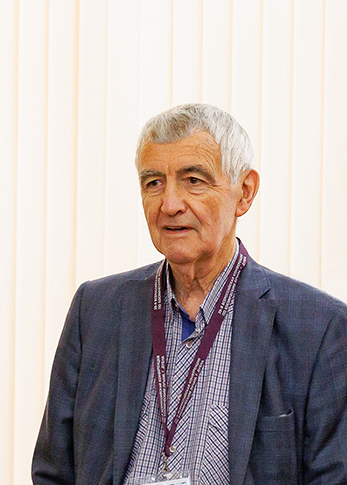
A. P.: In the 1990s, the countries of the Commonwealth withdrew from participation. Space stations were mainly in the Union Republics: Armenia, Georgia, Kazakhstan, Uzbekistan, Tajikistan. Therefore, they used to actively participate and conferences were held during the Soviet Union in different places. Also, in the 1990s, the number of young people began to decrease. Because there were no prospects or decent salaries in scientific organizations. But then, despite all the difficulties, interest increased. And this year, there are a lot of young participants.
L. K.: The Organizing Committee allowed students and graduate students to participate without an organizational contribution. In order not to rent a hotel, there is an opportunity to check into the dormitories of the Branch of Moscow State University and Dubna University. You can come for one day. That is, the participation of students and graduate students is made as accessible as possible. Therefore, there are really a lot of them this year and in my opinion, the students made interesting reports that is nice. Anatoly Afanasievich in his centre NEVOD is just a forge of young specialists for cosmic rays. And you need to understand that young people are always attracted by new achievements. Today, the Baikal‑GVD experiment is a world‑class leader. And in this experiment, there is an increase in the participation of young physicists.
268 people and more than 20 scientific organizations are declared, where are the most representatives from? How actively is JINR involved?
L. K.: Moscow State University, Moscow Engineering Physics Institute, INR - as a rule, these three centres. Obligatory is LPI, IZIMIRAN but less from them. This year, there were many reports from the Physics and Technology Institute named after A. F. Ioffe from St. Petersburg. Physics from Siberia: Irkutsk (ISU and ISZF), Yakutsk (IKFIA), Barnaul (ASU) participate with interesting reports. JINR is very actively involved; in addition to being the organizer, the staff prepared 20 reports.
What topics are covered at this year's Conference, what issues are discussed?
L. K.: The Conference has six areas. First, primary cosmic rays are cosmic rays with energies less than 1 PeV (1015 eV). Such particles can be studied using spacecraft. Experimental and theoretical reports were given on them. Second: high-energy cosmic rays, above 1 PeV. There were many reports on this topic on our facilities. There was a speaker from China who talked about their achievements. A significant contribution has been made by the Chinese facility LHAASO, located at an altitude of 4,300 meters above sea level in Tibet.
The third area: muons and neutrinos. This area includes the Deep Underwater Baikal-GVD experiment. The long‑term coordinator of this area at our Conference is Anatoly Afanasievich Petrukhin that is responsible for the ground-based neutrino detector NEVOD.
The fourth area: cosmic rays from the Sun, how they are born and how to register them. Fifth: space weather, we follow the flow of cosmic rays, if suddenly it dropped, then a storm occurred on the Sun. A piece has come off the Sun - a billion tons of plasma that flies in space, and it prevents cosmic rays from getting to Earth. By the rate of counting cosmic rays, we can see that a piece is flying towards Earth. When it bursts into the atmosphere, it changes magnetic fields and interferes with radio communications. One such event occurred in the 19th century, when all telegraphs stopped working. And in North America, the electrical grid failed. This is a grand phenomenon. Sixth: cosmic rays and geophysics. Also, non-trivial things. We are trying to understand how thunderstorms form. Until now, we do not know how lightning forms. One suggestion is that high‑energy cosmic rays initiate lightning. In particular, atmospheric ionization is also cosmic rays.
What important reports were presented?
L. К.:New results from the TAIGA experiment were presented. In particular, I represented about spectrum, mass composition and gamma astronomy. A very interesting report was given by Responsible for the facility Igor Anatolievich Belolaptikov on the Baikal experiment and the prospects for its development. First of all, the experiment has reached such a level of technology that participants can deploy a large number of photodetectors during the ice season. About 700 optical units were installed this season. It's incredible level. Once I participated in an experiment on Lake Baikal and we could install only 20‑30 units per season. A technological leap has taken place both in the quality of optical units and throughout deep‑sea technology - they work stably. Moreover, interesting results have been obtained. Neutrinos of cosmic origin have been isolated. There are individual events that can be interpreted as events from astrophysical particle accelerators. Absolutely incredible plans for the future. There is development within Russia and within the framework of cooperation with China. There are two neutrino telescopes in the world today that have reached a size of one cubic kilometer.
А. P.: Do you know what a cubic kilometer is? 109 tons of water. Kilometre up, forward and sideways. It seems like a small cube turns out. What do you think, if you collect all the people on Earth in one heap, then in what volume will they fit? The calculation here is very simple. If on average, a person fits into a volume of 100 liters and each of seven or eight billion - to allocate 100 liters, then it will turn out 0.7 or 0.8 cubic kilometers. Now, the Baikal‑GVD facility has a volume of 0.8 and there you can gather all the people living on Earth, they will not even be crowded like herrings in a jar, they will be able to move calmly.
The Americans have already made a cubic kilometer in the ice of Antarctica, a little bit left on Lake Baikal. 0.8 and one is about the same thing. An increase in the detector volume to 7‑8 cubic kilometers is discussed. The Americans are going to make ten from a cubic kilometer. And China offered thirty at once.
L. К.: Another important topic is that we do not completely understand the origin of cosmic rays. In the 1960s, Academician Ginzburg suggested that most cosmic rays are born from supernova explosions. Recent investigations in gamma astronomy have shown that the energy of cosmic rays that are born in supernovae does not allow reaching a level of 1 PeV. With such energy, the energy spectrum of cosmic rays changes. Today, it is one of the main research areas in the field of gamma astronomy and neutrino physics. Many reports from theorists were given at the Conference. A large report from Academician A. M. Bykov from St. Petersburg and his young colleagues, a report by V. N. Zirakashvili from IZMIRAN.
There is another aspect that should be mentioned - this is a muon riddle. The term officially appeared in 2014. When we study the mass composition of cosmic rays, how many protons, helium nuclei, iron are contained, then miracles occur in the range of very high energies. We can study mass composition by fluorescent radiation. And we can study by registering the number of muons in a wide atmospheric shower. The mystery is that if we estimate the mass composition from fluorescent light, then it will be light. And if we study using muons, then it turns out to be heavy. Extra muons come from somewhere. Many explanations have already been invented. These issues were also given considerable time at the Conference.
What foreign collaborations is the cooperation currently supported with?
L. К.: Today, some of the Member States have left Russia. The TAIGA experiment had many employees from Germany but they froze their participation. Contacts with China increase. The Baikal experiment widely cooperates with China. Individual groups, such as those from the Institute for Nuclear Research, participate in the LHAASO facility in China. Participation in the American‑Japanese collaboration Telescope Array has been preserved.
Is there a practical use of cosmic ray knowledge?
А. P.: Cosmic rays play a very important role. All our life on Earth depends on the Sun. And the Sun is a reactor, there are powerful explosions, as a result of which a plasma cloud breaks out and if it flies towards the Earth, then a magnetic storm may occur, the weather will deteriorate and much more. An interesting point arises here. The Sun is monitored by observatories, corresponding telescopes, any flash on the Sun is recorded instantly. But in them you do not see the direction but only the emission to the side. There are techniques that calculate at what angle the movement is going. And now they say: there was a class X event, very large, directed towards the Earth that means that powerful magnetic storms are expected. They announced but there are no storms. What's the problem? The fact that with the current system it is impossible to estimate exactly the angle. Imagine if you made a mistake by one degree. This is a small figure but since the distance is long, we get an error of 2.5 million kilometers. Therefore, the question arises, how to find out whether a plasma cloud is flying towards the Earth? And cosmic rays just help in this. If it flies, then in it, magnetic fields deflect particles, and we see a dip in the flow of cosmic rays. Since the Earth spins and the plasma flies two or three days to the Earth, it means that we first saw a decrease in the flow, if after a day the decrease disappeared, it means that the plasma flies somewhere to the side. And if it flies to us, then the decline becomes stronger. And that prediction is at the heart of space weather.
Maria KARPOVA,
Photos by Elena PUZYNINA