
40 years ago
No. 25 (2814) 25 June, 1986
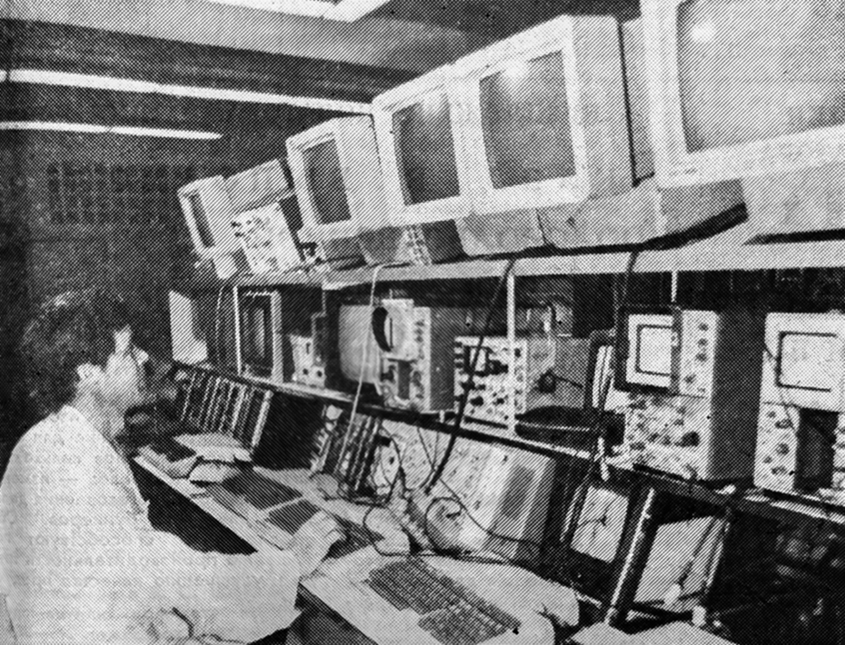
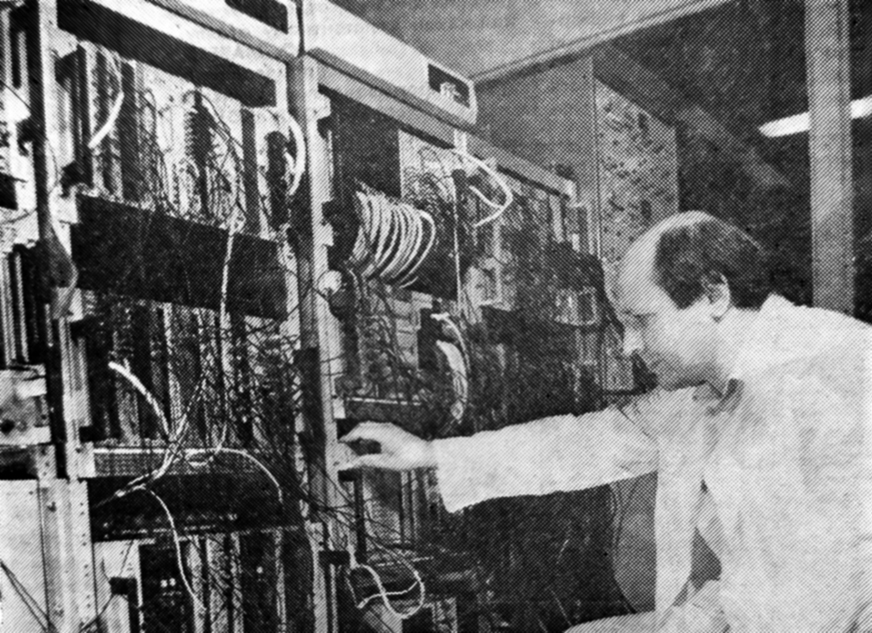
The main task of the Department of New Acceleration Techniques is to complete the development of an accelerator of heavy KUTI‑20 ions, the work on the first stage of which has entered a decisive stage. This year, a physical launch is to be carried out. Meeting this difficult task will require the staff of the Department to maximize mobilization and focus efforts on all areas and key problems. First stage of accelerator includes head part of KUTI‑20 consisting of linear accelerator SILUND‑20 and magnetic compressor adhesive‑20 and three sections of induction accelerator of electronic LUEK‑20 rings. In addition, for the successful operation of this complex, an automated control and monitoring system is required, as well as tools for diagnosing beam parameters at various technological stages of acceleration.
Given the large volume of simultaneously manufactured, customizable and commissioned equipment, the decisive issues at the final stage of work are the coordination of the efforts of large staffs of scientific and production departments and groups participating in the physical commissioning of the first stage of the KUTI‑20 and the estimation of their priority tasks.
***
Along with meeting fundamental scientific problems, the JINR staff focuses on the use of the achievements of nuclear physics research in practice - in related fields of science and technology, in the national economy. The results of work carried out in JINR Laboratories find increasing use in medicine, agriculture, biology, geology, energy and other fields. The importance of these results is confirmed by official feedback received from many organizations. JINR applied papers are awarded prizes of the Council of Ministers of the USSR.
***
At a regular meeting of the presidium of the OMC trade union, the issue "On the progress of the implementation of the action plan for the implementation of critical comments and proposals made during the 1985 reporting and election campaign" was considered. The information was made by Chairman of the Organizational and Mass Committee T. V. Bespalova. She thoroughly told how work is underway to implement them.
***
A meeting of young people of DLNP with the employees of the JINR Patent Department was held. Answers were given to numerous questions formulated in advance by the organizers of the meeting: about the information service of the patent department, about the peculiarities of organizing invention at the Institute, about the ways of rewarding innovators.
***
To work four days at social and cultural facilities - this decision was unanimously made at a meeting of the Komsomol organization of FLNP. Such objects will be the surgical building of the medical unit, an architectural monument in Ratmino, sponsored school No. 9. And on Sunday, Komsomol members of cultural and sports institutions of JINR went to their next community work day to remove the territory adjacent to the Cultural Centre “Mir”.
16 years ago
No. 26 (4016) 25 June, 2010
The discussion at the PAC meeting on nuclear physics focused on the report of FLNP Deputy Director V. N. Shvetsov, on fundamental and applied research in the field of neutron nuclear physics and above all, on the first experiments at the IREN facility, a new generation base facility that is developed in the laboratory. "Now, we are moving in this direction," Valery Shvetsov said. “We have signed a contract with the Japanese company Toshiba for the supply of a new klystron... The next qualitative leap in the development of the facility can be expected in the first quarter of next year, when we receive this klystron and I hope to successfully install it. However, even before that time we have something to do: the current intensity is enough to carry out experiments. We carry them out and will continue this work."
***
A representative delegation of JINR scientists headed by Acting Director of the Institute M. G. Itkis was in Ulan Bator, where he took part in the International Meeting "New prospects for cooperation with JINR - from particle physics to nanotechnology". The meeting was organized by JINR in cooperation with the Nuclear Energy Agency of the Government of Mongolia. At the request of the editorial board, the leading employee of the compulsory medical insurance M. G. Loshchilov comments on the results of the visit, “Mongolia is one of the JINR Member States that stood at the origins of the Institute and we were glad to have many meetings with Mongolian scientists who are well known to us from Dubna. Many of them today are leaders in the development of science in Mongolia and are very interested that Dubna, as before, was a school of modern physics for young specialists in the country. However, considerable efforts have to be made for this, because there has been a generational change and now, young people in Mongolia are more focused on English than Russian and physics is not so popular in society today. Therefore, the main task of our meetings and negotiations with Mongolian colleagues was to fully restore and continue scientific cooperation, to preserve the continuity of generations and to attract Mongolian scientific youth to Dubna.
Columnist Irina LEONOVICH,
Photos by V. BELYANIN