
Remembering Svetlana Petrovna...
"Today is not the birthday of the University Centre but there are some of those who stood at the origins of this wonderful initiative - the establishment of the UC," JINR Director G. V. Trubnikov opened the seminar. “Unfortunately, not all, many are no longer with us, but we see them in these beautiful photos (on the slide show during the seminar it was possible to learn aboutb the photographs from the personal archive of the Ivanov family, the archive of BLTP and UC - O. T.). In the early 1990s, N. N. Bogolyubov, V. P. Dzhelepov, M. G. Meshcheryakov, G. N. Flerov, I. M. Frank passed away. The Institute was picked up and was able to keep afloat in a rather difficult geopolitical time, quite young people aged 45‑55, continued the best traditions of their teachers. And these were not only Directorates of the Laboratories and Directorate of JINR, but also many laboratory employees, project leaders that took responsibility at a difficult moment. I include Svetlana Petrovna among them.
35 years have passed and thanks to these people, JINR not only lives, but develops. Svetlana Petrovna had a lot of talents. She was a wonderful scientist, she had a talent for human communication, while she was a surprisingly organized person, a person with a steel rod inside. I would like today to be bright and joyful and the memory of Svetlana Petrovna remained the same bright. About a year and a half ago, after probably a ten-year break, the UC Council met. And the first thing they thought about was perpetuating the memory of S. P. Ivanova.
I can't help but share my personal impressions. I appeared at the UC at the end of August 1996. Svetlana Petrovna was to us, students, like a second mother. Everything related to the structure of life and everyday affairs, any problems were met by her and Isabella Fedorovna Vdovina. And it is very pleasant now to see Svetlana Petrovna's smile in these wonderful photographs and next to her Igor Nikolaevich, to remember this family of excellent scientists with numerous publications and students."
The history of the establishment of the JINR University Centre was analyzed by Head of the JINR Historical Archive E. K. Malaya. To begin with, she looked into the past - in the 1940s, when the Department of Atomic Nucleus and Radioactivity was organized at the Physics Department of Moscow State University, and D. V. Skobeltsyn headed it. On its basis, the Institute of Atomic Nucleus Physics was established in 1946. Elena Konstantinovna decided to consider the history of the establishment of the UC from that moment, since D. I. Blokhintsev taught at the Department of Physics of the Atomic Nucleus of this Institute, the future NIIIF. He thought about training future scientific personnel, developing a holistic system for cultivating them. Considering history in such a broad context, we can talk about the continuity of the UC and the Research Institute of Nuclear Physics of Moscow State University. The founder of NIIIF D. I. Blokhintsev, becoming Director of JINR, began to organize a branch of the institute in Dubna. In 1961, thanks to him, as well as S. N. Vernov, V. I. Veksler, a branch appeared. "If there was no branch of NIIIF and a long tradition of teaching, it would be more difficult for S. P. Ivanova to apply her talents," Elena Malaya said. She comes to D. I. Blokhintsev to work at BLTP in 1964, two years later, she becomes a teacher in the Department of Atomic Nucleus Theory of the NIIIF branch and in 1979 - an assistant professor and begins to teach a course in theoretical nuclear physics. "It seems to me that a synthesis of the traditions of D. I. Blokhintsev and the talent of S. P. Ivanova arose here," she stressed.
We also saw the documents according to which the UC has two birthdays. On 16 January, 1991, by order of the USSR State Committee for Public Education and the Ministry of Nuclear Energy and Industry, a training and scientific centre of Moscow State University and Moscow Engineering Physics Institute was established on the basis of JINR. The second date is 29 April, 1993, when the UC became a division of JINR with a staff of two people - a director and a researcher. The speaker extended the thread of continuity further - without the UC, Dubna University would not have arisen. One of the orders on JINR in 1993 stated: "On the organization at the UC Institute and the establishment of Dubna International University on its basis, to provide the UC with the required premises in the LCTA building." "It was a difficult story but this story is about continuity," E. K. Malaya concluded her speech.
S. P. Ivanova was introduced to the scientific research areas by the chief researcher of BLTP R. V. Jolos. Its first publication appeared in 1962 - a preprint of a joint work with B. N. Kalinkin. At that time, the development of a microscopic protoype of the nucleus had just begun in the world. Then Svetlana Petrovna worked together with F. A. Gareev, V. G. Solovev, L. A. Malov, N. I. Pyatov. "D. I. Blokhintsev, after the development of the first nuclear power plant, became a very popular person and, already working at JINR, received many letters," Rostislav Vasilievich recalled. ‘He asked Svetlana to become his secretary and prepare answers to them. She prepared, he ruled, and when after a while her answers ceased to require his adjustment, Dmitry Ivanovich said, "That's it, you're ready. You don't show me any more answers." In the 1980s, Svetlana Petrovna was engaged in a statistical model of the nucleus, then with O. I. Knyazkov (Leningrad) - proton scattering on nuclei, convolution potential. In the 1990s, together with V. Scheid, N. V. Antonenko and R. V. Dzholos S. P. Ivanova worked on using Lindblad's axiomatic approach in describing non-equilibrium nuclear processes. The last decade and a half of her work was dedicated to research on the dual nuclear system; a clustered core structure; super and hyperdeformed state of nuclei and some other areas. The performance was accompanied by a photo shot of S. P. Ivanov and his colleagues in BLTP and business trips with his husband. "Svetlana has been gone for almost 20 years. What was done then now widely develops, FLNR is interested in part of these investigations. I hope I showed that Sveta was a very active person, very capable and very sociable," Rostislav Vasilyevich finished his speech.
The report of Director of the UC D. V. Kamanin was called "UC Today". "The UC ship was built, equipped and launched by Svetlana Petrovna in free navigation," he began his speech with this image. A serious foundation was laid - graduate school was opened. UC today is about 600 students annually, 14 basic departments, participants in educational programmes from more than 40 countries. In 2024, it was estimated that out of 326 graduate students of the UC, 130 work at JINR, of which 34 are heads of various levels. He spoke about the expanding functionality of the Centre's educational programmes and changing its structure that provides modern opportunities for the UC, from holding science festivals, working with school teachers, creating interactive curricula to engineering workshops, international student practices, START and INTEREST programmes. "We continue to build her ship," Dmitry Vladimirovich concluded his speech.
M. S.Pilipenko presented the team that worked with her on the creation of the photo album "Family. Friends. Colleagues" dedicated to S. P. Ivanova, they are the daughters of Svetlana Petrovna Olga and Maria, granddaughter Anna, edited by Anastasia Goldstein.
In her speech, T. V. Tetereva warned against a possible mistake: Svetlana Petrovna in 1966 did not move from BLTP to a branch of the Research Institute of Nuclear Physics of Moscow State University, she was welcomed to the department of D. I. Blokhintsev at the Physics Department of Moscow State University. This status is ranked higher, although for simplicity, the Dubna departments of Blokhintsev and Pontecorvo were called the departments of the NIIIF branch. It was she who built the work of the Department five years after its organization. "I always emphasize that Svetlana Petrovna was an employee of the Faculty of Physics, Dmitry Ivanovich's right hand, his irreplaceable assistant at the department," Tatyana Vsevolodovna said. “And it was so until the tragic death of Dmitry Ivanovich in 1979. Then she was transferred to the department of A. F. Tulinov. When a request was received from Cuba for students to study at Moscow State University, it instantly responded, accelerating the slow bureaucratic processes of the university and ten Cuban students began to study in Dubna at the Department of A. F. Tulinov. He hid for a very long time, but after some time it turned out that one of them was the son of F. Castro," T. V. Tetereva recalled. She also recalled the role of V. L. Aksenov and Dean of MEPhI V. N. Belyaev in the opening of the Department of MEPhI in Dubna that served as a personnel feed for the student influx that weakened in 1991.
A.V. Kulikov remembered his acquaintance with S. P. Ivanova at an off-site conference and joint work at the NIIIF branch. He supervised the work of the branch and after the establishment of the UC, he lectured to students of the Moscow Institute of Physics and Technology and the UC for 20 years. After the lecture, he usually went to Svetlana Petrovna's office that was always open. "She was a bright, hospitable, friendly person," Anatoly Vladimirovich emphasized.
N. Yu. Shirikova somehow helped F. A. Gareev by optimizing his computer programme and she was invited to work together with a group of theorists that included S. P. Ivanova - "irrepressible, the energy in it seethed". And then there were joint trips and rafting along the rivers with adventures and memorable moments. While the Ivanovs did not yet have their own children, Svetlana and Igor helped Nella with her babies every day for a month. "Our whole life was spent in communication, we teased each other, composed wall newspapers, life was stormy. You have not seen such Sveta - here she was a teacher and organizer," Nella Yulyanovna shared.
This is how T. A. Strizh recalled, "The 1960s‑1970s were an amazing time for everyone, Dubna lived as one big family. And Svetlana Petrovna created the same family at the UC. I've been lucky enough to work with her for the last eight years. I never felt she was the boss, we were more friends than employees. She was always ready to come to the rescue and helped everyone. Ideas constantly came from her, we always learned something from her. Svetlana Petrovna had a large notebook in which she wrote down all the cases, even the smallest ones, and then crossed out what she had done with great pleasure. And she also had a huge book - a paramedic's handbook or some other medical volume. Crowds of people came to her to look through it, look for their symptoms and make a diagnosis. And she, with her theoretical mindset, reassured everyone.
1993 was a difficult year for LCTA. The processing of film information has ended, the Automation Department, located on the fourth floor of the laboratory building, has closed. The staff of LCTA has almost halved - from 650 employees to 350. Auditoriums were gradually vacated and handed over to the University Centre, where they were renovated by the Centre's staff. It seems to me that the brightest memory of Svetlana Petrovna will be the restoration of the UC graduate school, this forge of personnel that has givenmany leaders in the scientific areas of the Institute."
I. A. Lomachenkov shared his student memories. After the winter holidays of 1973, a group of students from the Department of Atomic Nucleus Theory and the Department of Particle Physics came to Dubna. A small town in cloudy weather after the capital did not make a favorable impression on them. Everything changed the next day, when a meeting with Svetlana Petrovna took place in a large audience of NIIIF. She asked everyone to talk in detail about their scientific interests in order to select scientific leaders. She said, "I will help you!" And Svetlana Petrovna really helped, she lived the life of students. "She was the curator of our group, and we met quite often on a variety of problems," Ivan Alekseevich said. “She played a very big role in my fate. Svetlana Petrovna recommended my supervisor V. I. Furman, I worked at FLNP, managed to defend my thesis. And somehow, she invited me to the UC, "Ivan, I know that you are engaged with schoolchildren, they have achievements, victories at the Olympiads. Come to us at UC, I have big plans." It inspired me, I agreed and since then I have been working in education. The memory of this amazing, extraordinary man will remain in our hearts."
Yu. P. Kurlapov met S. P. Ivanova in 1982 at a parent meeting at school number 8. "Svetlana Petrovna was the person who always needed the most," he recalled. “She had experience in the parent committee of the school for 20 years. I have never seen such experience again." In 1991, on the initiative and with the support of A. N. Sissakyan and S. P. Ivanova, the International School of Young Researchers "Dialogue" was founded and still functions. And today, the daughters of Svetlana Petrovna Olga and Maria teach at the Lyceum named after V G. Kadyshevsky.
O. I. Melnikova (Ivanova) highlighted that the idea with the memorial album was very good, it contains the memories of different people, their intonations are preserved, the result is "a voluminous picture and the person is seen alive. Many thanks to the UC for this work, thanks to everyone who wrote memories, who sent photos. Thank you all very much!"
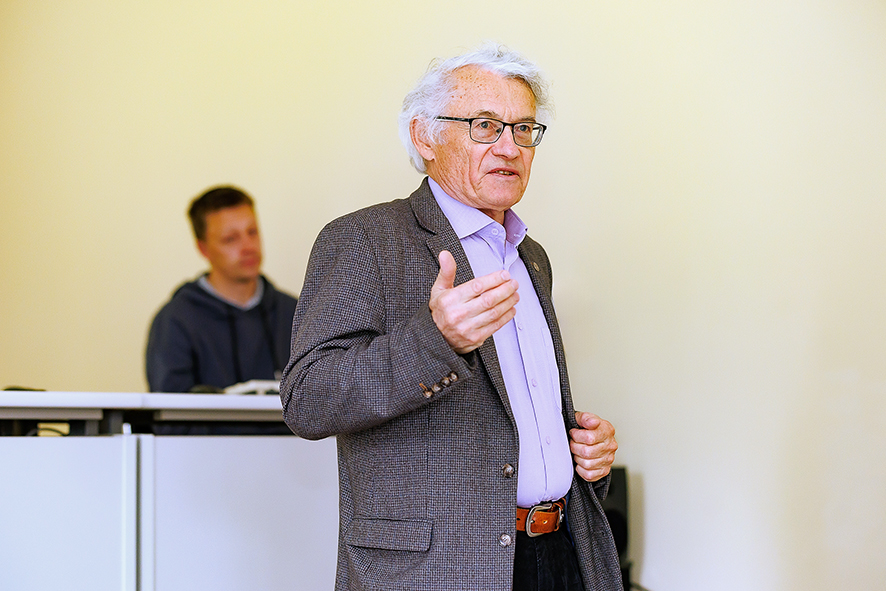
I. A. Lomachenkov
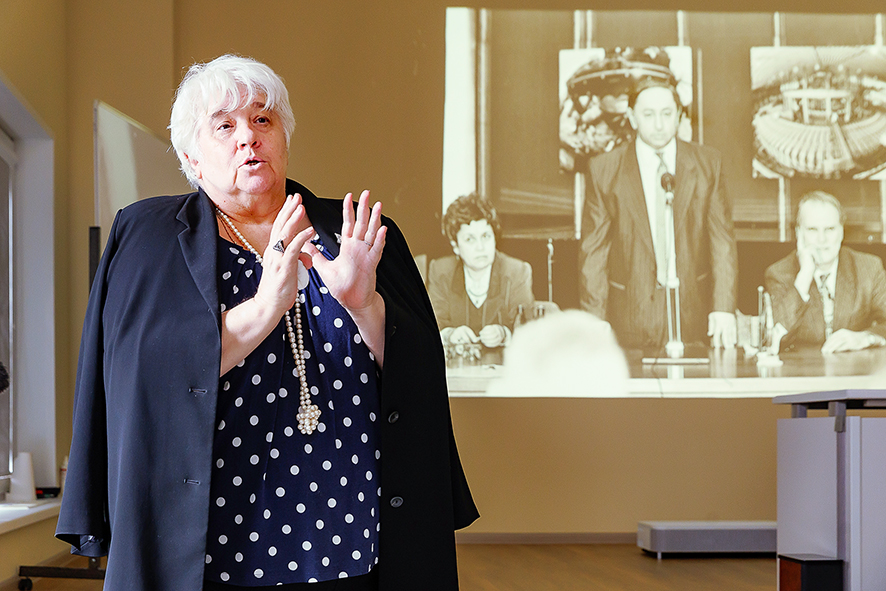
T. V. Tetereva
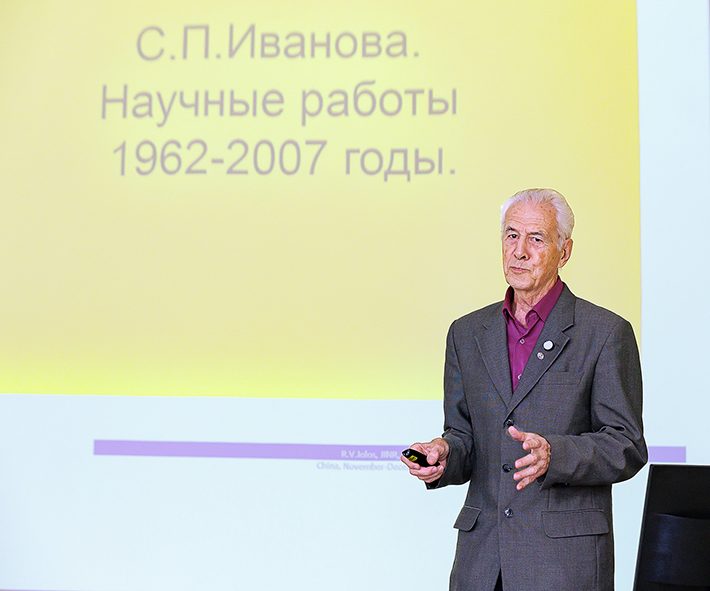
R. W. Jolos
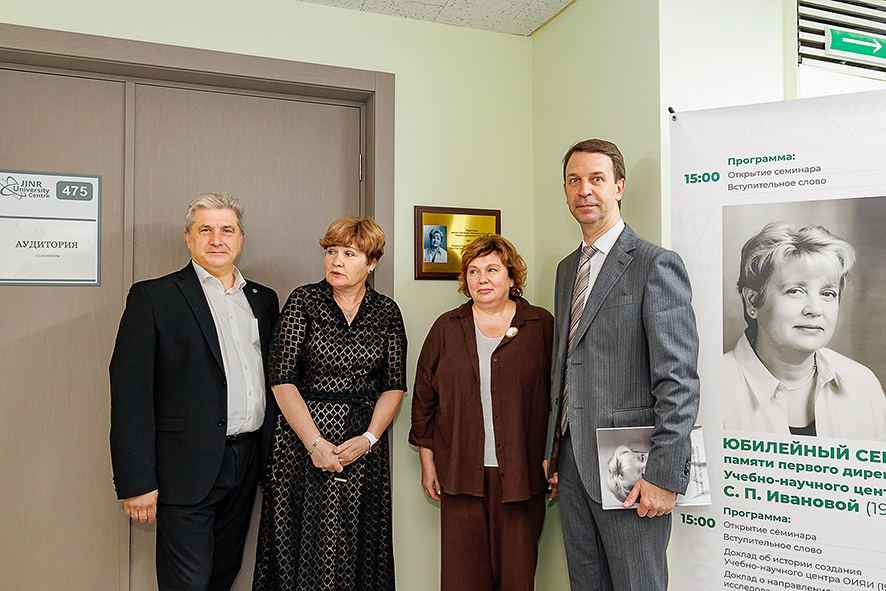
D.V. Kamanin, O.I. Melnikova, M.I. Ivanova and G.V. Trubnikov
Olga TARANTINA,
Photos by Elena PUZYNINA