
ISINN is true to traditions
and committed to the future
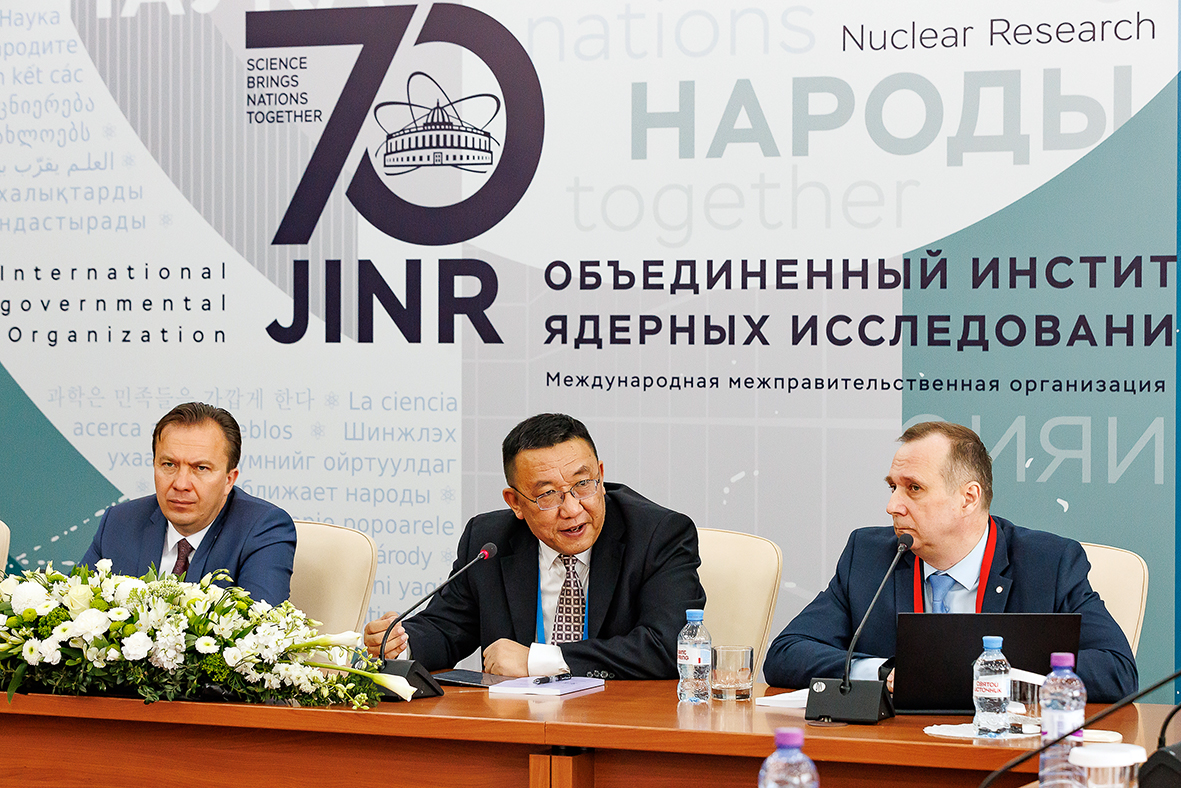
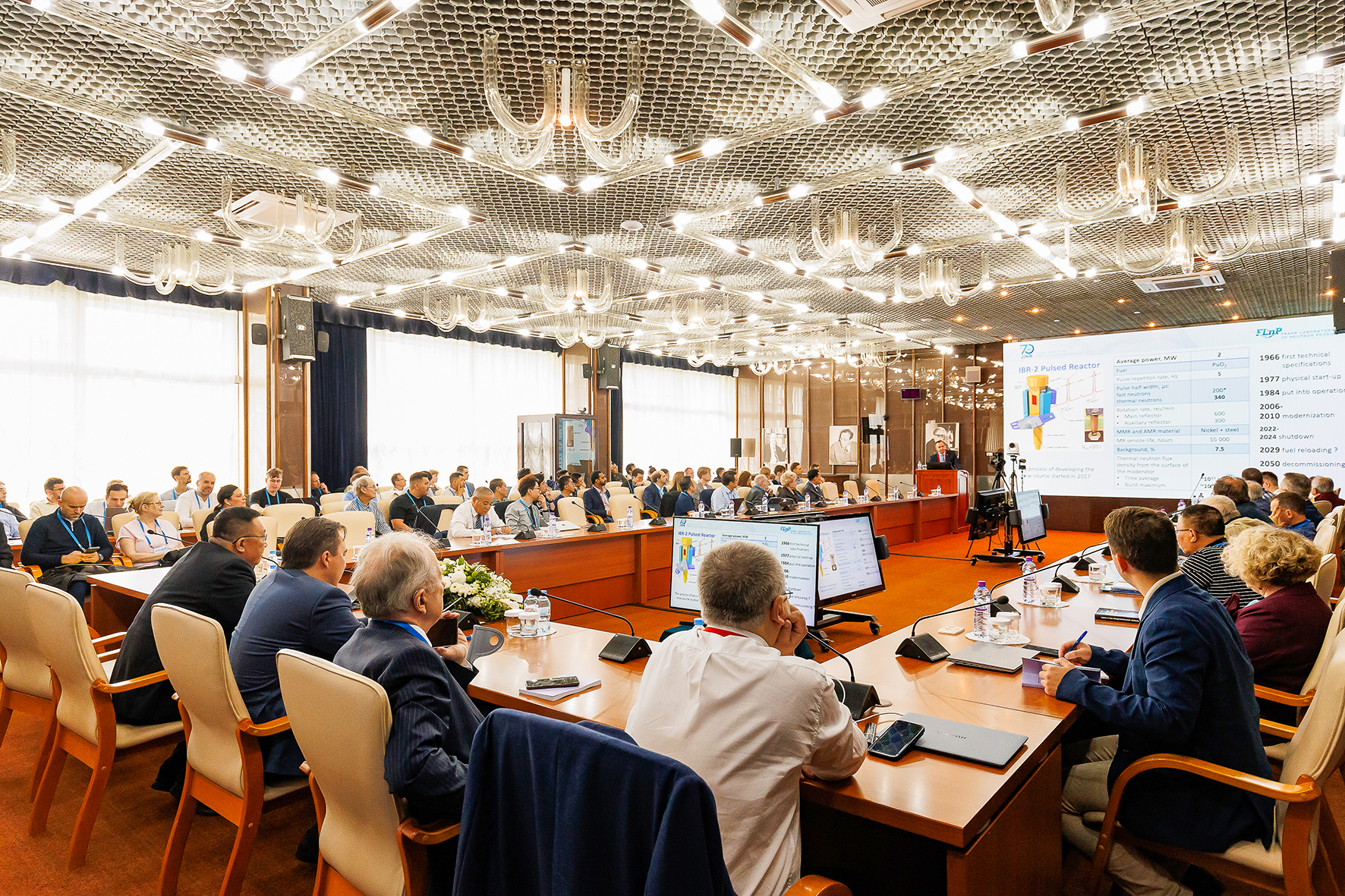
Traditionally, the subject of the Conference includes the fundamental properties of a neutron; fundamental interactions and symmetries in the neutron caused by reactions; nuclear fission; nuclear data for applied and scientific purposes; ultracold neutron physics (UCN); physics of nuclear reactors and other areas.
On the first day of the Conference, all participants were greeted by JINR Vice Director S. A. Kulikov that emphasized that ISINN has recently been held in different countries, but this year, Dubna again hospitably opened its doors. FLNP Director E. V. Lychagin congratulated the Conference participants on an interesting programme and expressed the hope that communication would be successful, new contacts would arise. Liang Tianzao, Deputy Director of CSNS (China) that participates in this Conference with great pleasure, also welcomed the participants. In a greeting and his subsequent speech, he talked about new opportunities for users at China's CSNS neutron source and the next phase of its CSNS‑II upgrade.
The first speech at the Conference was the report of E. V. Lychagin "The current state of affairs in the development of a new promising neutron source of FLNP JINR". I asked him to outline the highlights of this important report for the Laboratory and the Institute.
"The report consisted of two parts, although it was dedicated to the project of a new promising neutron source for JINR, I took half of it from the situation with the current source – the IBR‑2 reactor” Egor Valerievich said. “From 2021 to 2024, we had a forced long stop due to the fact that we changed heat exchangers in the second sodium circuit, received a new license from Rostekhnadzor. Geopolitical events were superimposed on the situation that influenced the work of the factories preparing our new heat exchangers, as a result, the shutdown was longer.
The first. After a long stop, we launched the reactor and worked for a year for the experiment. We earned on the same capacity at which we stopped - 1.5 MW, while we resumed the user programme: already in the second half of 2025 we collected applications, worked out applications in the first half of 2026 and collected for the second half of the year. According to statistics, we can say that the number of users has not decreased but they have been replaced: the number of proposed experiments from European countries has decreased, but Egypt has been added as a new Member state, there is an active exchange with China - we go to experiments with them, Chinese scientists come to us. The ratio between the total number of Russian and our internal experiments to the number of external ones has been preserved. It makes us happy.
The second point. We have reached a good pace of attracting new users. For 2026, we registered 200 new users in our database. 200 researchers that had not previously used our services. For the year is not bad. Another thing, and this worries us a little, is that three quarters of them are scientists from Russia. Therefore, we are now thinking how to attract more users from JINR Member States and Partner states thyat in the future may become Member States.
We also try to evaluate how long we can put the reactor into operation. The current license ends in early 2032. The extension of the reactor operation is based on three points: obtaining a new license; it is necessary that the equipment, the reactor can operate at power; need appropriate personnel. Regarding the license: the regulator, according to the new regulations and rules, sets us the task - the security justification should be carried out using specialized computer programmes. The task is difficult, since before that we carried out all the calculations analytically and specialized programmes for IBR‑2 were not developed. Most likely, we will not be able to fulfill this task on our own, but last year, we began to cooperate with a large number of specialized organizations - the Research and Design Institute of Energy Engineering, the Institute for Safety Problems of Nuclear Energy Development of the Russian Academy of Sciences, the Scientific and Technical Center for Nuclear and Radiation Safety, Physics and Energy Institute (Obninsk) and several other organizations with the help of which we hope to meet this problem and reach licensing. As our experience shows, it is advisable to submit documents a year and a half before the end of the current license, that is, by the end of 2030, we should collect the entire package.
As for technology. We have a list of equipment important for the operation of the reactor, for its safety that has a technical resource. And there is a rather routine task of extending the resource. There are more than 90 systems and equipment items on the list, and there is a specific plan. What is critical? The reactor vessel in all parameters can be operated unchanged until 2050. The movable reflector, judging by how energy is being generated now, can probably be operated until 2032‑2034, depending on what power we will operate at. What is important, we had a spare movable reflector manufactured seven years ago and in a year, we will be technically ready to replace if required.
The third is fuel. Due to fuel degradation, we are forced to constantly reduce power. The degradation process in the operating reactor scheme cannot be prevented or changed in any way, so the only way is to replace the fuel in order to, as it were, return to its original position. We will be able to return to a nominal capacity of 2 MW, and in seven years we will begin to reduce it. We turned to the Institute's Directorate with a proposal to purchase a new fuel load for the reactor. The proposal was supported, funds allocated and a contract was awarded for the manufacture of a new fuel load. According to the contract, fuel should go to JINR in the first half of 2028, in the summer break of 2029 they could install it. At least, we will technically be ready.
Thus, according to the resources of the main components, we now see that technically the reactor could be operated until the end of the 2040s, having passed the license cycle two more times. Usually a license is given for eight years, that is, until 2048 we could have a reactor as it is now. Replacing fuel, moving reflector, obtaining a license - you need to think carefully so that these events are spread over time and minimize reactor shutdown and work as much as possible for the experiment. We do it now.
As for the new source. It is important that in 2024 NIKIET, when calculating the thermohydraulic properties of a reactor using neptunium fuel, saw that it would be necessary to reduce the power of this reactor, because temperature deformations cross the permissible limits. It is necessary to iteratively see how these parameters decrease with a decrease in power and at what power they will fit into the necessary tolerances. This is a long work, we are not doing it yet. We continue to study the dynamics, since in the Neptune project we have not agreed with the designers in what form the core should be assembled. Our physicists widely study the dynamics of pulsed reactors in general, trying to apply their models to IBR‑2 – the only operating reactor which these models can be tested on, comparing the calculated values with those observed experimentally. Fortunately, we managed to interest NIKIET in this issue, they are included in the work.
In 2025, we slightly changed the approach to the ideology of developing a new source. Prior to it, the neutron flux density was indicated an order of magnitude higher than that of IBR‑2, but it is already clear that achieving such parameters will require too many technical innovations. In reactor engineering, big steps forward are rarely taken. It is clear that it will result in a delay in the implementation of the project and probably, to an increase in its cost. We changed the logic a little, based on the fact that when the IBR‑2 reactor was developed in the late 1970s, it had initially very high parameters - today's sources, even based on proton accelerators, are only approaching them. But at that time, the developers did not think much or did not have the ability to effectively extract neutrons, so if the designers and our physicists can offer a machine with parameters no worse than IBR‑2, then we will try to improve the extraction efficiency by an order of magnitude due to advanced moderators and neutron optics and thereby increase neutron fluxes tenfold on samples in experimental facilities. Then such a project, it seems to me, will become interesting for our Member States and it can be implemented.
In 2025, NIKIET tried, retaining the ideology of IBR‑2 - the principles of core layout, to see if it was possible to make such a reactor in today’s requirements. They did not succeed in the necessary flows that suggests that it is necessary to retreat in some technical solutions. In parallel with the Neptune project, a proposal was developed for a new promising plutonium-based reactor, in which the layout of the core differed from IBR‑2 in that the controls were located inside the reactor vessel. This year, we asked NIKIET to see if this idea could be used and calculate what flows we could get. If they turn out to be commensurate or higher than that of IBR‑2, then it seems to me that this will be a promising approach for a new reactor. And we, in turn, will simulate what neutron optics need to be done, what reflectors, moderators, perhaps choppers need to be used depending on the methodology of the experimental facility. We want to calculate, to be sure of factor 10, whether it can be implemented in practice.
We have an agreement with NIKIET until March 2027, so we will get the answer to the question whether it is possible to get the required flows in this layout that they currently consider. I hope that by this time, we will be able to simulate some kind of neutron facilities and neutron optics."
To be continued.
Olga TARANTINA,
Photos by Elena PUZYNINA