
Parallel projects intersect
Lectures are held at the site of the Scientists’ Club with the support of the JINR Museum of History of Science and Technology. The project was a continuation of the joint historical and archival initiative of the Joint Institute for Nuclear Research and the Higher School of Economics that is supervised by Deputy Chief Scientific Secretary of JINR Alexey Zhemchugov and Associate Professor of the School of Historical Sciences of the Higher School of Economics Galina Orlova. Galina told us about how lectures complement the exposition.
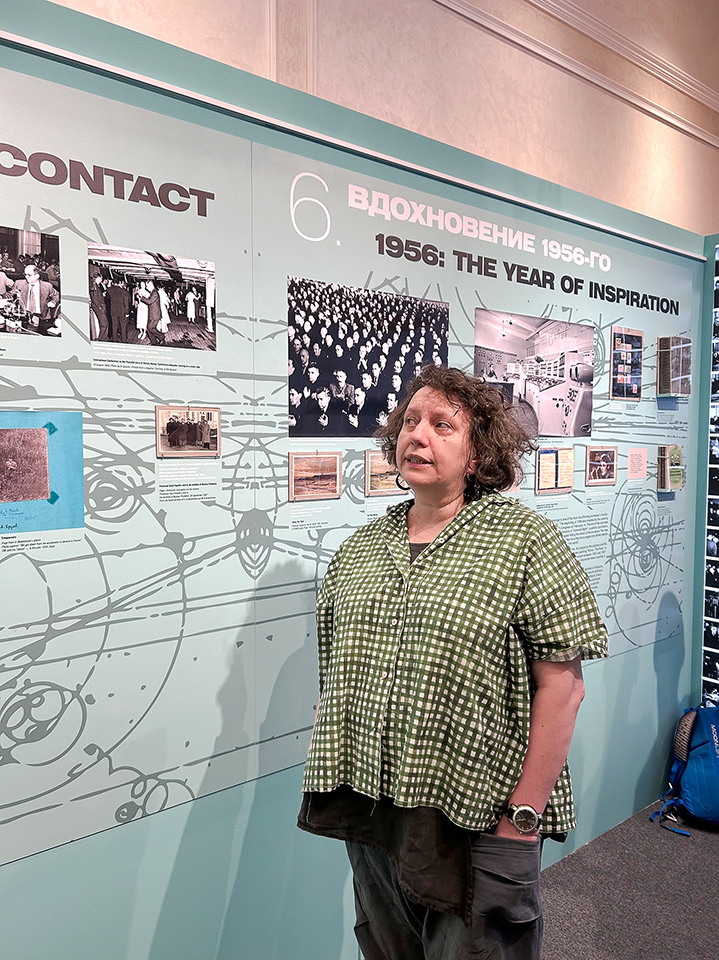
It follows from the name that the main concept of the project is interaction. How did this idea come about?
- Indeed, our exhibition told the history of the establishment of JINR as a story of interactions where science, politics and culture are intertwined. When coming up with the concept, we were inspired by the signature "First star" made by the hand of D. I. Blokhintsev under the track shot from the newly launched synchrophasotron. You know better than us that in high energy physics, stars are called traces of intense interactions that have become events. And we invited the guests of the exhibition to peer into the archival traces of the events of seventy years ago, seeing the first stars in them.
Much had to change before representatives of 11 countries signed the JINR Agreement in Moscow on 26 March, 1956. The atom was to become peaceful, physics - advanced, world-class accelerator facilities - declassified and international scientific staffs - in demand. Readiness for new interactions and the ability to trust each other at that time turned into an important component of these changes and later - the cultural code of JINR.
It is symbolic that at the forefront of international contacts that in the mid‑1950s became a sign of renewal and hope, were physicists focused on the investigation of fundamental interactions. We relied on this rhyme when creating the concept of the exhibition.
What is the idea of the lecture part, how does it concern the history that is revealed at the exhibition?
- The task of the parallel programme is to show that the establishment of JINR belonged to the era of interactions that change the world and people for the better. The mid‑1950s in this regard was a truly exceptional time.
Let's remember that a month before the constituent meeting, the 20th Congress of the CPSU ended that brought with it not only the beginning of de‑Stalinization, but also "hopes for a new collegiality" as the future director of JINR formulated. A month later, a historical lecture by I. V. Kurchatov wa given in Harwell, at which for the first time, issues of controlled thermonuclear fusion and new opportunities for the peaceful use of atomic energy were openly discussed. Given this neighborhood, we can better understand the historical significance and if you will, the historical mission of the Joint Institute for Nuclear Research.
Seventy years ago, physics was the science of the front line and physicists were cultural heroes who could cross borders. And yet, the international nuclear institution arose not in a vacuum but in an environment saturated with interactions that yesterday were impossible. We asked lecturers to talk about some of them as part of a parallel programme for the exhibition.
How was the selection of what was important or wanted to talk additionally?
- The six episodes included in the series “Meridian of interaction” are dedicated to new relationships, contacts, relations and ways of dormitory that in the mid‑1950s were basis of political culture, international life, environmental consciousness, everyday mobility and of course, scientific cooperation. Some of the topics expanded and deepened certain aspects of the exhibition.
For example, in one of the sections of the exposition, documents are presented that note the role that the prospect of expanding CERN, outlined in 1955 and the beginning of the construction of powerful accelerators in Geneva, played in the fate of JINR. Whereas the experience of designing the European Centre for Nuclear Research and the development of a protocol for international cooperation were behind the scenes of the exhibition. This absence was made up for by the lecture of Alexey Zhemchugov, the first in the cycle.
Another section of the exhibition, "Contact zones" opened with a rare picture of A. S. Garanin from the RIA Novosti photo archive. On it, N. S. Khrushchev addresses the rally participants in a gesture of traditional Indian greeting. The case takes place during an official visit to India in October, 1955. This year, not only physicists, but also the Soviet system, through its leaders, showed its readiness to cross borders and cooperate in a new way. The international image and style of Khrushchev's communication, the spontaneity and contact of which were well received by foreign partners, was dedicated to the lecture of Tatyana Petrova.
With the exception of Alexey Zhemchugov, all lecturers specialize in the investigation of the twentieth century, focusing on the interval of the 1950s‑1960s. Participation in the lecture hall of a professional physicist who is seriously interested in the history of the industry and at the same time is familiar with the work of CERN from the inside is another way to throw a bridge between physicists and lyricists, between different ways of cooperating with the traces of historical events that form the basis of the exhibition and a parallel programme to it.
The series contain such original reports as Soviet forestry and cars. Why did you decide to cover these topics?
- Today, social researchers increasingly go beyond the world of human relations in order to capture the inhuman - natural and technological - neighborhood. We also tried to keep up.
In the course of creating the exhibition and compiling the lecture cycle, we proceeded from the fact that in the mid‑1950s, one of the most important problems of modern physics was the investigation of fundamental interactions. The shift from nuclear forces to interactions rhymed well with the demand of the post-war world for a new nature of relations and the language of physics allowed this change to be expressed.
However, physicists are not the only ones showing interest in interactions. As Yana Parshina showed in a lecture on forestry of the thaw period, the shift from conquering nature to mastering the art of existence in it, outlined in the second half of the 1950s, brought to life the understanding of the forest as a form of interaction. And Elena Tverdyukova, dedicating a lecture (auto) to mobility, as sociologist John Urry calls them, she talked about the freedoms and burdens of the Soviet man on wheels. In the mid-1950s, when there were no more than four cars per 1000 people in the USSR, physicists were one of the most motorized professional communities.
Without directly referring to the content of the exhibition, these plots pushed the boundaries of the noon of the twentieth century, in which new interactions came to the fore. In addition, pages related to forest protection initiatives and scientific projects of employees are easily found in the history of JINR. And the unique base of car enthusiasms in Dubna was discussed during the discussion of Elena Tendryukova's lecture on 18 June.
Will your speech close the series, what is it dedicated to?
- Returning to the curtain to the concept of the exhibition and deepening it, I am going to dedicate a lecture to the physics of interaction and the inspiration that it carried into the renewed world. I will give only one example.
I began my curatorial lectures at the surface of the newsreel, into which the gaze of the visitor to the exhibition rested at the exit. It is made up of 256 frames or the first one and a half minutes of protocol shooting that was carried out at the entrance to the Marble Hall of the Presidium of the USSR Academy of Sciences. At 10 am on 20 March, 1956, a meeting was opened there, timed to coincide with the establishment of JINR. The chains of ceremonial bows, smiles and handshakes exchanged between the hosts and guests of that historic meeting make the rituals of interaction visible. So, the outstanding sociologist of the twentieth century Irwin Goffman denoted the fundamental particles of social life involved in the fundamental maintenance of social order. Yesterday's employees of the Comintern, foreign participants in the Soviet Atomic Project and trainees of the Marie Curie laboratory met in Moscow in a special capacity - as plenipotentiary founders of the international institute. JINR's birth was thus preceded by a new interaction.
Continuation, of course, follows.
Article by Maria KARPOVA