
ISINN is true to tradition and committed to the future
Continuation. Start at №27
FLNP Scientific Secretary Alexander Nezvanov spoke to some of the Conference participants. First of all, he asked questions to Professor Liang Tianjiao (CSNS, Institute of High Energy Physics, China).
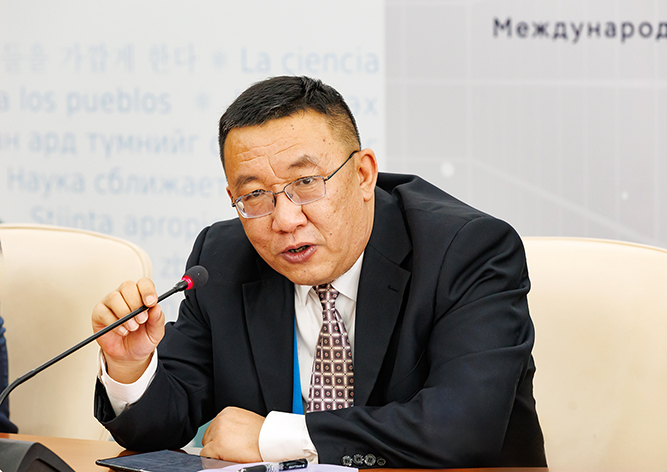
Since CSNS has been a co-organizer of this Conference for many years, how would you rate its level, the quality of the participants' reports, as well as the impact of this Conference on physics in China and on science, technology and physics in the world?
- I think that I first established contacts with FLNP employees in 2007, during the International Conference on Neutron Scattering. Then, Sergey Kulikov took part in its work, today, he is Vice-Director of JINR. Then, as far as I remember, he worked on simulating a cold moderator and I did a similar task. At that meeting, we focused on the design and key neutron scattering technologies to construct the facility. Later, in 2016, I visited FLNP for the first time and took part in the ISINN-24. This conference focuses on fundamental neutron research using such facilities. At the time, CSNS was still under construction.
I think there are two main topics in the scientific programme for IBR 2 and FLNP. One is neutron scattering for interdisciplinary sciences and the other is traditional: neutron physics and core structure. This is exactly the main topic of ISINN.
In 2016, only two institutes represented China at that seminar and only three people participated. However, as a result of this meeting, we established very close cooperation in the field of nuclear data measurement and research in the field of neutron physics. This time, about 20 people from China are participating in the Conference. Among them are not only representatives of CSNS, but also other institutes, for example, the Institute of Modern Physics of the Chinese Academy of Sciences, Peking University, Lanzhou University and other universities.
So, first of all, I think this meeting is very important for fundamental neutron research, nuclear structure research and nuclear data measurements. I think this is a very important conference on a global level. As for me, I myself do not directly work with nuclear data measurements but I have participated in many conferences on nuclear data in China. And the participants told me about the significance of this conference in their field. They hold their own conference on nuclear data, it seems, every four years, while ISINN is held annually. Therefore, I believe that this is a very important and necessary event in this area.
Two decades have passed since your first meeting with colleagues from FLNP and about ten years - since your first participation in the ISINN Conference.
- At that time, CSNS was in the design and construction phase, so we had little time for experimental work. But after the start of operation of our facility, we have more common interests and today, we can cooperate more closely. I think it's a good opportunity for our young people. This time, we have about ten participants from CSNS. With the exception of me, the rest are about 30 to 40 years old, that is, they represent the younger generation. Only one or two of them have been to Dubna before, the rest are here for the first time. This is a good chance for them to establish a strong relationship and cooperate with FLNP in the future.
What do you think about the current state of cooperation between FLNP and CSNS? What about the future, especially today, that the second phase of CSNS is launched? What areas of cooperation would you mark as the most promising?
- At the current stage, cooperation between CSNS and FLNP is focused, for example, on nuclear data measurements, since our Back-n facility currently functions. In FLNP, the measurement of nuclear data has a very long history. Scientists from FLNP have already carried out more than three experiments on the Back-n facility at CSNS and I think there will be even more experiments in the future. Just yesterday, I met with several young researchers from Peking University. Today, they carry out experiments at FLNP.
Another important area is neutron scattering. With the support of both sides, we have developed a larger programme aimed at supporting cooperation in the field of cold moderators, as well as an ultracold neutron source. Other areas include neutron optics, neutron detectors and electronics, sample environment systems and neutron polarizers. These are all key technologies for neutron facilities.
However, I believe that the most important area is the practical use of neutron scattering. Since last year, researchers from FLNP have carried out over five experiments at CSNS. Recently, CSNS staff has also visited FLNP and has carried out an experiment on IBR-2. Therefore, I think that we can expand cooperation in the field of neutron scattering techniques. It's a vast area and we have a lot of complementary strengths. And one more point: as you know, we currently design and develop our ultracold neutron source, discussing future experiments at this source. FLNP is the cradle of the use of ultracold neutrons, you have a very long history and a rich experience in experiments with UCN. We look forward to closer cooperation in this area.
You are talking about promising areas in which we could not only start cooperation, but have already started it. But what do you think about how this collaboration can be made even deeper and stronger in the context of the current scientific challenges? It may be necessary to create or develop administrative tools such as travel grants, to initiate joint funding applications, or something else.
- I think the first thing we need is to get to know each other better. As I have said, 20 years ago, I met Sergey Kulikov and 10 years later, we met again. Of course, we intersected at other international conferences. But I mean, both sides of cooperation should, first of all, know each other well: know what you are doing, what I am doing and what our common interests are. Then we can form the basis for cooperation. We also need support from some funding body, for example. Of course, we also need specific goals that will guide such cooperation. It means, more young people today come here and more young people from FLNP attend CSNS and carry out experiments on our facilities. It's a way to help people to understand and get to know each other better.
In your report on the UCN source at CSNS, I did not see a link to the main publication about it. Therefore, we would like to propose: if the CSNS group working on the source of UCN prepares a conceptual technical report, technical report or joint article on the concept of the source, then these materials could be sent for publication in one of the scientific journals of JINR. As you have mentioned, given Dubna's scientific expertise in the field of UCN and international relations, I believe that such work will obviously allow you to receive useful feedback and comments from reviewers and readers.
- I agree with you. In fact, last year, we were going to organize a meeting on the use of UCN in May of this year. But due to some circumstances, of course, one reason is that we are all very busy and have other commitments, this meeting has been postponed. In accordance with my plan, we would like to invite experts from FLNP. Perhaps in winter, when we start organizing this meeting, I would like to invite friends and experts from FLNP to share their suggestions and comments. We may have many options for the first experiments. I think we will make a list, estimate the prioritization of different types of experiments and we will also need to identify the advantages and disadvantages of our source.
Since there are many UCN sources in the world, we need to ask ourselves the question: what is our advantage? What experiments should we carry out at the beginning of our source exploitation programme? I think that in all these issues, FLNP and JINR could help us a lot. And I would also like to work more closely with experts from JINR and FLNP.
Thanks. Of course, I think it would be an honor for JINR and FLNP to take part in such an event. And we would be very happy to jointly consider a possible scientific programme for your source.
End follows
Alexander NEZVANOV,
Olga TARANTINA,
translated by Tatyana AVDEEVA,
photo by Elena PUZYNINA