
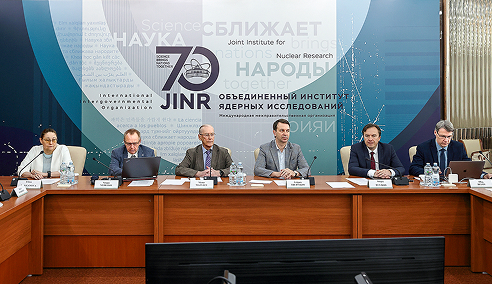
Information on the implementation of the recommendations of the previous meeting of the PAC was made by Chairman of the Committee D. Nagy. JINR Vice Director S. A. Kulikov informed about the resolution of the 139th session of the Scientific Council and the decisions of the Committee of Plenipotentiaries of the Governments of the Joint Institute (March).
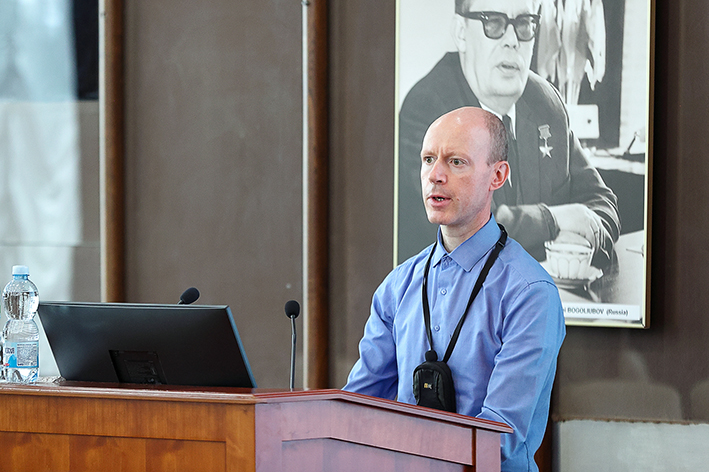
The report "The current status of the IBR 2 reactor, the prospects for its operation and the state of work on the development of a new promising neutron source for JINR" was made by FLNP Director E. V. Lychagin. (He has already introduced this information to the participants of the ISINN-32 Conference, the main points of his speech are set out in No. 27 of the weekly - O. T.). Head of the Department of FLNP D. P. Kozlenko spoke about the "Development of a neutron imaging and small-angle scattering spectrometer: completion of the imaging facility and the first results."
"Some time ago, as part of the development of our complex of reactor spectrometers of IBR‑2 it was decided to develop a new facility that would unite two experimental techniques: low-angle neutron scattering and neutron imaging (radiography and tomography),” Denis Petrovich commented on his message for our readers. “Today, in the user community, the low-angle scattering technique is one of the most popular, about 25-30 percent of requests go to this technique but we have only one facility for such tasks, and it is optimized to operate with the thermal neutron spectrum. In order to expand our capabilities, the new facility will be optimized to use the spectrum of cold neutrons on beamline 10A. It will be complementary to the current YMO small-angle scattering spectrometer and will provide more detailed information in the investigation of some classes of objects, in particular, large macromolecules. Also, cold neutrons provide an additional advantage for research in the field of neutron imaging, when neutrons are used to visualize the internal structure and meet problems related to non-destructive testing, flaw detection and materials science problems. That is why it was decided to develop a united tool with the possibility of using several techniques.
For a number of objective reasons, we had delays in the manufacture and supply of one of the main elements to complete the configuration of small-angle neutron scattering, a position-sensitive detector. Therefore, we decided to focus on completing the neutron imaging configuration, since all the components for it had been constructed. At the beginning of this year, the main components of this configuration were installed in working positions, including a neutron beam production system, a goniometer at the sample location and an sCMOS camera-based detector that allows for a high frequency of neutron imaging that is especially important for cold neutron investigations and allows for the implementation of energy dispersive radiography and tomography techniques. The fact is that almost all crystalline materials have specific Bragg jumps in the neutron attenuation coefficient that estimates the contrast of the neutron image. They are characterized by a certain wavelength, different for various materials and concern the peculiarities of their crystalline structure. In the area of the Bragg jump, the neutron attenuation coefficient can change several times. Thus, if we tune in to the Bragg jump for the element under study and analyze the area of the neutron transmission spectrum near the jump, we will thereby be able to increase the contrast for this component in the object under study against the background of other components and accordingly, study with greater accuracy the spatial distribution of this component in the object, defects inside and other features. For this purpose, it is important to use a fast neutron image registering chamber, since its operation should be synchronized with the reactor pulses and the response rate should be at least five times per second.
We have carried out appropriate experiments and showed that energy dispersive radiography and tomography techniques can be implemented in our facility. Thus, it can be used both for traditional applications, when we use the entire white neutron beam, but with a shift to the cold neutron spectrum that also provides a number of advantages for the contrast of some materials and for the development of energy dispersive techniques for more detailed spatial visualization of individual components by adjusting the chamber mode on the Bragg jump areas. It will give us new experimental opportunities that we can provide both for users and apply for the implementation of our own scientific programme that includes research of cultural and natural heritage objects, various structural materials, including cement materials, research of various engineering and technological objects.
The results that I talked about today were mainly obtained in the experiments of the last cycle of the reactor in April, we still need to carry out extra testing and finally work out all the stages of applying the technique. It will take some more time and perhaps next year, we will be able to implement such experiments in standard mode and use new opportunities both to meet our own scientific problems and the tasks offered by our user community."
MLIT Deputy Director O. Chuluunbaatar made a report on the project "Methods of computational physics for the investigation of complex systems" and Head of Sector of FLNP V. Milkov - on the project "Development of a wide-aperture backscattering detector for the HRFD diffractometer". Scientific reports were delivered by the leading researcher of FLNP M. Balashoy and a senior researcher at FLNR U. V. Pinaeva.
I asked the two most active members of the PAC present in person to comment on the central reports of the meetings - speeches by E. V. Lychagin and D. P. Kozlenko.
P. A. Alekseev
(Research Centre "Kurchatov Institute"):
"These two reports are bright, holistic. Denis's report on the development of the instrument base is very impressive because in my opinion, everything moves in the right direction of maximizing the opportunities provided by neutron sources. And Egor's report was very informative, deep and interesting. He comprehensively covered the situation with the new source where it goes. The Scientific Council or FLNP staff should, in the end, decide which option is preferable and accordingly, prepare for the development of an instrument base, taking into account all the expected parameters of the future neutron source, optimize future instruments. I can say: "Well done - both egor and Denis!"
In my opinion, the Committee meeting was very informative and interesting. I also want to highlight the speeches of young scientists, although the subject of their posters is diverse, they were all made very high quality. Young people go, I would say, to the world level."
A.S. Ivanov
(Laue-Langevin Institute, France):
"The central report of this meeting of the PAC was the report of egor Lychagin on the reactor functioning programme, how it operated in the first months after the restart and it was especially important to hear what the prospects for IBR‑2 for a long period were. We realized that the reactor operates reliably, there are practically no unscheduled shutdowns, the user programme is executed. Its resource is quite large and you can almost expect that IBR‑2 will still operate for 15, or even 20 years, starting from now. This period is also very important in order to be able to prepare a draft of a new source after IBR‑2 has to be shut down in terms of technical parameters. The design of a new source must be accepted and there is not much time left to decide what type it will be, which is very important, bearing in mind the timing of the design development and manufacture of this source. The essential point is whether a new type of fuel or an old, proven one will be used. This issue should be resolved in the next year or two by the laboratory Directorate with leading design institutes in order to start designing the source in time. That was the central point of the performance.
Just as significant was the report on the work on the development of new devices that is currently underway. We know that there is a working fleet of spectrometers and diffractometers of small-angle scattering. A project of a new instrument was proposed and has already been practically implemented that allows, on the one hand, to do neutron radiography and tomography, on the other, to implement research with small-angle scattering. So far, only the tomographic option is ready but there are plans to finish the low-angle one that was supported and recommended by the PAC. We have planned to be given a report at a future meeting on the next new instrument - the inelastic scattering spectrometer, since only one such instrument operates in the current reactor fleet. We need a device that will become a world-class spectrometer. We want to hear about how the design of this tool is going. All these projects were included in the agenda of the next Programme Advisory Committee meeting."
The poster session was attended by 13 young scientists from FLNF and MLIT. The first place was taken by the paper of M. V. Naumenko (FLNP) "Small-angle X-ray scattering (SAXS) and complementary techniques in the characterization of liposomal delivery systems for biologically active isothiocyanates".
According to the tradition established in recent years, Chairman of the PAC Denes Nagy sent his final comments by e-mail.
The main report of the meeting was the report of E.V. Lychagin on the prospects for using IBR‑2 and the state of affairs with the project of a new source. How did the PAC members rate it?
- The report of E. V. Lychagin was very well welcomed by the members of the Program Advisory Committee. The IBR 2 pulsed reactor has now entered its usual mode of operation - about 80 days a year with a thermal power of 1.45 MW. This has already made it possible to resume the work of the user programme on experimental facilities in the same volume. At the same time, there is a decrease in the number of new users from foreign research centres. Taking into account the realistic forecast of the reactor life that is calculated until 2042, under the optimistic scenario - until about 2048, the RCC considered the work on developing an improved neutron source for JINR extremely relevant.
In addition, the Committee considered it justified to revise the approach to the design of a new reactor in favor of technically more achievable solutions and supported the desire of FLNP to estimate the possibility of obtaining a significant increase in neutron fluxes in experimental facilities. The PAC also recommended FLNP Directorate to analyze the reasons for the decrease in the number of new users of IBR‑2 from foreign research centres and to develop measures to restore the attractiveness of facilities for international users. Finally, the PAC recommended constant systematic investigations of pulsed reactor dynamics, as an important fundamental basis for future neutron sources and simulating of typical facilities, taking into account advances in the development of new types of moderator and neutron optics and expects that new results will be presented at future committee meetings.
According to the report of D. P. Kozlenko. If I do not confuse, two or three years ago, the PAC recommended developing spectrometers in this area of research. Is the Committee satisfied with the result or is one new spectrometer not enough?
- To be more specific, your question obviously refers to the development of a spectrometer for neutron imaging and small-angle scattering. In fact, I'm also surprised how fast time flies: the forced shutdown of IBR 2 began on 16 October, 2021 that is almost five years ago. Low‑angle scattering has always been a bottleneck on IBR‑2. Therefore, we clearly need a second device in addition to the much-demanded YUMO spectrometer. Neutron imaging is a task of a very different nature, with rapidly increasing demands in many fields, including materials science and engineering and social and human sciences such as cultural preservation or archaeology. It is a welcome fact that both problems can be met with one tool.
The scientific reports by M. Balashoy, "Investigation of the structural properties of carbon fibers obtained from waste and their potential use" and U. V. Pinaeva "Functionalized track membranes for the electrochemical determination of toxic metals" were dedicated to environmental problems by and large. How did theCommittee members react to them?
- The PAC listened with interest to the speeches of M. Balashoy and U. V. Pinaeva and thanked them for their excellent reports. In addition, the authors were invited to consider submitting their articles to the JINR-created journal Natural Science Review.
Please, share your impressions of the atmosphere of the meeting, as well as of the meeting with JINR Directorate.
"I was really fascinated by it. As for the entire PAC meeting, all members of this body were very active. Admittedly, there were technical limitations due to some members joining the meeting from very distant time zones. The atmosphere at the PAC meeting, as always, was very positive and purposeful. As for the meeting with JINR Directorate, it was brilliant from a technical point of view. In fact, JINR Director G. V. Trubnikov was outside Dubna at that time - and yet he surprised us by getting in touch from the car with his absolutely meaningful participation for almost half an hour, including on numerous specific points set forth by him from memory.
Let me make some final remarks. First, I would like to emphasize once again that the "mini-conference" of young scientists has proven to be the best way to introduce the results of these researchers and in my opinion, we should adhere to this practice at future PAC meetings. Secondly, I would like to announce that Professor Hartmut Fuss (Technical University of Darmstadt, Germany) that was probably the most active member of the Committee in decades, has reconsidered his intention to resign and will work in the Committee for at least one more year. I am convinced that this is a great value for the PAC. Thirdly, I sincerely thank the Scientific Secretary of the PAC O. V. Belov for his professional work. Without his substantial contribution, the meeting would not have been possible. Fourth, I would like to highlight the work of the JINR IT Department. Their work is the most thankless, because it becomes visible only in case of technical problems; in the lack of such, it remains hidden.
Olga TARANTINA,
Photos by Igor LAPENKO