
Outstanding results, plans and prospects
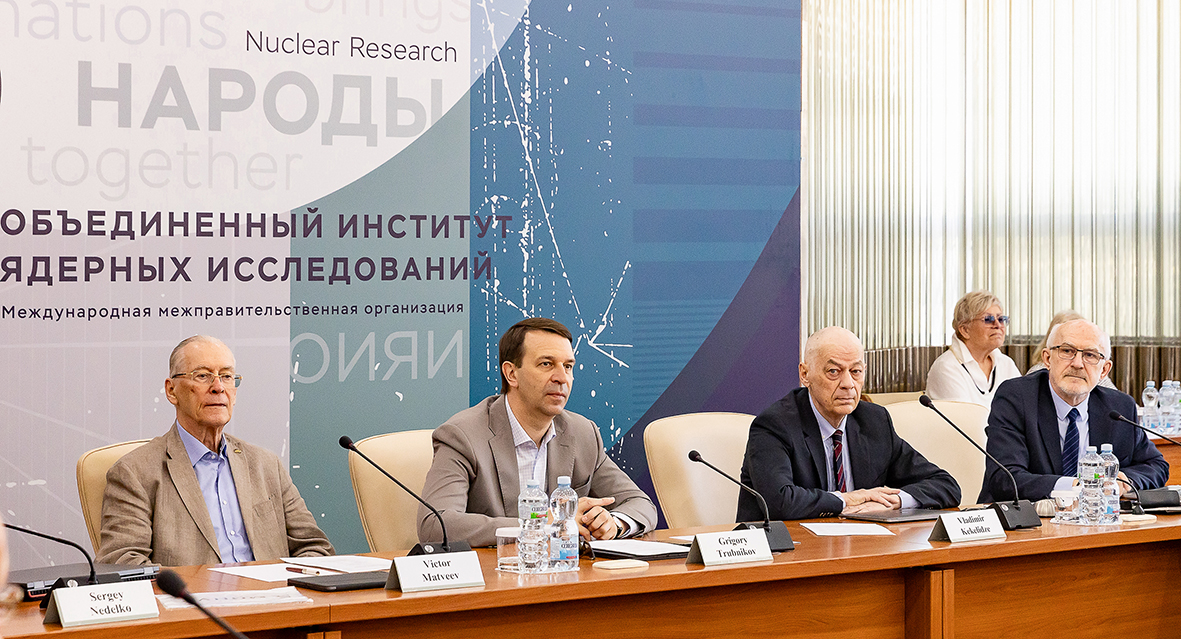
PAC Chairman Itzhak Tserruya presented an overview of the implementation of the recommendations adopted at the previous meeting. JINR Vice-Director Vladimir Kekelidze reported on the resolution of the 139th session of the Scientific Council, held in February and on the decisions of the meeting of the Committee of Plenipotentiaries, held in March. The Scientific Council supported all PAC recommendations to extend ongoing particle physics projects within the proposed timelines and rankings.
Deputy Head of the Acceleration Department for Research of VBLHEP Anatoly Sidorin spoke about the progress of work on the implementation of the Nuclotron‑NICA project.
"The accelerator complex presented the results obtained mainly after the previous meeting of the PAC," Anatoly Olegovich commented. “And the main of these results is to obtain a beam in both collider rings and to unite them at the meeting point. This is probably what the Laboratory has been striving for, for more than 20 years. We have carried out a fairly successful intensive meeting on fixed targets that primarily includes BM@N, this is one of the parts of the NICA project, as well as experiments by the ARIADNA collaboration, applied research. In addition, two new experimental stations SIMBA and ISKRA were tested with the beam. And after eliminating the detected comments, they are ready for regular operation."
The PAC experts highly appreciated these achievements of VBLHEP, also highlighted intensive preparations for the launch of the MPD experiment, modification of the booster design, elimination of vacuum leaks in Nuclotron, modifications of the beam transportation line between Nuclotron and collider, as well as improvements to collider systems.
Progress was highlighted in the implementation of the BM@N project that was reported by Head of the Department of Baryon Matter at Nuclotron Mikhail Kapishin. In the course of physical experiments in February and April, about 3· 109 interactions of Xe124 + Sn124 were registered at xenon beam energies of 1.6, 2.2 and 3.0 AHeV. The BM@N team focused on aligning the centre tracker, calibrating the time-of-flight measurement system and processing data to reconstruct events. Progress has been made in studying the production of Λ -hyperons, π ±, K ± mesons, protons and light hypernuclei in Xe + CsI interactions at an energy of 3.8 AHeV. An article on the production of Λ-hyperons in carbon-core interactions was sent for publication to the journal JHEP (Journal of High Energy Physics). At the moment, additional track and neutron detectors are developed for use with a bismuth beam.
The report on the implementation of the MPD project was presented by a chief researcher at VBLHEP Victor Ryabov. Over the past six months, significant progress has been shown in the development of this facility, today, MPD is in the final stages of construction and assembly. The superconducting solenoid magnet was successfully put into operation at a maximum magnetic field of 0.57 T. Magnetic field mapping at 0.5 T will resume in June, before the TPC sensor is installed. TPC assembly, leak test and high voltage tests are successful. In the MPD magnet, a carbon fiber supporting frame is mounted. The production of all ECal semi‑sectors has been completed and all 50 semi-sectors are installed inside the MPD. All the rest components for the first stage of MPD, including the time-of-flight TOF system, the front fast FFD detector and the front hadron calorimeter FHCal, are basically ready to be installed. Full assembly and equipping of MPD for data accumulation are scheduled for later this year. A comprehensive investigation of the possibilities of implementing a physical MPD facility programme is currently underway, the results of which are already presented in two articles prepared as part of the collaboration.
The next topic is the implementation of the SPD project. "The report presents the progress of work on the development of an experimental facility for the first phase of the experiment," DLNP Deputy Director Alexey Guskov said, “The main event of the year for the project should be the conclusion of a contract for the manufacture of a yoke of a superconducting magnet of a detector weighing over 1000 tons. Progress was shown in the development of SPD detector subsystems, in the development of computer infrastructure and project software." Testing of prototypes of the main SPD subsystems is underway. An international online seminar "Spin physics on the eve of the SPD experiment at NICA" was successfully held.
The first of the reports on projects ending in 2026 was presented by a senior researcher at VBLHEP Andrey Zaitsev on the state and future plans of the JINR group participating in the NA61/SHINE experiment at the SPS accelerator at CERN. During Ar + Sc collisions, a significant violation of isospin symmetry between u- and d-quarks was discovered during the production of kaons. For quantitative interpretation of NA61/SHINE data, a self‑similarity approach was developed, first proposed by A. M. Baldin. The Evaluation and Analysis Committee recommends that JINR's participation in the NA61/SHINE experiment to be extended until the end of 2028 with a B rating to allow the team to complete ongoing physical analyses and work on the project.
The progress report of the JINR group participating in the NA64 experiment was presented by D. A. a junior researcher at VBLHEP Dmitry Shchukin. NA64 is one of the world's leading experiments in the search for new physics below the electromagnetic scale. The PAC members supported the group's plans and recommended that JINR's participation be extended to A‑rated 2027‑2031.
The following is a report by a senior researcher at VBLHEP Alexey Aparin on the participation of the JINR group in the STAR experiment. "Active processing of the experiment data is underway," Alexey Andreevich told our newspaper. ‘There is an analysis of the birth of charged particles and particles with strangeness in the range of collision energies 3‑27 GeV to estimate the exact thermodynamic parameters of the nuclear environment developed in collisions of gold ions. Together with BLTP, prototypes are improved to describe the state of dense nuclear matter. The effect of residual charge on particle pair correlations has been found at low collision energies, allowing a more accurate description of the dynamics of particle pairs. Focus is on the training of young personnel: every year, within the framework of the project, theses are defended by the students of the basic departments of JINR in leading universities, primarily, Moscow State University, as well as universities of the Member States. Many young employees currently work within the project and after graduation from universities. At the moment, five master's theses are in preparation, the next defense is scheduled before the end of this year. The STAR group will be happy to apply all the accumulated experience in the analysis of experimental data from the NICA complex."
The PAC recognized the importance of training young scientists in heavy ion physics. In reference to the completion of the RHIC in 2025, the JINR team was recommended to gradually reorient its activities to NICA experiments. The PAC recommends extending JINR's participation in the STAR experiment until the end of 2027 with a B rating.
The report of MLIT Deputy Director Nikolay Voitishin on the project "Mathematical techniques, algorithms and software for simulating physical processes and experimental facilities, processing and analysis of experimental data" was taken into account. The project is aimed at organizing and providing computational support for research programmes with the participation of JINR, developing and improving mathematical techniques and software for simulating physical processes and experimental facilities, as well as processing and analyzing experimental data in the field of particle physics, nuclear physics, neutrino physics, radiobiology and other fields. It is recommended to extend the project for the period 2027‑2031 with a rating of A.
The participation of JINR in the AMBER fixed target experiment on the SPS accelerator at CERN was highlighted. "The first results of the AMBER experiment to measure the yield of antiprotons in reactions of interaction of high-energy protons with helium nuclei were presented," the speaker Alexey Guskov commented. “This data is required for the astrophysical search for dark matter. The results of the JINR group's work over the three years of the project were summed up and a work plan for the next three years was presented. Focus was on the participation of JINR employees in the preparation of the physical programme of the second phase of the experiment."
The PAC members endorsed the extensive physical programme of the AMBER experiment, the interconnection of the AMBER and NICA SPD experiments and the potential benefits of training young investigators. It is recommended to extend JINR participation for the period 2027‑2029 with an A rating.
The report on the participation of the JINR group in the JUNO experiment was presented by DLNP Deputy Director Dmitry Naumov. JUNO is the leading experiment to estimate the order of neutrino masses. The most accurate measurements to date of two key oscillation parameters have already been obtained. The work of the JINR staff is highly appreciated in the collaboration for its significant contribution to the development of equipment, software and data analysis. A significant number of JINR scientists hold positions on JUNO boards, committees and collaboration groups. Given the important contribution of the JINR staff to the JUNO experiment, it is recommended to extend JINR's participation in JUNO for the period 2027‑2031 with a rating of A.
The PAC was delivered a report by Artur Borodin on the project "Astrophysical research in the TAIGA experiment". In the reporting period 2023‑2026, three atmospheric Cherenkov telescopes and 200 m2 muon detectors were deployed at the observatory and the TAIGA-HiSCORE facility area was expanded to 1 [;km2. The JINR group plays an important role in the work of the observatory. It is recommended to extend its participation in the experiment for the period 2027‑2031 with a rating of A.
Further reports were presented on the results of investigations carried out by JINR groups in experiments at the Large Hadron Collider at CERN. B. V. Batyunya spoke about the new results obtained by the JINR staff in the ALICE experiment. The report on the participation of the JINR group in the ATLAS experiment was presented by I. V. Eletsky. The report of V. Yu. Karzhavin was dedicated to activities within the framework of the CMS experiment. JINR's participation, including young scientists, in these projects was approved.
At the poster session, the Programme Advisory Committee considered 23 reports of young scientists from DLNP, MLIT and LCTA. The report "Directed proton flux in Xe+CsI collisions at a beam energy of 3.8 AHeV in the BM@N experiment," prepared by a junior researcher at VBLHEP M. M. Mamaev was selected for presentation at the session of the Scientific Council in September, 2026.
The next PAC meeting for Particle Physics is scheduled for 25 January, 2027.


Galina MYALKOVSKAYA,
Photos by Elena PUZYNINA,
Igor LAPENKO