
Start of a big experiment, development of projects, modernization of facilities
Chairman of the Committee Valery Nesvizhevsky made a welcoming speech, after which he presented an overview of the implementation of the recommendations adopted at the previous meeting.
JINR Deputy Director Latchesar Kostov made a report on the resolution of the 139th session of the Scientific Council, adopted in February and the decisions of the JINR Committee of Plenipotentiaries, adopted in March.
An urgent topic was the experiment that had started on the synthesis of new elements. Two reports and a comment were delivered by FLNR Scientific Leader Yuri Oganessian.
Head of Sector of FLNR Vladimir Utenkov spoke about the status of the experiment on the synthesis of element 119 at the SHE Factory, "Experiments on the synthesis of a new element with atomic number 119 in the reaction of the complete fusion of berkelium-249 and titanium‑50 nuclei have begun at FLNR. For this, a unique isotope of berkelium-249 has been produced and a target has been manufactured at the Research Institute of Atomic Reactors (JSC SSC NIIAR) in Dimitrovgrad that has been transported to JINR. The experiment is held on the accelerator DC‑280 of the Superheavy Elements Factory and a gas‑filled separator GNS‑2. The duration of the experiment should be several months in 2026. The experiment will be carried out next year after reprocessing the current target, adding a new accumulated portion of Berkelium‑249 and making a new target."
The scientific report "Theoretical predictions of the nuclear structure and cross sections of the production of new superheavy nuclei with Z = 119 and 120" was given by the chief researcher at BLTP Gurgen Adamyan. "The single-particle potentials generated by the non-relativistic approach were incorporated into a microscopic-macroscopic prototype to predict the structure of superheavy nuclei. The self-consistent microscopic prototype was found to produce deeper single-particle potentials than those used in phenomenological prototypes and stronger shell effects at a charge number of Z = 120 than at Z = 114. Using the predicted properties of superheavy nuclei, we calculated the cross sections of the production of new superheavy nuclei with Z = 119 and 120 in complete fusion reactions with flying nuclei 48Ti and 50Ti. Our calculations inspire hope for the success of experiments on the synthesis of elements 119 and 120," G. Adamyan said.
The Committee emphasized the fundamental scientific significance of the work on the synthesis of element 119 and recommended FLNR Directorate to ensure the maximum possible concentration of material, technical and human resources for its successful completion.
The voluminous report "The current state of work on the development of a new promising neutron source for FLNP JINR " was presented by FLNP Director Egor Lychagin.
It follows from the report that at the moment, the IBR-2 reactor operates in a standard mode, about 100 days a year, with a thermal capacity of 1.4 MW. It allowed to resume the programme of work with experimental facilities at the previous powers. Under the current conditions, a realistic estimate of the service life of IBR‑2 is visible until 2040 and under an optimistic scenario - until about 2050. In this regard, the development of a promising neutron source for JINR is of great importance. To date, the efforts of the Laboratory have focused on estimating the possibility of a significant increase in neutron fluxes in the new reactor to meet the needs of experimenters. It implies the use of the current type of fuel and reliable design solutions implemented in the IBR‑2 reactor. The increase in flux is possible by increasing power, using a beryllium reflector, advanced optical neutron extraction systems and improved moderators.
The PAC is recommended to keep developing a promising neutron source for JINR. At this stage, it is recommended to optimize the design of the new reactor, moving to technically feasible solutions while maintaining high neutron fluxes.
The report on the project "Modernization of the EG‑5 accelerator and its experimental infrastructure" and the proposal for its extension were announced by Head of Sector of FLNP Alexander Doroshkevich. Progress has been highlighted in the modernization of the facility, in particular, the main technical systems of the EG-5 accelerator have now been improved: a vacuum system, a gas compressor, ARMS (Automated Radiation Monitoring System) and SBiS (Control and Blocking Systems) and design parameters have been practically achieved. By the end of 2026, the operation of the accelerator in its basic configuration is scheduled to resume.
To ensure the technical feasibility of implementing a scientific programme for studying reactions with fast quasi-monoenergetic neutrons, developing nuclear physics techniques for analyzing the elemental composition and meeting the problems of neutron radiation materials science, it is necessary to continue work on modernizing the EG‑5 accelerator. In 2027, a new ion source and an oil-free high-pressure pump station for the accelerator body will be installed. It is also scheduled to replace the nitrogen evaporator in the gas compressor system. These upgrades are expected to provide a maximum beam current of 100 μA at 4.1 MeV with a 500 eV energy dispersion.
The project for the modernization of the EG 5 accelerator and its experimental infrastructure is recommended for extension until the end of 2027.
BLTP Deputy Director Nikolay Antonenko made an interim report on the topic "Theory of nuclear systems" for the period from 2023 to 2025.
During the implementation, significant results were obtained in the field of nuclear structure research (including superheavy nuclei), dynamics of low-energy nuclear reactions and systems of several particles interacting with external fields. In addition, high-energy nuclear processes were studied in the context of preparing experiments on the NICA accelerator complex. An investigation on the quantum-mechanical description of collective angular motion in a system of two touching fission fragments was awarded the first JINR Prize for 2025.
The Committee emphasized the high level of publication activity and the successful involvement of a significant number of young researchers, as well as the development of close international cooperation. The need to continue strengthening the current international collaborations and developing new ones is emphasized. The results obtained in the main research areas were highly appreciated by the PAC members and recommended to continue work on this topic in close collaboration with the experimental groups.
DLNP Deputy Director Dmitry Naumov spoke about the JINR Neutrino Programme. The programme includes investigations of rare processes, the development of new types of detectors, the improvement of low background radiation technologies, radiochemical techniques of analysis, computational approaches and the current techniques of processing experimental data. Focus is on the flagship projects such as the Baikal‑GVD deep-sea telescope to search for ultra‑high energy neutrinos of cosmic origin and the highly sensitive JUNO observatory in China. An important area of the neutrino programme is dedicated to reactor antineutrinos. Their investigation allows not only to study the fundamental properties of neutrinos, but also to develop new techniques for monitoring the operation of nuclear reactors (DANSS and GeN ν projects). JINR is also actively involved in experiments to study accelerator neutrinos. The international NOvA experiment (USA) studies neutrino oscillations at long distances. Joint analysis of data from NOvA and T2K experiments allows us to clarify the parameters of neutrino mixing and to investigate a possible violation of CP symmetry in the lepton sector. A separate fundamental area is dedicated to the research of the nature of the neutrino mass and the issue of whether neutrinos are Dirac or Majorana particles (LEGEND projects and others).
The comprehensive strategy of the JINR Neutrino Programme that unites basic research, detector development, low background radiation technologies, radiochemical techniques, computational approaches and data analysis, was approved by the Committee members. Further expansion of international cooperation to develop these investigations is recommended.
The scientific report "Status and prospects of the MLIT scientific programme" was delivered by MLIT Deputy Director Dmitry Podgainy.
Focus was on the main activities of the Laboratory related to providing the Institute with network, computing and information resources based on the JINR Multifunctional Information and Computing Complex (MICC), as well as mathematical and algorithmic support for a wide range of research in the field of high energy physics, nuclear physics, condensed matter physics and other areas. One of the key activities of MLIT is the development of the JINR Digital Ecosystem that unites services for scientific, administrative and social activities.
At the end of the meeting, six brief reports in the field of nuclear physics by young scientists from FLNR were presented. Three were named the best: "Investigations of reactions 238U + 54Cr, 242Pu + 50Ti and 237Np + 48Ca at the SHE Factory," delivered by Dastan Ibadullayev, "Current status of 18 GHz and ECR‑source of ions DECRIS‑5M of FLNR JINR" given by Kirill Berestov and "Investigation of fusion‑fission processes and quasi‑directions using the CORSET spectrometer" presented by Aniruddha Dey.
The report of Dastan Ibadullayev was recommended for presentation at a meeting of the JINR Scientific Council in September, 2026.
The next PAC meeting for Nuclear Physics will be held on 28‑29 January, 2027.
Advisor to JINR Director, FLNR Deputy Scientific Leader Mikhail Itkis commented on several topics of the meeting.
What is the most important thing about the experiment on the synthesis of new elements?
- Probably, the most important thing we have heard is that our collaborators managed to prepare a substance for the target - berkelium in the designated period. It was produced for six months at the largest reactor in Russia in Dimitrovgrad and in general, there are only two of them that produce such isotopes in the world. According to the plan, the experiment was supposed to begin at the end of May. It began on 1 June. It is very important that we know how to meet the deadlines that is not so easy today. Of course, we will not say that we will get the result tomorrow. The experiment is long. There are different prerequisites - experimental and theoretical estimates that were also voiced today in reports. If you believe them 100%, then it takes about a year to achieve a regular result in order to get at least a couple of events of element 119. If you are optimistic, then you can get one event in four months. But let's not guess. The experiment is underway and will not stop until the target is in perfect order. We will type an integral that will allow us to speak when we finish element 119. On the other hand, when there is already a substance, then in a year, it will turn into californium that we need for the synthesis of element 120. This is a continuous plan until 2030. With any luck, we should get both elements by 2030.
How do you evaluate the Neutrino Programme?
- I think Baikal-GVD is a really great facility. We hope it catches up on accuracy and beats the IceCube. Everything goes on according to plan, the volume has increased to 0.7 cubic kilometers. As for our collaboration experiments, like JUNO and others, the employees from DLNP make a great long-term contribution and it is appreciated. There are problems, not so much experimental as interpretive - a set of statistics. Another important area at the Kalinin nuclear power plant, everything goes on well there, too, work continues that has long started. I think that neutrino physics in DLNP develops quite successfully.
What is special about today's meeting?
- It can be emphasized that today review reports from several Laboratories are presented: FLNR, DLNP, BLTP, FLNP, MLIT. We see the possibilities of each and it is very good that everyone has plans. Long-term plans. There is also an important traditional part, that is, our colleagues from the Member States are present online and in the hall. They are included in the discussion and, as always, are very active.
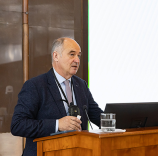
Valery Nesvizhevsky
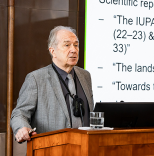
Latchesar Kostov
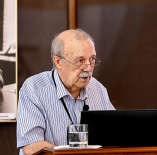
Vladimir Utenkov
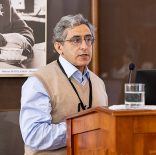
Gurgen Adamyan
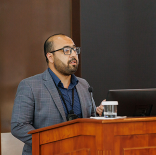
Dastan Ibadullayev
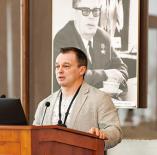
Dmitry Naumov
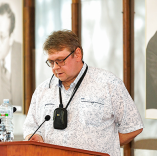
Dmitry Podgainy
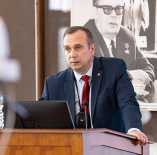
Egor Lychagin
Article by Maria KARPOVA,
Photos by Elena PUZYNINA