
Electronic english version since 2022 |
The newspaper was founded in November 1957
| |
|
Number 8-9 (4806-4807) SPECIAL REPORT
|
He was cautious even about trifles
In the late 1960s, with the advent of the new Director Professor A.M.Baldin, a promising programme started to be implemented in the Laboratory - the acceleration of high-energy ions at the JINR synchrophasotron.
Soon, the world's largest proton accelerator (with a maximum energy of 70 GeV) was launched in Protvino. Several large experimental facilities of LHEP (in the development of which we were also extensively engaged) began to successfully operate on a new accelerator. Groups of physicists from the University of California, Krakow, Bucharest, together with the physicists from Dubna, were engaged in the implementation of these experiments. The obtained methodological and physical results were reported at international conferences, published in prestigious journals.
In 1973, on the initiative of Alexander Mikhailovich, an experimental facility PHOTON was developed and began to operate on the synchrophasotron that includes the most advanced detectors and computers. Our Sector participated in the development of a large coordinate detector system for this facility.
In those years (late 1960s - mid 1970s), a unique atmosphere of creative upsurge reigned in JINR. Such as, at the "electronic" committees of the Institute (an analogue of the current PACs), where new projects were discussed and resources were shared, researchers carried out heated discussions with members of the Academies. And the Committee's decisions were often difficult to predict. Unfortunately, the era of "stagnation" that followed did not bypass our Institute either.
Alexander Mikhailovich was my supervisor for many years and most of the production issues were resolved with his participation. And almost always, the decision was made as a result of deep and comprehensive discussions. He focused on the development of detectors and electronics. He was cautious even about trifles. Once, when he was going on a business trip to CERN, I asked him to bring a few meters of special mesh to make a wire detector. And he brought. And a week later, we were already manufacturing this detector.
In 1977, the biologists from Moscow State University turned to us and proposed to jointly develop a device for radiochromatography based on coordinate particle detectors. Alexander Mikhailovich supported this initiative. A device was quickly constructed that allowed speeding up the process of research in this area hundreds of times. The investigation was awarded the Gold Medal of VDNKh and later - the Prize of the Council of Ministers of the USSR.
Director of JINR, Academician N.N.Bogolyubov began to receive numerous letters from the Academicians R.V.Khokhlov, V.A.Engelhardt, Yu.A.Ovchinnikov, N.N.Blokhin, B.N.Weinstein with requests for the development of instruments (based on detectors of nuclear physics) for biomedical research. JINR Directorate treated these requests with great attention. A.M.Baldin (then already an Academician) actively supported these investigations and the Academician G.N.Flerov supervised them under the USSR Academy of Sciences.
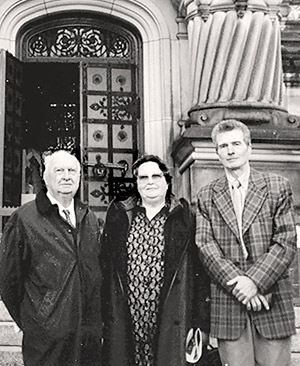 |
| A.M.Baldin with his wife Inna Sergeevna and Yu.V.Zanevsky in Darmstadt during a visit to the Russian Orthodox Church of St. Mary Magdalene, built at the personal expense of Emperor Nicholas II, on the land brought from Russia |
In 1995, we were invited to join the European HADES collaboration to develop a unique device and to carry out joint research on a heavy ion accelerator at GSI (Darmstadt). Significant physical results have already been obtained using the HADES device. And HADES is a first priority device that will start operating on SIS-100 (FAIR) after modernization.
Alexander Mikhailovich visited GSI in 1999, learnt about the operation of the SIS-18 accelerator in detail, about the use of a beam of carbon ions for therapy and the HADES device. In the evenings, he shared his impressions and memories. He talked about the work at the Lebedev Physical Institute, about the Academicians D.V.Skobeltsyn, P.A.Cherenkov, V.I.Veksler, M.A.Markov.
He extensively supported the idea of establishing a new modern laboratory (Detector Lab) in LHEP for the development and manufacture of coordinate detectors. Such a laboratory was founded in 2004 in the building 40 of LHEP. Many well-known scientists from the leading physics centres of Russia, Europe, the USA, China visited it and learnt about the technology of developing advanced detectors. More than a hundred cameras have been developed here for the largest transient radiation detector TRD ALICE and currently, the most complex track detector TRS is developed - the "heart" of the MPD facility for the NICA Accelerator Complex developed at JINR.
I was lucky that I worked in a laboratory headed by Alexander Mikhailovich for about 30 years. I learned a lot from him and he often helped me in my work and in my life.
Professor Yury ZANEVSKY,
February, 2011
