
Electronic english version since 2022 |
The newspaper was founded in November 1957
| |
|
Number 8-9 (4806-4807) SPECIAL REPORT
|
From CM to Nuclotron
The 90th anniversary of the birth of Alexander Mikhailovich Baldin is a good reason, especially in the current situation, to recall the business style of this magnificent scientific organizer, a brilliant theorist.
Almost his entire conscious life was united to the Dubna synchrophasotron. While still a student at MEPhI and later becoming an employee of the "reference laboratory" of V.I.Veksler at the Lebedev Physical Institute, he took part in the development of the theory of cyclic accelerators and became a co-author of the physical justification of the technical design of the CM (the CM object was previously called the synchrophasotron). In subsequent years, his creative activity was associated with the Lebedev Physical Institute. It brought A.M.Baldin a wide international fame and he was awarded the USSR State Prize for the paper "Photocomposition of pi-mesons on nucleons". A remarkable feature of Alexander Mikhailovich as a theoretical physicist was a deep understanding of the specifics of the experiment. The cycle of investigations on the research of the nuclear properties of light on the Dubna synchrophasotron, recorded as a discovery: the decay of the vector phi-meson into an electron-positron pair, actually determined the further creative activity of Alexander Mikhailovich Baldin at LHEPJINR.
In 1968, he was appointed Director of this Laboratory. What is the Dubna giant at that time, launched in 1957? Its design parameters had already been surpassed on foreign accelerators. The accelerators in CERN and the United States (Brookhaven) operate with a rigid focus on proton energy of 25 and 30 GeV, respectively. The closest rival in proton energy, Bavatron (USA), for an energy of 6.2 GeV, had completed the modernization. An unpleasant situation had developed - the Dubna synchrophasotron had actually lost its attractiveness for physicists. It needs an early modernization and most importantly, a multiple increase in the intensity of accelerated protons.
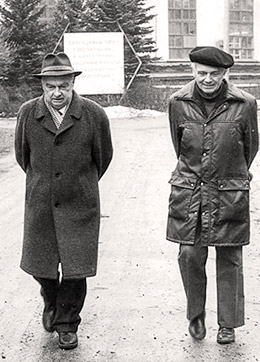 |
| A.M.Baldin and I.N.Semenyushkin |
The implementation of the scheduled programme required a clear organization. Almost the "headquarters" of LHEP had been the regular work of the Director's meeting since November 1968 under the chairmanship of A.M.Baldin. The focus was on fateful issues for LHEP: the development of the synchrophasotron accelerator complex, the implementation of the laboratory's obligations to develop physical facilities for research at the Serpukhov accelerator, the organization of its own research programme and the deepening of cooperation with JINR Member States.
The results of the modernization of the LHEP accelerator complex were summed up in 1982 by the Representative State Committee, "The Synchrophasotron in its parameters: energy of accelerated beams, the slow withdrawal complex, has a leading position in the world as an accelerator of relativistic and polarized nuclei and can ensure competitive research on relativistic nuclear physics and other physical areas for a long period. The efficiency of the accelerator, that is a simple 5-7 percent of the scheduled operating time of the entire accelerator complex, testifies to the satisfactory condition of the units and systems of the synchrophasotron and corresponds to the level of reliability of the best accelerators in the world."
For many years, the updated accelerator complex of the Dubna Synchrophasotron had been the only source of relativistic nuclei, as well as of the vector and tensor polarized deuterons with record energy. For research in relativistic nuclear physics and other areas, a wide range of particle beams, nuclei and polarized deuterons (20!) were available. It was possible to simultaneously carry out about five experiments, including online. The accelerator complex operated strictly on a schedule of up to 4,000 hours a year.
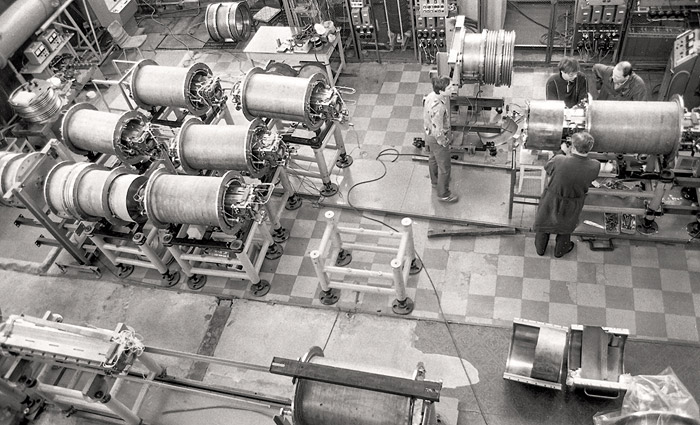
Assembly and testing of Nuclotron dipole magnets on work benches in LHEP, 1988
Recognition of the merits of A.M.Baldin in the development of modern theoretical physics was the award of the Lenin Prize (1988), the V.I.Veksler Prize of the Russian Academy of Sciences (1997) for the series of papers "Development of the Dubna Accelerator Complex "Synchrophasotron - Nuclotron"; development and implementation of a physical research programme in relativistic nuclear physics".
Alexander Mikhailovich possessed encyclopedic knowledge, was a great lover of poetry, an interesting interlocutor, an active public figure and in his youth - an excellent climber, master of sports, champion of the USSR.
Igor SEMENYUSHKIN, LHEP Deputy Director in 1962-1988,
February, 2011
