
Electronic english version since 2022 |
The newspaper was founded in November 1957
| |
|
Number 8-9 (4806-4807) SPECIAL REPORT
|
Academician Baldin, about how I remember him
By nature, he was a leader. It was evident in science, when he chose the most relevant research topics and when he headed the work of employees, unobtrusively setting out his vision of the problem and when he organized international meetings, various kinds of committees, scientific councils and even more so when he headed the staff of the largest laboratory of JINR.
His leadership also manifested itself in what interested and captured him in life. It was mountaineering - and he conquered previously inaccessible peaks, or poetry that captivated him - and he discovered new poets for himself, whose poems he read by heart. He was a leader with an active life position, always highlighted the achievements of Russian science and scientists, promoted new research areas, defended and promoted his research area - relativistic nuclear physics. It was a feature of his character - to do everything with full effort and emotions.
I first met A.M.Baldin in the late 1950s, as a graduate student in the Laboratory of Photonuclear Reactions at the Lebedev Physical Institute, where I was instructed to collect material on the energy distributions of photo neutrons. But I was more interested in the general problem of the interaction of photons with nuclei. People suggested that there, in the "nursery", on another accelerator, experiments are underway on the photo producing of peonies and that they are successfully explained by the active and knowledgeable theorist A.M.Baldin. And so, I went to him with questions. I was immediately surprised by his democracy. He, as if thinking aloud, moved away from my not relevant issues on the topic of a diploma and began to talk about the main thing, about the nature of the dipole resonance in the nuclei excited by photons, as one of the main ways of collective movement of nucleons. Starting from here, he believed that neutron yields should be explained as a decay process of this resonance. He was always interested in the basic physics of the phenomenon and if it was possible to reveal it, then the ways of meeting secondary, sometimes simply applied problems became clear. For me, it was an example of how to work in fundamental science. Then, Baldin became interested in a new, seemingly very bold idea to investigate the polarizability of nucleons and nuclei. Polarizability itself assumes the occurrence of the environment and at that time, nucleons were considered elementary particles, objects without an internal structure. But as you can see, Baldin worked ahead of the curve, focusing on new discoveries. As for the physics of nuclei, today, after more than forty years, the problem of the polarizability of nuclear matter has become very relevant both in astrophysics and in understanding the processes of motion of nucleons in nuclear matter and in building the theory of nuclear-nuclear interactions.
In the early 1960s, in BLTP, I unexpectedly met Baldin, advancing along the 4th floor corridor with a swift gait. It turned out that he headed a group of theorists here. He immediately spoke approvingly of our article that proposed a technique for calculating electron scattering by nuclei, in which the physics of the process was clearly manifested. For us, aspiring scientists, it was quite flattering.
In the 1970s, we welcomed Baldin as the new Director of LHEP. It seemed unusual that a theoretical physicist became the director of the experimental laboratory and everyone was waiting for how he would work in the new environment, what ideas he would bring to the laboratory. And they, these ideas, were expressed at once. In 1970, the acceleration of deuterons on the synchrophasotron was perceived by Baldin as a colossal success and a prelude to the acceleration of nuclei - here it is, a new and promising programme for research on LHEP. In 1971, Baldin put forward the idea of obtaining beams of high energy particles with relativistic acceleration of multiply charged ions. He introduced a new concept - cumulative reactions, they are already observed in LHEP and he linked them with the manifestation of quarks that make up the nucleons themselves. A new term appeared - multi-weld systems in the cores. In 1973, a new area is approved, called Baldin relativistic nuclear physics: science that studies complex systems with relativistic speeds of mutual motion of their constituent particles. Baldin and a team of specialists prepared considerations for the development of the JINR accelerator complex based on LHEP. In 1974, a new idea came: to develop another basic facility in LHEP, a new advanced Nuclotron accelerator. Baldin began to develop a theory of major invariance that brought a single basis for many phenomena in particle physics and in nuclear physics at high energies. It gave an impetus to the investigation of the same fundamental problems at both light and heavy ion beam accelerators and elementary particle accelerators. During this decade, he had made more than thirty reports at numerous Russian and international conferences, seminars and meetings, promoting this idea.
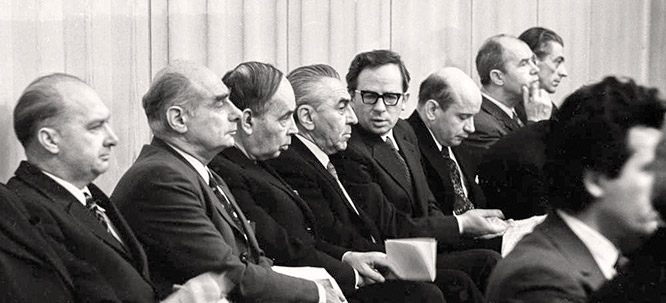
At the CP JINR session, Laboratory Directors A.M.Baldin, G.N.Flerov, I.M.Frank, V.P.Dzhelepov,
V.G.Soloviev, A.A.Tyapkin, ..., V.P.Sarantsev. 1974
In 1975, we found ourselves together in a group of JINR scientists and Soviet scientists at the Conference on High Energy Physics and Nuclear Physics, held in the USA. Baldin gave a report "On the interaction of heavy ions at high energies", talked about research on relativistic nuclear physics in Dubna. I saw how, with his characteristic emotionality, he defended the priority of the work of JINR theorists that had established the behavior of the structural functions of multi-welded systems, currently known as the "quark counting rules". Who could then know that after thirteen years, these investigations will be awarded the Lenin Prize and among the winners will be Baldin that contributed to "the establishment of dynamic patterns in the quark structure of elementary particles and atomic nuclei"?
The 1980s were apparently the most difficult years of Baldin's life. These were the years of the Nuclotron with superconducting magnet windings - at that time a new and little-studied way of effective acceleration. The unusualness of this case was also that the accelerator was developed mainly by LHEP. Usually, such major basic facilities were designed and manufactured by Sredmash institutes and enterprises - here everything was done on their own with the help of laboratory and central experimental workshops. On the shoulders of Baldin, as the director of LHEP, there was a huge responsibility and burden to knock out money and resources, to work with higher authorities, where he did not always find understanding. It was necessary to maintain the spirit and determination of the staff, especially, when it was necessary to meet the occurring problems both in the work itself and in organizing the cooperation of various structures that supported it.
At that time, scientific life at the Institute was closely intertwined with public one. Nuclotron was constructed during the years of perestroika, when party and trade union meetings were constantly held, the assets of specialists were collected to discuss the development plans of the Institute, its scientific and production base, housing construction, social and personnel issues. Baldin spoke a lot, explained the scientific policy and programme for the development of LHEP, dealt with issues of the life of the Institute and the country as a whole. And here he made full use of his outstanding abilities as a talented scientist, an experienced lecturer - a popularizer of science, an emotional person and capable of infecting an audience with his ideas. I must say that the party committees of LHEP and the Institute did a lot to implement the intended task - to put into operation this new basic facility. And in the early 1990s, it was launched and started operating on new experiments. It was a huge achievement.
And if we evaluate a person by his deeds, bearing in mind the principle: what came before him and what appeared with his efforts, then, in my opinion, Baldin could present from what he did in life, first of all, Nuclotron. He was its main creator "from and to", from the original idea of the principle of operation to the launch of the advanced basic facility, constructed by the efforts of LHEP staff mobilized and charged with his ideas.
Remembering Alexander Mikhailovich, one cannot but say about the style of his work as a leader. He was characterized by real democracy in relations with people, in his creative work he did not require petty and unquestioning subordination, when setting the task, he set out the essence of the idea and outlined a programme of action, he was interested in the result and everyone chose the ways and techniques of execution independently.
Thanks to A.M.Baldin's activity, such concepts and areas of scientific research as the cumulative effect, relativistic nuclear physics, the quark-parton structure of the nucleus, the extreme fragmentation of nuclei, the principle of weakening correlations in the space of four-dimensional speeds entered and became entrenched in science. All this, like Nuclotron, inextricably concerns his name and will always live in the memory of people that knew him.
Professor Valery LUKYANOV,
February, 2011
