
Electronic english version since 2022 |
The newspaper was founded in November 1957
| |
|
Number 8-9 (4806-4807) SPECIAL REPORT
|
Great scientist, organizer of science, strong personality
Our acquaintance with Alexander Mikhailovich Baldin lasted more than a dozen years.
As a student at Moscow State University, one of the authors of this article listened to a special course in nuclear physics by associate professor A.M.Baldin. The lectures were convincing and understandable, left a pleasant memory. Maybe also because then, on the exam, the knowledge gained was rated quite high by the lecturer. Outwardly, then Alexander Mikhailovich differed little from students. Behind his eyes he was called "Shurik". He was very mobile, even impetuous, obviously, it was the result of his passion for mountaineering. He treated the case with interest, with enthusiasm and even curiosity, in students he saw future colleagues and encouraged non-standard questions.
Until 1995, our communication was very episodic. They knew and heard quite a lot about him but he could hardly identify us among many other people. To say that we were fans of his talent and temperamental, flamboyant speeches at academic councils and seminars would be an exaggeration. Sometimes, he was repulsed by the sharpness which he expressed some of his ideas with. The discussion in the presence of Alexander Mikhailovich was often one-sided. Tolerance could hardly be considered the main feature of his character.
However, time passes and already in yourself you find the same weaknesses and behavioral motives which you were previously intolerant to. You begin to better understand people and therefore, treat them more respectfully.
This is not an easy task - to talk and even more so to write about Alexander Mikhailovich, a man with "a face with an uncommon expression". We quite often heard this line of the poet Baratynsky from him and he noticed and appreciated this very "lack of community" in people. But we also need to remember with gratitude about A.M.Baldin because there is an important anniversary ahead - the 90th anniversary of his birth.
Deep, philosophical approach
Even as a student, possessing an exceptional memory and being capable of science, Alexander Mikhailovich quickly reached a level where he could conduct scientific discussion on equal terms with famous, venerable scientists: D.V.Skobeltsyn, M.A.Markov, V.I.Veksler and others and therefore, was accepted into their circle from a young age. From Moses Alexandrovich Markov, he learned an informal, philosophical approach to physics, although he was rather skeptical about philosophy as such. This approach obliged to know what each specific investigation is for in general terms of physical knowledge, how it is associated with large fundamental problems. "What question do you want to ask nature?" - Alexander Mikhailovich usually asked experimenters. He considered it important to isolate the main thing. Without it, you can easily get lost in a great many small problems.
A.M.Baldin was constantly occupied with thoughts about the infinite possibilities of Nature. It looks extremely diverse and the amount of knowledge "embedded" in it really turns out to be inexhaustible.
Along with the inexhaustibility of matter, with its infinite variety, it is almost always possible to detect similarity in the behavior of some of its systems as a consequence of the so-called "automodality" of their properties. Here, we are talking about the special symmetry of the physical system with respect to certain variables.
Such a dialectical idea of the diversity and dissimilarity of systems and objects on the one hand and their similarity on the other also determined the scientific policy of A.M.Baldin. At the time of the physicists' craze for the idea of a "limitless" increase in the energies of interacting particles, it pushed Alexander Mikhailovich to look for other tasks. Namely, to stop in Dubna to study the interactions between nucleons and nuclei, and nuclei with nuclei accelerated to relatively low energies. Based on a deep understanding of the principle of similarity that often manifests itself as the independence of reaction properties from collision energy, A.M.Baldin was convinced that a detailed investigation of nuclear matter along with new properties inherent in nuclei would result in the discovery of effects found at extremely high energies in elementary particle reactions.
Note that not only the thought of similarity forced A.M.Baldin to oppose such an all-encompassing desire of large staffs of physicists for grandiose "construction projects of the century" in the field of particle acceleration.
Alexander Mikhailovich tried to compare the "race" of energies with the scientific problems of nuclear physics in the field of average energies, to delay the focus and interest of physicists in them. He felt that there were many interesting discoveries in this area. As we can now see, the discovery, for example, of new modifications of nuclear matter shows that these predictions are already confirmed. Thus, it is obvious that the research area, so successfully named by A.M.Baldin: "Relativistic nuclear physics" was chosen in the laboratory in a very timely and correct manner.
A.M.Baldin sought to create a machine for accelerating nuclei that would allow JINR to make its own independent and original contribution to science.
Do we need independent research in our age?
The question arises: is it really so necessary with modern globalization and internationalization of science to follow the path of independent research to a single Institute? After all, some experiments are extremely expensive. Pouring into the work of powerful scientific centres, our scientists, as it seems, for a moderate fee get access to participate in current major experiments and become participants in discoveries!
Why was A.M.Baldin against the "universal" hobby for CERN experiments, against the numerous and often unjustified trips of young specialists there, against the rampant export of materials and money abroad, as a result of which the LHEP experimental base, currently VBLHEP and the entire Institute was then extremely poor? Although, of course, it was further facilitated by the general decline of the economies of the JINR Member States in the 1990s of the last century. A.M.Baldin believed that in every country, especially, in such a large one as Russia, it is absolutely necessary to deal with advanced scientific problems. Therefore, first of all, you need to promote your ideas, to use and develop your capabilities for the benefit of your Institute and your countries.
Employees of each scientific centre should feel what it is to make discoveries on their own. And the role of the Joint Institute is significantly more relevant than the "subsidiary enterprise" of another institute - this is not why it was established. In addition, the experience shows that the greatest benefit and activity in the preparation and implementation of experiments and in the practical training of young specialists at CERN was brought by those people that by the beginning of their activities there, had already acquired experience and skills in the institutes of their countries, as well as in JINR.
It seems that only recently, Directorate of the Laboratory of High Energy Physics has realized the situation and gradually embarks on a difficult path of creating experimental groups and painstaking education of young scientists, as it was when the laboratory was established in the 1960s of the last century.
In the position of Director
Having assumed the post of Director in 1968, the theorist A.M.Baldin began to head the largest experimental laboratory at JINR. He was prepared for it because he was not alien to developments of an applied nature. So, even before taking the post of director, along with theoretical developments, he was engaged in purely practical problems, such as, calculating the motion of beams in accelerators, was a co-author of an important and useful book for experimenters on the kinematics of nuclear reactions.
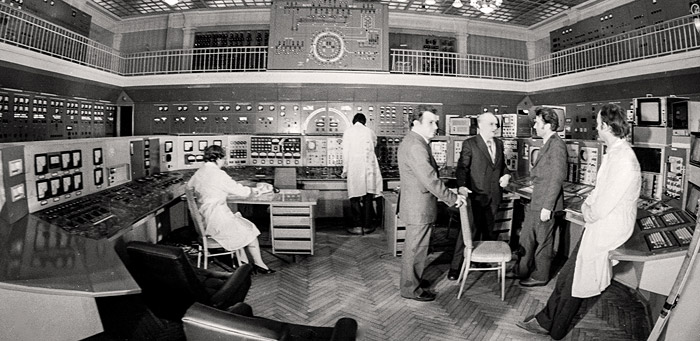
Central synchrophasotron control panel. Head of Department A.A.Smirnov, Director of LHEP A.M.Baldin,
Head of Sector I.B.Issinsky, junior researcher V.A.Mikhailov. 1981
A.M.Baldin did not manage the affairs of the laboratory formally, but deeply delved into all the problems, including issues of an engineering and technical nature. His efforts, as well as the selfless work of many engineers and technicians, were crowned with solid successes. On the old synchrophasotron machine, light nuclei were accelerated and polarized beams of deuterons were produced.
It is important to state that A.M.Baldin was a member of the team of authors of the synchrophasotron construction project and therefore, was among its leaders.
At a good pace that was set by an accelerator operating almost constantly for a whole year, the first results were obtained on collective interactions of particles in the nucleus, called cumulative. The effect of extreme nuclear fragmentation was also investigated. This effect is manifested in the fact that the spectra of secondary particles built in specially selected variables do not actually depend on the collision energy, that is, they turn out to be similar. Moreover, deviation from similarity usually indicates the appearance of new effects.
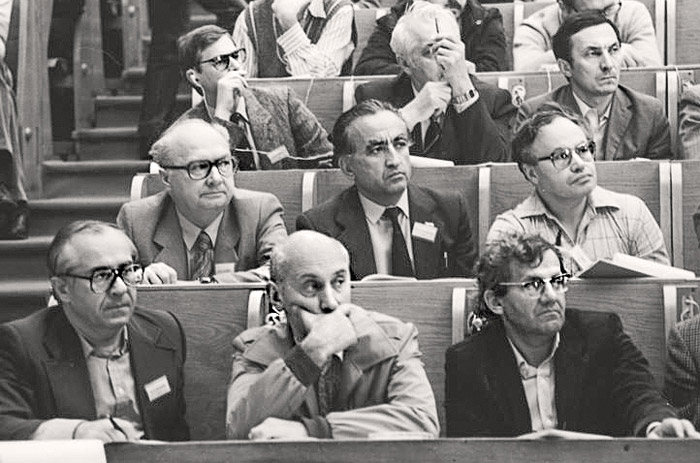
7th International Seminar on High Energy Physics. A.M.Baldin (left in the second row) and V.N.Penev (right in the first row). 1984
Development of Nuclotron
To confirm and to furtherly study the effects mentioned above, as well as to test his other ideas from the field of "vector dominance" (see below), Alexander Mikhailovich organized the construction of a new and for his time very modern machine called Nuclotron. This machine uses superconducting magnets to accelerate multi-charged ions to energies of 4-6 GeV per nucleon.
Thanks to the persistence of the Director and the tough style of his leadership, this machine was launched by 1993. However, since the Nuclotron was constructed in very far from favorable technical and financial conditions and it was not constructed by development specialists, but rather by the operating personnel of the synchrophasotron, many shortcomings were found in it. It turned out a combination of modern semiconductor, cryogenic technology with a rather outdated control.
A relevant improvement of the machine, namely the fast, cryogenic withdrawal of Nuclotron beams into the experimental hall, was already carried out without Alexander Mikhailovich under the supervision of A.I.Malakhov and A.D.Kovalenko. Thus, it was possible to carry out many successful experiments. It was followed by modernization of the cryogenic system and accelerator control systems.
Thereby, no matter what is said about the quality of Nuclotron, it turned out to be useful to the Institute and other accelerators are currently developed on its basis. To a large extent, thanks to Nuclotron, people got jobs, ranks, positions, privileges. It is possible that Nuclotron, due to its aging, will eventually serve only as a model for part of the new collider under construction that is also very important.

V.A.Matveev and V.D.Kekelidze at the anniversary rally at the memorial plaque to A.M.Baldin. 2016
Complex character
Needless to say, Alexander Mikhailovich's character was not easy. In his quest for victory, Director could even break the fate of those standing in his way. Intransigence towards people that had opinions different from his, sharpness towards the end of his life was aggravated by illness, as well as a constant "battle" when defending his own ideas and projects. In our conditions of sustained, often "undercover" struggle for the funds necessary for scientific experiments, it was required and even today it is required, that the leader has a strong will, a large focus of energy in one matter, a tough organization.
However, it is worth noting that a major scientist and organizer that also has a good and sweet character, is extremely rare! Alas, it is difficult to find a scientist-leader who, to some extent, is not subject to the temptation of recognition and fame, the desire to raise his ideas above others. In our country, these aspirations are especially manifested due to the poorly functioning system of turnover of managers. The administrative experience of many of them is comparable to the duration of their own lives.
Scientific "piggy bank" of Alexander Mikhailovich
A.M.Baldin managed to do a lot in science. Alexander Mikhailovich was a bright generator of ideas. In the piggy bank of his useful research and even discoveries, in addition to those already listed, there are others: for example, the prediction of the patterns of near-threshold photogenesis of mesons. For these investigations, he was awarded the USSR State Prize (1973). No less important was a deeper understanding of the vector dominance model, according to which gamma rays, in addition to their electromagnetic properties, also exhibit nuclear forces, that is, the properties of hadrons. Under the supervision of A.M.Baldin, experimental confirmation of this theory followed: the discovery of a direct photon-vector meson transition using the example of decays of vector mesons into electron-positron pairs.
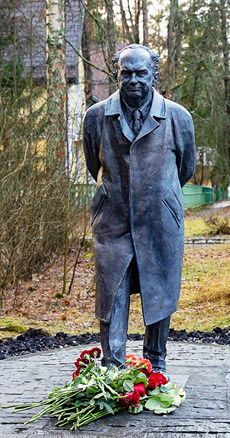 |
| Monument to A.M.Baldin on the Lesnaya street |
In ordinary life, Alexander Mikhailovich was a very interesting, respectful interlocutor, knew a lot of poems and expressively, he quoted them to the place. I recall his brilliant impromptu at various informal meetings, ironic jokes, like: "the truth always pops up, but sometimes up with a belly" or "a narrow circle of limited people" when he beat bureaucratic red tape, others.
A great scientist, an organizer of science, a strong personality Academician Baldin was highly appreciated by the state and society during his lifetime.
Recently, there have been different, including opposite opinions about whether it is necessary to erect a monument to A.M.Baldin in the city in which he lived and worked for a significant part of his life and became his honorary citizen? It seems it would be sacrilege to oppose it.
However, if we consider the situation with monuments and plaques in Dubna, then it may be better to postpone until the time when an order comes in this matter and a common sense appears. For example, when public participation will not be limited only to the selection of proposals for perpetuation, but also to the activity in selecting a sculptor and organizing public discussions of projects submitted to the competition. Funds for construction should be made up of donations from people and not only from the "institute treasury", then, the responsibility will be higher.
Perhaps, we should leave the issue of the monument to the descendants and certainly, agree that Academician of the Russian Academy of Sciences Alexander Mikhailovich Baldin was a brilliant scientist, in many ways, an amazing and a wonderful person. In addition, the best monument to a scientist or an artist is his achievements.
Alla SHKLOVSKAYA, Vladimir PENEV,
Sofia - Dubna, February 2016
