
Electronic english version since 2022 |
The newspaper was founded in November 1957
| |
|
Number 8-9 (4806-4807) SPECIAL REPORT
|
Awards
Oganesson in a duet with Chagall
On 20 February, the Oganesson Prize was awarded at the A.S.Pushkin State Museum of Fine Arts. The winners in 2025 were Honorary Director for Research at CEA (Atomic Energy Commission of France) M.Spiro, Director of the Institute of Chemistry and Problems of Sustainable Development of the Mendeleev University of Chemical Technology of Russia N.P.Tarasova, Director of the Institute of System Programming of the Russian Academy of Sciences H.I.Avetisyan, Chief Researcher at the Physics Institute of the Russian Academy of Sciences A.M.Semikhatov.
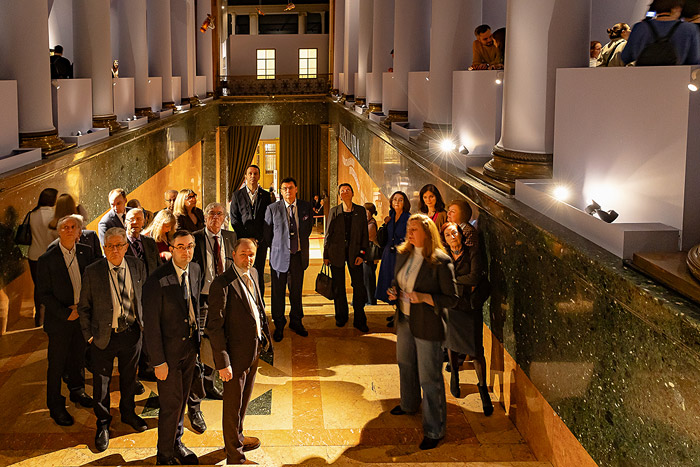
The members of the Prize Committee, the winners of past years, the employees of JINR, Russian and foreign research centres and universities gathered in the Italian Hall (Michelangelo Hall).
"The first prize was awarded in 2023 and according to the good tradition of the Russian Ministries of Culture, Foreign Affairs, Science and Higher Education, the Italian hall of the museum keeps hosting this ceremony," Director of JINR Grigory Trubnikov opened the celebration. "Let me remind you that the Prize was established by Yu.Ts.Oganessian. Yuri Tsolakovich is not only a pioneer in the synthesis of superheavy elements and in the research of the island of stability, but also the first winner of the Sberbank Scientific Prize in Russia that he sent to the annual support of young scientists in the field of natural sciences and popularizers of science. I greet everyone on behalf of JINR, where the Oganesson element was synthesized and especially the members of our Scientific Council participating in this ceremony."
"It is a great honor for me that I am still Chairman of the Prize Committee," Alexander Sergeev (National Centre for Physics and Mathematics, Sarov) said. "Recently, there have been more and more non-state awards in Russia. This is very important since the scientific community itself decides who to reward. Sometimes, it gives a double effect - Yuri Tsolakovich, having been awarded the Sberbank Prize, established his own. Maybe one of the Oganesson award winners will also establish a new award and this chain will continue. For me, the Oganesson element primarily symbolizes harmony, since it completed the next period of the periodic table and the synthesis of 120 will become a bright chord. This prize from a scientist for scientists and the current winners is a worthy addition to the bright galaxy of previously rewarded prizes."
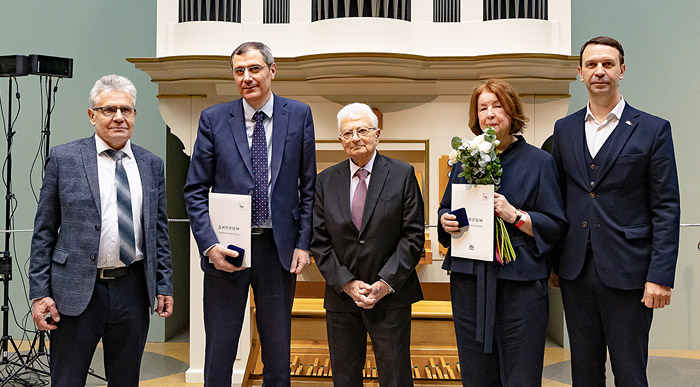
Alexander Sergeev, Harutyun Avetisyan, Yuri Oganessian, Natalia Tarasova, Grigory Trubnikov
As Grigory Trubnikov emphasized, out of four annual winners, one represents the foreign scientific community, although fundamental science has no borders and nationality. "The winner of our award was the wonderful French scientist Professor Michel Spiro that has long headed IUPAP, the initiator of the International Year of Basic Sciences for Sustainable Development. He achieved that at the UN General Assembly announced the International Decade of Sciences for Sustainable Development. Michel is a member of the Scientific Council of our Institute and we held the award ceremony at the just past session of the Council," Grigory Trubnikov said.
A.M.Sergeev recalled how he "had listened to a lecture by M. Spiro, where he said that fundamental science has no nationality. Sciences also have no boundaries dealing with global problems of sustainable development - climate change, pandemics and others. The decision made by the jury of the award this year is our tribute to the recognition of the merits of Michel Spiro."
Michel Spiro answered the questions of the weekly correspondent the day before, during the break in the meeting of the Scientific Council.
Do you think that basic sciences can influence sustainable development?
- Yes, I do since basic sciences are driven by curiosity, they fill the knowledge bank that future generations will use to meet problems. Quantum mechanics was developed on pure curiosity and 50 years later, we were able to produce lasers, transistors, stereo phones and everything else that we use today. Einstein's theory of general relativity seemed like pure speculation. Half a century later, we use GPS with general relativity.
Science reveals phenomena that predict technologies that improve our lives, serve humanity. Unfortunately, they can be used for evil. And humanity needs to make a choice how to use technology - to improve life or to destroy it, they can lead to the destruction of the world.
You have been cooperating with JINR for over 20 years. How did you feel when you found out that you had become the winner of this award?
- I am immensely proud, very honored that I became the winner of this award. I highly appreciate this decision because firstly, I love Yuri Oganessian very much. He is a very bright scientist, a wise and charming person. Secondly, I am happy that I am presented this award at JINR, which I have been cooperating with for many years. I love the Institute, since there is a spirit of science, driven by curiosity and a spirit of cooperation with the whole world. Here, science is open to all - all results are published, made available to anyone, wherever they work.
This is a good model, promoting cooperation and openness, to meet the problems of sustainable development. A collaborative approach opens up exchange with the whole world to combat climate change, to preserve biodiversity, to provide clean water and food for every person, the world for everyone.
Alexey Semikhatov could not participate in the ceremony. Grigory Trubnikov described him as an excellent scientist and a fantastic popularizer of science, at whose lectures there are never free places at the university. A.M.Sergeev recalled that Alexey Semikhatov works in such a "prayed" place as the Department of Theoretical Physics at the Lebedev Physical Institute, where another wonderful popularizer of science V.L.Ginzburg has once worked.
Grigory Trubnikov presented N.P.Tarasova not only as a wonderful scientist, but also as an outstanding organizer of world-class science, that for a long time had headed IUPAC. Natalia Pavlovna had dedicated her whole life to establishing a school of fundamental chemistry and educating young personnel.
"For me, you are, first of all, the leader of the movement that resulted in the year of the Periodic table, with the bright holidays of its opening in Paris and closing in Japan," A.M.Sergeev highlighted. "It was a triumph of Russian science, achievements of D.I.Mendeleev. It seemed to me that after this event, the world increasingly starts to call the Periodic Table the Mendeleev Table."
Yu.Ts.Oganessian warmly spoke about his meetings with Natalia Pavlovna at international forums.
"It is a great honor to be awarded the Oganesson Prize for work related to advancing the goal of sustainable development in international organizations," Natalia Tarasova thanked the Committee. "Sustainable development is the science of the boundaries that are allowed to humanity in order for life to be endless. What could be nobler than to provide for those living without preventing future generations from providing for their needs? This excellent idea appeared almost simultaneously in different countries, with the chemist and geologist V.I.Vernadsky in his investigations on the noosphere and with the cybernetics group D.Meadows (USA). The first real step towards science being involved in the cooperation of man, the environment and society as a whole was made by Academician V.A.Koptyug. As President of IUPAC in 1988-1989, he established the Chemical Research for Humanity Commission. We continued this tradition. "Green chemistry is a tool for achieving sustainable development goals" - this postulate was formulated by the Director-General of UNESCO. And today, the principles of green chemistry are taught in all chemical universities not only in our country, but throughout the world. Once again, I thank the jury and dear Yuri Tsolakovich for the fact that sustainable development has found such recognition. In an interview, I compared chemistry with the music of life, I can say that Oganesson is practically our scientific Oscar!"
Representing H.I.Avetisyan, Director of JINR remarked him as an outstanding specialist in the fields of information technologies, big data, trusted artificial intelligence and in addition, a person of great charm. The latter was confirmed by A.M.Sergeev, calling his impact on listeners a field of unknown nature. He stated that recently, H.I.Avetisyan and his colleagues had met the problem of diagnosing heart disease using a cardiogram that they had been engaged in for 50 years.
In response, Harutyun Avetisyan highlighted that artificial intelligence has already reached each of us, so educational work about it is necessary. "I am lucky to be engaged in science that is both fundamental, national and meets all global challenges. Today, no field of science is possible without artificial intelligence," he emphasized. "We still have scientific schools on a wide front - in physics, chemistry, biology, creating vaccines. The scientific schools allow us to calmly look to the future." And addressing to Yu.Ts.Oganessian and the members of the Committee, he said: "This prize is subject and this subjectivity is very important to me." And Yuri Tsolakovich thanked the Committee for the choice made, "With this choice, we paid tribute to Harutyun's teachers, the University of Yerevan, which he graduated from and the mathematicians of Armenia. Harutyun is also remarkable for his ability to simply talk about artificial intelligence."
In conclusion, G.V.Trubnikov sincerely thanked the Secretary of the Prize Committee, the Press Secretary of the Institute N.V.Zaikina, FLNR and the JINR Press Office for organizing the event, the embassies of the Member States, the colleagues from friendly institutes and universities for participating in the ceremony.
Probably, the very atmosphere of the Pushkin Museum introduced an artistic note into every performance that sounded that evening. And the participants from Dubna received a wonderful gift - a tour of the exhibition "Marc Chagall. The joy of gravity", breaking all visiting records these days.
Olga TARANTINA,
photos by Elena PUZYNINA
