
Electronic english version since 2022 |
The newspaper was founded in November 1957
| |
About what the newspaper wrote that day
40 years ago
No. 5 (2794), 29 January, 1986
The new building was also obtained by LCTA. Today, almost all the basic computers of the Institute stand here. Over the five-year period, the computer fleet has increased by three machines. Their development was not easy but by the end of the five-year period, the LCTA staff, with the help of specialists from manufacturers, largely coped with these difficulties and the machines currently operate more reliably. Qualitative changes also take place: work is underway to unite all ССС machines and computer complexes of laboratories into a single local network that will give physicists the opportunity to significantly increase the efficiency of their work, to accelerate the pace of preparing experiments and processing the obtained physical results.
Today, JINR Directorate considers the issue of including the Central Computing Complex in a large national and even international network of computers. Such a network is developed in the Soviet Union and the central distribution point located in Moscow has access not only to scientific centres of the USSR, but also to foreign centres. In the future, this communication channel can be used to work with CERN specialists on the DELFI programme.
* * *
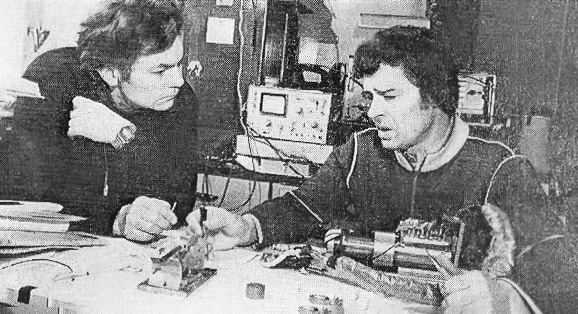
In 1986, the Topical Plan of Research and International Cooperation of JINR provides for the development of a facility and implementation of research of polarization phenomena in hadron interactions (PARUS project). The project involves specialists from Bulgaria, Poland, the USSR. Thus, a group of employees of the V.G.Khlopin Radium Institute (Leningrad) carry out research on nuclear fragmentation on synchrophasotron beams. One of the last experiments was implemented on a polarized beam of deuterons. In the photo: Head of Sector of the High Energy Laboratory of JINR, USSR State Prize winner V.A.Nikitin and a senior researcher at the Radium Institute V.V.Avdeichikov are discussing the design of a telescope made of semiconductor detectors. Photo by N. Pechenov.
* * *
Pilot production has developed to a whole new building that is equipped with technological areas focused on the development of especially large products, the production of wire detectors, printed circuit boards. Thus, the methodological possibilities for developing new large experimental facilities, nuclear electronics at the most advanced level have significantly expanded. It should inevitably affect the quality of the experimental technology developed at the Institute.
* * *
"International Dubna: 30 years of mutually beneficial cooperation" - this is the topic of the round table at JINR that is held today with the participation of journalists invited by the Press Agency "Novosti" from leading newspapers, magazines and agencies of socialist countries. The round table is attended by the members of Directorate, leading scientists of JINR. The programme of the three-day stay of journalists of socialist countries in Dubna includes a visit to the laboratories of the Institute, acquaintance with the life of specialists from the Member States and their work in JINR.
52 years ago
No. 8 (1921), 29 January, 1974
Seriously and businesslike, LCTA discusses the socialist obligations of groups, departments, the entire laboratory for 1974. The general laboratory socialist obligations include, for example, the following tasks: to provide 20 hours of average daily working time on a BESM-6 computer; to provide at least 4500 hours of working time per year on the SDS-6200 system, to measure 90 thousand events registered in the hydrogen bubble chamber on the scanning machine IIRD by 26 December, 1974.
* * *
The Theoretical Conference "The Future of science. Natural science and ecology" was held in Dubna organized by JINR and the Institute of Philosophy of the USSR Academy of Sciences with the participation of the Scientific Council on the Complex Problem "Philosophical issues of modern natural science" under the Presidium of the USSR Academy of Sciences.
An exchange of views took place between the specialists from different branches of science from the scientific centres of the Soviet Union. With great interest, the reports of a number of leading scientists of the Joint Institute were listened to, such as, Academician G.N.Flerov, Corresponding Member of the USSR Spider Academy D.I.Blokhintsev, Professors V.S.Barashenkov, V.G.Solovev, Corresponding Member of the USSR Academy of Sciences A.M.Baldin. The fundamental problems of modern physics were examined, the importance of their solution for scientific and technological progress, as well as of the preservation of the natural environment was emphasized in these reports.
68 years ago
No. 9 (20), 29 January, 1958
Many interesting and complex issues are met by the staff of the Department of High-Frequency Devices of HEL, headed by K.V.Chekhlov. The Department has sophisticated you-coil and electronic devices that allow one to accelerate protons in the accelerator to the calculated energy. By heading the acceleration processes of the synchrophasotron using electronic equipment, the Department employees make a lot of efforts to improve the operation of complex electronic circuits, with the help of which one can significantly increase the efficiency of the accelerator.
Columnist Irina LEONOVICH
