
Electronic english version since 2022 |
The newspaper was founded in November 1957
| |
Laboratory of Information Technologies
summed up results of 2025
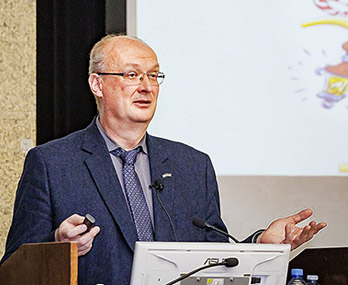
On 26 December 2025, a solemn meeting of MLIT staff members took place at the Meshcheryakov Laboratory of Information Technologies. Members of the JINR Directorate, Directors of the Institute’s Laboratories, Departments, and subdivisions also participated in the event. MLIT Director Sergei Shmatov and MLIT Scientific Leader Vladimir Korenkov presented the Laboratory’s major achievements for 2025, as well as plans for the upcoming anniversary year. The meeting concluded with an awards ceremony.
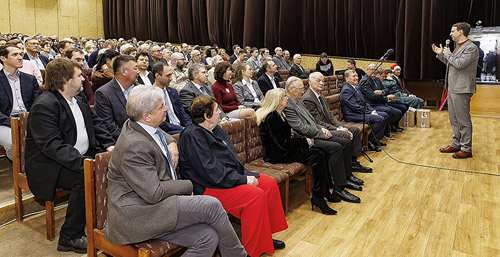
JINR Director Grigory Trubnikov welcomed the Laboratory’s staff members at the opening of the seminar: “The tradition of holding a final staff meeting with the participation of the Institute’s Directorate arose several years ago at MLIT. We come to these final seminars, listen, absorb the emotions you share, and celebrate your achievements and results.”
 |
| Sergei Shmatov |
The JINR Digital EcoSystem (DES), created and developed with the decisive contribution of MLIT, was enlarged with a number of new services. The completely redesigned PIN-2 with an updated design and additional user features was put into operation. The new document management service, DocMS, is available to users of JINR scientific collaborations and subdivisions. The system currently has over 225 users, and the number of documents exceeded 1,200. In collaboration with the JINR Laboratory of Radiation Biology and the Burnazyan Federal Medical Biophysical Center, the MOSTLIT web service for analyzing radiation-induced DNA damage was launched. In addition, services created at MLIT, such as the Map of Detector Technologies and the JINR Publications Repository, which was put into pilot operation, were recognized. In 2025, the Laboratory of Additive Technologies and 3D Modeling became fully operational at MLIT. The Automation Laboratory, which monitors all engineering systems, is developing. In the near future, it is planned to add the ability to predict the behavior of engineering systems and possible failures through the use of neural network approaches.
Among the scientific results, Sergei Shmatov underlined three MLIT projects carried out jointly with the other JINR Laboratories, as well as within international collaborations. These include a review of beryllium dimer computations for laser spectroscopy experiments and the modeling of its near-surface diffusion using beryllium alloys in innovative technologies in the electronic, space, and nuclear industries, including the ITER project. The other work is devoted to the search for dark matter candidate particles, the interpretation of the results within scalar and vector portal models, and comparison with the results of underground experiments. Another overview of articles focuses on studying the causes of Alzheimer’s disease at the molecular level.
In June, data storage systems on top of the EOS operating system for the experiments at the NICA collider, SPD and MPD, were commissioned. Each experiment received 7 PB, which is currently being utilized for the computational needs of these collaborations. The eos-mpd.jinr.ru and eos-spd.jinr.ru clusters have high bandwidth and fault tolerance and are located in dedicated racks of the MICC hardware module.
In July, in addition to hosting the 11th International Conference “Distributed Computing and Grid Technologies in Science and Education” (GRID’2025), a new stage of modernization of the “Govorun” supercomputer was completed at MLIT. Its total performance reached 2.2 PFlops, opening up new opportunities for applying machine and deep learning methods to tasks in particle physics, including tracking algorithms for the NICA experiments, the modeling of physics processes, analytics, and predictive modeling, as well as to tasks in radiation biology, materials science, astrophysics, etc. In particular, an outstanding result was obtained in the development of tracking for MPD using neural networks.
In collaboration with PNPI, Samara University launched a prototype of a distributed system for processing and storing experimental data for the SPD collaboration, which is the first one to actually operate for the experiments at the NICA complex. A significant step here was organizing the backup of Monte Carlo simulation data in the experiment’s data storage system: 200 thousand events and 500 TB of data.
This year, the performance of the JINR Tier1 site was increased by installing 17 new Nerpa Nord D5015 servers, bringing the total number of CPU cores to 23,360. The Tier1 grid infrastructure is employed for modeling, processing, and storing data from the megascience experiments at the NICA complex (BM@N, MPD, SPD), the JUNO neutrino experiment (2,000 cores with additional 1,600 cores allocated if needed), and the CMS experiment at the Large Hadron Collider at CERN. Moreover, among WLCG Tier1 sites for CMS, JINR continues to hold a leading position for several years. Sergei Shmatov emphasized that JUNO started physics data taking on 26 August, and just two months later, the collaboration obtained important results on solar neutrino oscillations, exceeding the accuracy of all previous global experiments combined, which were conducted over the past 50 years, by 1.6 times. These results were achieved partly thanks to JINR scientists and the Institute’s computing infrastructure.
In December, the modernization of Modules 1 and 2 of the JINR MICC was completed. 16 additional racks were installed, enhancing the cooling and power supply systems and optimizing the equipment placement.
 |
| Vladimir Korenkov |
Special attention was paid to telecommunication channels. At present, providing high-speed communication channels faces objective problems owing to the geopolitical situation worldwide. JINR coped with difficulties in maintaining communication channels caused by the suspension of Russia’s participation in the experiments at the LHC. In December, the Russian scientific network was disconnected from the GEANT network. This challenge was also overcome in collaboration with the CERN network service. Meanwhile, the outgoing traffic of the JINR network in 2025 almost tripled, reaching 90 PB per year, which exceeds Russia’s entire scientific traffic. Furthermore, it is crucial for MLIT to resolve the problems that the Baikal-GVD experiment is currently facing in the field of data transmission. Their solution requires laying a new fiber-optic cable under or around Lake Baikal and will be discussed at the upcoming workshop in Listvyanka in March 2026. In addition, in light of the start of data taking in the JUNO experiment, the issue of creating a direct communication channel with China is of strategic importance.
Vladimir Korenkov enlarged upon the development of the JINR Digital Ecosystem. The DES updates embrace a platform for remote radiation safety testing, the DocMS document management service, the redesigned PIN-2 system, parallel document approval in the Dubna EDMS, the integration of the Publications Repository and PIN-2, and the preparation of the document database for transfer to the Dubna EDMS. In addition, the Scientific Publications Repository features the automatic loading of data from new sources, developed algorithms for enhancing metadata quality, and a refined user interface. In geographic information systems, a room reservation mechanism was implemented, 44 buildings were mapped, and workstations for over 1,000 employees of MLIT, VBLHEP, and LRB were added.
Vladimir Korenkov emphasized that the JINR DES must reach a new level and provide users with analytical services through the implementation of artificial intelligence methods, digital assistants, and large language models. Next year, it is planned to realize this using the example of GIS and the Publications Repository.
Talking about the JINR Scientific Publications Repository, the speaker reported that in 2025, the Institute’s staff members had published 1,800 articles, 500 of which belonged to MLIT researchers. In 2025, MLIT hosted 35 seminars, with 70 talks delivered. The Laboratory’s staff members presented more than 150 reports at international and Russian scientific conferences. In 2025, 36 excursions were held at MLIT, introducing visitors of various ages and nationalities to the JINR computing infrastructure.
This year, MLIT conducted two important events dedicated to the memorable dates of the Laboratory’s founders: the 115th anniversary of M.G. Meshcheryakov’s birth and the 95th anniversary of N.N. Govorun’s birth, which was also marked by the publication of a book about Nikolay Nikolaevich. As Vladimir Korenkov highlighted, it was especially significant for MLIT that both of these events were held with the participation of relatives of the Laboratory’s founders. In 2025, the Quantum Computing and Machine Learning Workshop (QCML) was organized for the first time. The second scientific and practical seminar, HybriLIT Workshop 2025: Towards Efficient Scientific Computing, took place, and the Conference on High Energy Physics (CHEP-Yerevan’2025) was held with the participation of MLIT. The traditional JINR IT School was conducted. Remarkably, its autumn stage brought together a galaxy of prominent scientists as lecturers. The launch of a new course on applied mathematics and computer science at the MSU branch in Dubna and the start of training master’s students in its first program entitled “Data Processing Methods in Heterogeneous Computing Environments” became a notable event in training personnel for MLIT.
The Dissertation Council for IT and Computational Physics held three defenses this year: MLIT researchers Maksim Bashashin and Igor Pelevanyuk, as well as VBLHEP specialist Nikita Sidorov, successfully defended their Ph.D. theses. Another Ph.D. thesis, this time at St. Petersburg State University, was defended by MLIT researcher Irina Filozova.
In August, the Laboratory began the countdown to the 60th anniversary of its foundation. MLIT information platforms launched a series of historical essays, archival photo stories, and interviews with the Laboratory’s veterans. In 2026, the following scientific events will be held to mark the anniversary date: the Workshop on Mega-Science Computing for High Energy Physics (Listvyanka, 10-15 March), the Spring IT School (April), the MSU Universiade (April), the International Conference “Mathematical Modeling and Computational Physics” (6-10 July). And, surely, together with the entire Institute, the Laboratory will participate in celebrations dedicated to the 70th anniversary of the JINR foundation day (26 March).
Traditionally, a solemn awards ceremony took place at the end of the meeting. For contribution to the development of science and technology in Mongolia and long-standing fruitful cooperation with Mongolian scientists, Alexander Gusev was awarded the Government Honorary Medal “Advanced Scientist of Mongolia”, and Mikhail Matveev received the Honorary Diploma of the Mongolian Academy of Sciences.
Source MLIT
