
Electronic english version since 2022 |
The newspaper was founded in November 1957
| |
Their names - in the history of the Institute
Remembering Professor Yury Zanevsky...
This year, 1 January would have marked the 87th anniversary of the Honorary Professor of JINR, Doctor of Technical Sciences Yury Vatslavovich Zanevsky.
Yu.V.Zanevsky dedicated most of his work to the development of the Laboratory of High Energy Physics named after V.I.Veksler and A.M.Baldin. For many years, he headed the work on the development of automated detectors for experiments in high energy physics and for applied research.
In the early 1970s of the last century, on his initiative, a unique staff appeared in the HEL, focused on the development of detectors not only for fundamental, but also for applied research. A number of specialized facilities for crystallography, medicine and biology were developed headed by Yury Vatslavovich. In particular, detectors were developed and manufactured that allowed accelerating diffraction experiments with protein single crystals by a factor of two. With the help of these detectors, the structures of more than 200 single crystals of proteins have been studied at the Institute of Crystallography of the Russian Academy of Sciences with essential scientific results.
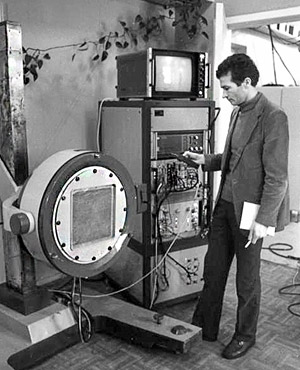 |
| Yu.V.Zanevsky. 1984. |
Significant results have been achieved in the field of neutron radiography. A position-sensitive detector for a polarized neutron spectrometer was developed. With its help, FLNP employees, together with the colleagues from the Laue-Langevin Institute (Grenoble, France) at the IBR-2 reactor, have carried out a number of investigations on neutron refraction and reflection in magnetic non-collinear environments, magnetic non-mirror scattering from multilayer structures and small-angle scattering of polarized neutrons.
A special merit of Yury Vatslavovich was the preservation and development of the staff in the difficult 1990s. Between 1990 and 2002, thanks to his organizational talent, the Imaging Detectors laboratory work was prepared, presented at five ICFA International Schools (Rio de Janeiro, Trieste, Bombay, Ljubljana, Leon/Mexico). Similar laboratory workshops were introduced into the educational process at the universities KTH (Stockholm, 1996), IEF (Debrecen, 2000) and UC JINR (Dubna, 2002).
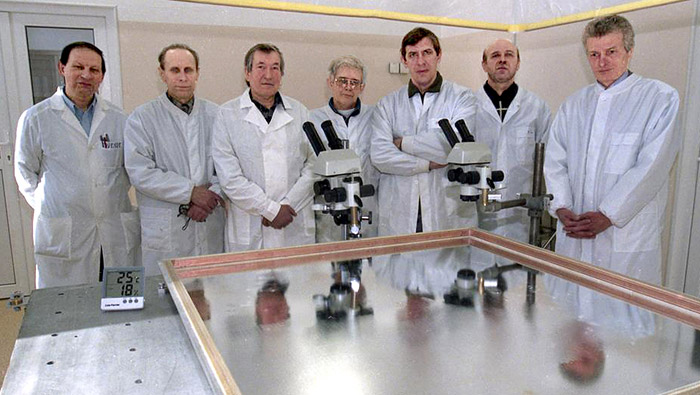
In the early 2000s, on the initiative of Yu.V.Zanevsky and under his direct supervision, a modern laboratory was established for the development, testing and manufacture of gas-discharge detectors based on multi-wire proportional chambers. An automated winding machine was developed that allowed winding wire with a diameter of 20-100 microns up to 2 meters long, as well as an automated stand for testing chamber parameters (estimating the uniformity of the gas gain, measuring the dark current, monitoring the percentage of O2 in the gas volume of the chambers). The capabilities of the laboratory allowed manufacturing and testing more than 100 chambers for the transient radiation detector of the ALICE experiment at CERN.
Within the framework of the European collaboration, the staff with head of Professor Yu.V.Zanevsky participated in the development of the HADES spectrometer and research on SIS-18 (GSI, Germany).
When JINR initiated a project to establish a new research centre based on the NICA Collider, Yuri Vatslavovich did not stand aside. With the consent of the staff and the head of the group S.P.Chernenko, he decided to actively participate in this work. During his lifetime, taking into account international experience, the concept and technical project of a time-projection chamber (TPC) was developed, that is, the main tracker of the MPD multipurpose detector, as well as its key subsystems: gas, cooling, laser calibration, high- and low-voltage power supply and a reading electronics system for 100 thousand registering channels.
After Yury Vatslavovich had passed away, the work was continued by his student Sergey Alexandrovich Movchan. After the approval of the technical project, the staff began the practical implementation of TPC with the participation of specialists from Belarus (BSU, INP BSU, IPCP BSU, others). Currently, the development and testing of a TPC for a multi-purpose MPD detector is in its final stages.
Time passes, generations change, yet the scientific and human foundations laid down by Yury Vatslavovich still live in the affairs of his students and colleagues.
Employees of Sector No. 1 of DMPD, VBLHEP
