
Electronic english version since 2022 |
The newspaper was founded in November 1957
| |
Gzhel - the technique of correct movements
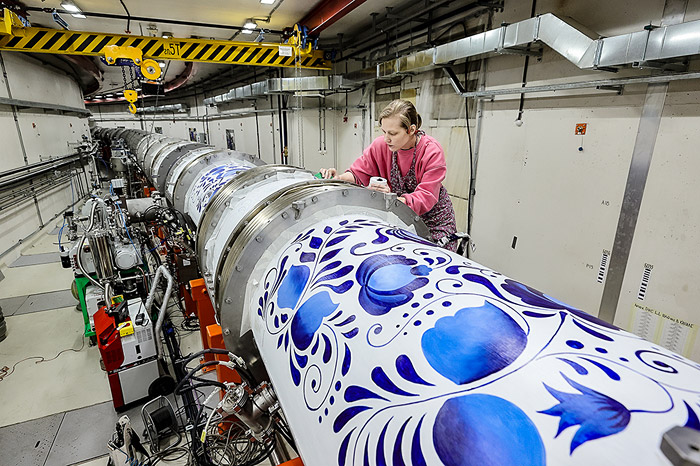
The NICA Accelerator Complex, painted with Gzhel patterns, surprised and pleased with this event. Original idea, professional execution, speed which everything was done with... Head of the JINR Artists' Club "Quarks-Sparks" Anastasia Zlobina spoke about how the work had developed, about her emotions and the features of monumental painting.
How did you perceive the task of painting a cryostat?
- I took it with great enthusiasm and in the best mood because the task was set on my birthday. Just a gift, given that I studied, first of all, precisely the technique of folk paintings. It implies a subtle mastery of the brush, something I love and can do. True, this object is unusual and large. But it did not scare me either because I like monumentalism.
It seems that the combination of a blue pattern on a white background is quite common in the world.
- It is true, similar motives, elements and colors are found in cultures of many countries. For example, in European porcelain: in Portugal, in Holland, in the Czech Republic. And also, in China and Mexico. Gzhel itself is well recognized in the world.
How did you make such a major project a reality?
- Since there was not much time for work, I decided to make a stencil. In this way, it allowed me to maintain the integrity of the composition and to make it diverse, constantly turning the stencil with different sides.
For more than a week, I ran between the workshop and the checkpoint, carrying with me huge parcels with updated sketches and superimposed them on the cryostat, trying to figure out how it would look. And finally, the sketch satisfied me and I immediately started applying it, having previously primed the surface.
With the help of a stencil, I outlined the composition, later, prescribed it with hand brushes. Gzhel is a technique of correct movements. If the hand is set and there is a good brush in it, everything will go like clockwork.
It turned out to be successful in choosing a shade of blue, it did not break out of the usual color of the cryostat and ultimately, I was convinced that Gzhel was a good idea for such a design.
The stencil did not lie on some parts of the cryostat due to the large number of protruding parts. I painted these parts without a stencil, leaving them to last.
What paint did you use, given the unusual nature of the painting? Was there a calculation for the long-term preservation of the drawing, or conversely, did you need to take into account the ease of removing the decor?
- It was decided to use acrylic paints. Although it is not the most suitable material for this surface, in our case, it was a question of making it easy to clean the cryostat from the pattern if necessary. The soil and paint are like a film, they have nowhere to absorb, so they are easily removed. But it is also a minus, since the surface is vulnerable to external damage. I warned about it. This problem can be solved if necessary, with a varnish coating.
How long did it take to paint?
- I started work on 20 November. By 19 December, it was necessary to finish. My performance is high, sometimes, I will get so carried away that I stand without water and food for 11 hours outside and draw. Unfortunately for me, experiments began at the NICA Complex by the time of my artistic activity and my visiting time was very limited. Saved the weekend, managed to do more for them. On 18 December, the stencil was moved along the entire pipe, except for sections with complex architecture, but to meet the deadlines, I invited Ekaterina Boytsova to participate and help in this unusual project. Katya is a wonderful artist and often travels with our club to the summer open air. A very responsive and combat person, works in the JINR Publishing Department.
What area have you painted?
- I have painted 27 sections of the cryostat. A total of about 30 linear meters.
Looking back, what was the hardest part of the job?
- Tearing off the protective tape when finished. All the components of the cryostat that were not decorated were covered with paper tape. In the process of painting, paint fell on top that glued it together with a dense film with a pattern. The separation of tape from the surface resulted in almost jewelry work.
And of course, I can't get around the very surface of the cryostat that is studded with different tubes, wires, handles, signs. Sometimes, in order to crawl over a vacuum pump, you had to show cat flexibility and from below you had to kneel at all. At some points, there was a feeling that we were doing yoga.
And what was the most interesting?
- Since the case was a particular one, before painting, I learned about all the nuances that may arise in the course of work, including in case of failure.
Here you are drawing on the pipe and inside it is -270 degrees, goosebumps run!
In general, I learned a lot of interesting things. And in the course of work I was learning invaluable experience!
And of course, this feeling that you joined the beautiful, looked at how everything works inside. Giant human labor! People every day, often in loud technological noise, do complex and painstaking work. NICA is a Megaproject and I am glad that I was able to join the cause that will glorify our city. Thank you for this opportunity!
Maria Karpova,
photo by Igor Lapenko
