
Electronic english version since 2022 |
The newspaper was founded in November 1957
| |
Spectrometers complex of IBR-2:
the new ones are developed, the old ones are modernized
On 19-20 January, the 62nd meeting of the Programme Advisory Committee for Condensed Matter Physics was held. It opened with traditional messages on the implementation of the recommendations of the previous meeting of the PAC, the resolution of the 138th session of the Scientific Council and the decisions of the Committee of Plenipotentiaries of the Governments of JINR Member States.
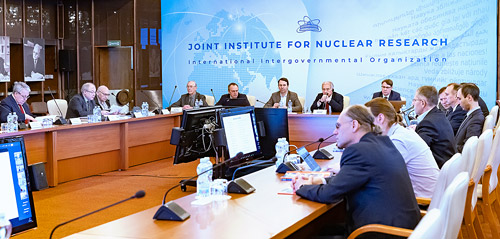
The results of the first cycles at the IBR-2 reactor were summed up by Deputy Director for research Bagdaulet Mukhametuly, the speeches of Head of Department Denis Kozlenko and the leading researcher Evgeny Goremychkin were dedicated to the complex of spectrometers of IBR-2. Alexander Nezvanov spoke about the scientific conferences in which the laboratory staff participated in 2025 and about the scheduled ones for 2026 at FLNP. Scientific reports were made by the senior researcher M.A.Zakharov ("Strict theory of diffraction on volumetric and surface-relief lattices"), the junior researcher M.P.Zarubin ("Dsup tardigrade protein as the basis for the development of radio protectors"), the junior researcher Nguyen V.M.Chung ("Positron annihilation spectroscopy in DLNP: modernization of the spectroscopy based on Doppler broadening of the annihilation line for beams of slow positrons and for research").
I asked Denis Kozlenko that presented the report "IBR-2 spectrometers complex: development plans for the period 2026-2030" at the meeting about why so many instruments were proposed to be modernized.
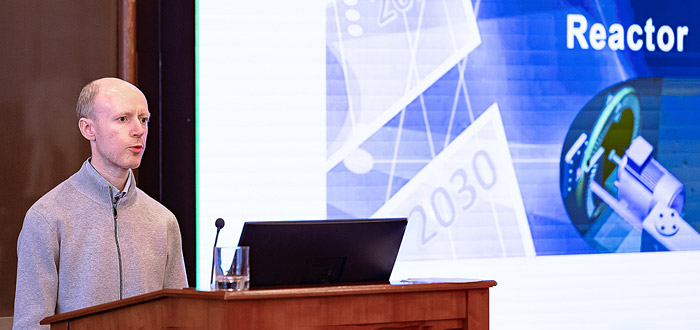
Denis Kozlenko
- The modernization of the spectrometers complex is almost constant, since there is an objective need and potential for improving parameters and expanding experimental capabilities in order to more efficiently implement the scientific programme and the user programme. Usually every five years, we update our plans, look at what has been done, what ideas are there for further improvements, what are the current needs and they also change. Based on it, we make plans for the next five years. If you look at the previous plans, many ideas were implemented that allowed significantly improving the parameters of our instruments and the quality of research.
Do you prioritize modernization?
- Absolutely. Proposals for the development of instruments are considered as a priority, since in fact the amount of funding is always limited. We have to choose the most important thing.
Do new instruments also have the first priority?
- Of course. For example, for the new small-angle scattering and imaging spectrometer that we currently develop on beamline 10. Almost all the basic components are already available. Moreover, for fashion imaging (radiography and tomography), at present, they are installed in an operating position and the first test experiments will soon be scheduled. There is a problem with the delay in the supply of a position-sensitive detector for small-angle mode. When it is decided, it will be possible to start completing the development of this mode of the spectrometer.
As for the BJN spectrometer, this is one of the first-priority subprojects included in the project of the large research infrastructure of FLNP JINR "Pulsed neutron source and spectrometers complex". We lack inelastic scattering spectrometers and the development of this instrument with world-class parameters will significantly expand our capabilities for research in the field of condensed matter dynamics.
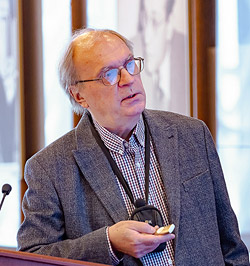 |
| Evgeny Goremychkin |
- I will start from afar so that it is clear what it is about. There is a task of studying the atomic, magnetic and molecular dynamics of complex substances. The BJN instrument is developed to meet problems in this area. There are such instruments in many centres: in JINR, in ISIS (Great Britain), in SNS (USA), will be in CSNS (China) and in ESS (Sweden). It is a worldwide practice to have instruments of this kind to study the vibrational dynamics of various substances, including pharmaceuticals.
The fact that such an instrument is needed is unambiguous. And if the instrument is 35 years old, it needs to be replaced with a new one - this is what they do all over the world, technologies develop very fast. A few years ago, we decided that we would develop a new inelastic neutron scattering spectrometer in reverse geometry with a high aperture in Dubna. This is not a cheap pleasure but an extremely necessary one. Among the Committee members is Sasha Ivanov from the Laue-Langevin Institute in Grenoble, he designed the Lagrange instrument several years ago. The geometry of his secondary spectrometer inspired us to develop a similar instrument but not a copy, since a stationary reactor operates in the ILL and IBR-2 is a pulsed source.
We have come up with a new reflective surface. It exactly matches the time and energy focusing conditions that allows "catching" almost half of the neutrons scattered from the sample. This is an impressive parameter, often only a tenth of such neutrons are "caught". No current and projected instrument in the world has such a solid angle.
When are you completing the spectrometer?
- This is the most difficult question that I have no answer to now. When we started all this, there were certain agreements but the situation has changed and we need to look for new opportunities in supply. We need to find a company that will provide "hardware" for cryostat and other equipment and in my opinion, it is not a trivial task. We will try to meet it together.
Committee member A.S.Ivanov (Laue-Langevin Institute, France) shared his impressions of participation in the meeting.
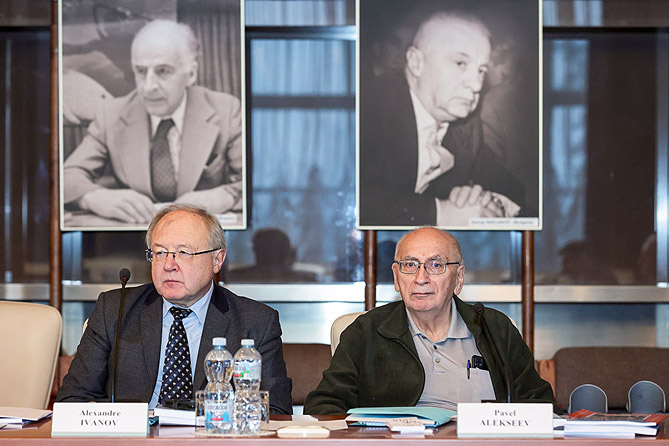
A.S.Ivanov and P.A.Alekseev
"I am following with great interest the development of the project of one of the FLNP spectrometers that is called BJN. This is due to the history of the development of spectroscopy in Dubna, with the names of Polish scientists standing at its origins - A.Bayorek, E.Janik and I.Natkanets. By the way, I did my first work in Dubna, on the spectrometer developed by Irek Natkanets. Today, another device is currently constructed at FLNP, using such a funny property: focusing a beam scattered to a fairly large angle into a relatively small one. This idea was originally used for one of the ILL spectrometers, called Lagrange, as it is a large graphite analyzer.
Here the idea was modified for the time-of-flight technique property of a pulsed reactor. On the one hand, it is good that the already time-tested focusing principle is used, on the other hand, it is adapted to another technique that is widely used at your Institute. It seems to me that this device has very good prospects, even according to preliminary calculations, it should be 200-300 times better than the current one. It will open up much more capabilities for researching various materials even in small quantities that previously could not be done, at least on FLNP spectrometers.
It seems to me important that this is a new device based on a new principle - a component of a small part of the new tools that are currently developed in the laboratory. The reactor has 14 experimental devices and there are only three projects of future new instruments and one of them is a BJN spectrometer. I would like devices of this class, based on a new principle and colossal increasing capabilities, to become increasingly popular in the development of the FLNP instrument base. Its development programme exists and is currently implemented and it was reported by D.P.Kozlenko at this meeting but it is largely related to "horizontal" expansion when they try to improve current devices. It is good, it is important but the development of new devices, with new characteristics that improve capabilities not by a few percent but at times, tens, is an additional vector of development. It should not be forgotten and we will try to look for opportunities not only for the development of current devices but also for the development of new ones. This is what I would like to wish the laboratory."
***
The young scientists from FLNP, BLTP and DLNP made poster reports at the 62nd meeting. The best of the 16 speakers were the FLNP employees - the junior researcher Evgeny Kolupaev ("Development of reflectometric techniques in oscillating magnetic fields on the REMUR polarized neutron spectrometer"), the researcher Polina Kobchikova ("Interatomic machine learning potentials for molecular crystals of flexible organic compounds") and the laboratory assistant Polina Gergelejiu ("Ibuprofen vibrational spectroscopy: experimental features and DFT calculation").
Olga Tarantina,
photos by Igor Lapenko
