
Points of contact of the worlds
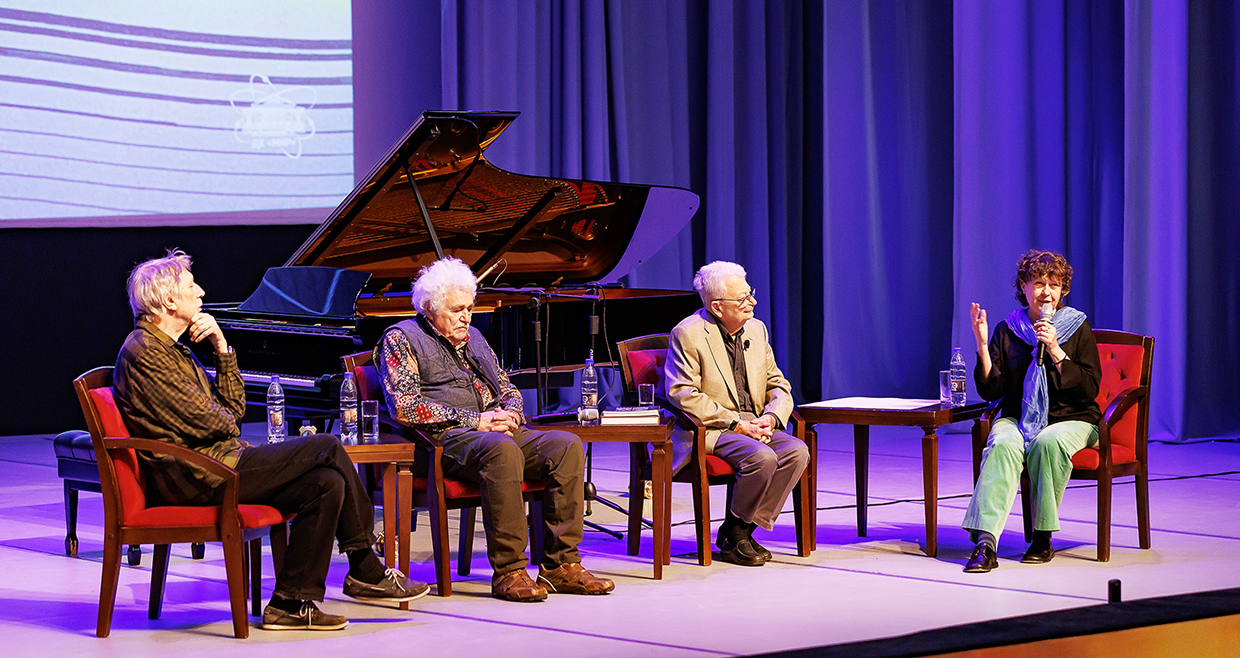
The topic of conversation was the search for infinity, the nature of creativity and ways of knowing the world. The meeting was organized by JINR and the Veretevo Art Estate as part of the ArteFakty Francisco InFante exhibition at the JINR Gallery. The conversation was conducted by art critic and Art Director of Veretevo I. G. Gorlova.
"JINR Gallery became the first professional space, beautiful and high‑tech," Irina Gorlova began the conversation. “Discussing the project of the first exhibition, I immediately thought about Francisco, and when he came to see the hall, I realized that he was created for him. Francisco is a pioneer, his art began in the 1960s, a time of upheaval and great discoveries in science. Why exactly during this period was there a turning point in art? It's not just about the "thaw", it's a time of accomplishment and discovery. Art and science have different goals and development paths. The launches of the first spacecraft affected Francisco's consciousness. At the age of 16, he made his first work - a metaphor for the infinity of the world, and all his work is a constant experiment."
"Since I have been living in Dubna for 70 years, first of all, I want to thank the audience who came today," the word passed to Yu. Ts. Oganessian. “Many of you have already visited the exhibition of F. Infante, which we are grateful to him for. I am not an art critic, although I am interested in art and I will say that this is a wonderful artist. With Vladimir (Martynov - Ed.) we met only today, I hope he will still come to Dubna, we have a grateful audience. And the topic of finding points of contact between science and art was chosen with a big swing, you can hold more than one meeting." Touching on the concept of infinity so beloved by Francisco, Yuri Tsolakovich stated that it can be different depending on whether it is about science or art. And he recalled that they were interested in this problem back in Ancient Greece: Aristotle was looking for infinity in small things, and Democritus was the first to understand that there should be an indivisible "brick" - an atom, and it took almost 20 centuries to understand that there are even smaller bricks of the universe. As well as the chemical elements which our world is created from, or the letters of the alphabet that form the diversity of language. There are abstract concepts in science, Yu. Ts. Oganessian emphasized but it always operates with proper results in the process of knowing the material world around us. Art is entirely based on abstract thinking.
"Now, I don't think about infinity," F. Infante entered the conversation. “I have never thought about it at all, I felt involvement with it when I was young. I thought it was sufficient that the world was infinite." He noticed that ultimately the artist comes to a metaphor, trying to express his feelings through it, and he also needs feedback. You can't live your whole life in isolation and be an artist. "I know that in science right now, intuition is not a thing to appeal to. In quantum mechanics, as far as I know as a layman, there is an idea of infinity, but it is not fundamental, because it is not known whether it is or not, whether the world is infinite or not. If an artist creates a theory in his mind and follows it, simply illustrating, then the result will not be very good. For me, the word "illustration" has a negative meaning." When scientists, Francisco said, begin to illustrate their established theories, then art fails. The artist always feels whether the metaphor turned out or not. The most important thing is to create a metaphor that is evidence of what he has some idea of. 'It's a very complex mechanism, I don't know how to explain it in words. Indeed, you begin to understand that a spoken thought is a lie. Everything is presented in metaphor, but in words it is impossible to convey everything in its entirety. Metaphor is a word that I respect," the artist emphasized.
As Yu. Ts. Oganessian recalled, when physicists took up the microcosm, they realized that this is a completely different world, different from ours, with different laws and speeds. To his question to Francisco, "When you talk about infinity, do you imagine another world?" he replied: "No, in my opinion, this is our world, these are my impressions of this world."
"At one time there was a fashion for installations, and everyone did installations," Francisco shared his thoughts. “I am now sitting between science and philosophy, I do not speak either scientific or philosophical language. I try to make art, art is closer to me. We retroactively discuss or distinguish some things, and the rear number is very good for distinguishing something, while it is very difficult to explain what happens today.
Many currently do not perceive something as art, in the future, it becomes art, oddly enough. It happens that the artist stands at the "gate of truth" (I symbolically call it, in general in art everything from symbolism), this moment cannot be organized in a strong‑willed way. One artist can stand with them once, the other twice in a lifetime. Many confuse art with craft, art gives rise to new meanings that are not always clear at birth. It seems to me that Picasso stood at the "gates of truth" many times, but not at the end of his life.
We think we are the blacksmiths of our own happiness. Not a bit. There is some kind of predestination, there are higher powers, but there is no need to rely on this, then a person is completely deprived of the ability to act and ceases to be a person. You feel that something high is present against our will. We are exhibiting with my wife Nonna, she is my colleague and co‑author, we do everything together in art. In our being with Nonna, I personally, I believe, stood at the "gate of truth" twice. The first time I was engaged in infinity, and the second - when I realized that the world is mysterious, and I wanted to express this mystery of being through metaphor."
I. G. Gorlova tried to clarify with F. Infante what an artifact is: "Is this not the same as an installation? Don't you install objects in space?" "No, it's not an installation, an artifact is an artifact," Francisco explained. “Perhaps we are installing, but an artifact is something that cannot be, but mysteriously happens, something that cannot be predicted, predetermined. What appears under the sign of an instant and under the sign of lack of time. When I felt it, I thought that we live in a world of technology, an analogue of which was not in history. We live among the technical products that make up the power of the second nature. This is the nature of artificial objects, in the world of which we live and which we can no longer imagine our lives without. I thought, if we include in the infinity of nature artificial objects that are symbols of the technical part of the world, then it would be cool. And I created a form in art that I called an artifact. Once I designed Clifford Saymak's book "Goblin Reserve" at the Publishing House “Mir”. This is fantastic, there the dragon lived in a black stele. The black stele is an artifact. This concept arose in ancient Persia two thousand years ago. When I read Simak, the word artifact seemed to me absolutely adequate to what arose in my mind. It wasn't an end in itself, it happened naturally."
Yu. Ts. Oganessian recalled the words of the great physicist Paul Dirac that believed that Europeans, when they think, operate on some forms. In the East, they came up with numbers, and operate with them. The artist definitely thinks in shape and color, but what about music? At one time they were fond of musical improvisation, especially in jazz. Yuri Tsolakovich attended one concert in the USA. It was a very talented improvisation, a real dialogue between the two pianos. The thought occurred to him that it could not be absolute improvisation. And being next to the instruments, in musical notes he saw numbers instead of notes. Then knowledgeable people explained to him that in jazz music numbers are used instead of notes. "Vladimir," he turned to V. I. Martynov, "when you write music, you have numbers, notes, what do you have? Francisco has color and shape, I have form and numbers, and you?" "Sound per se," came the reply, "yet to take the form of a note."
V. I. Martynov added Pythagoras and Plato to the already mentioned Aristotle and Democritus. Pythagoras began to divide the string into parts, receiving different musical intervals - an octave, a fifth, a quart and others. According to Pythagoras, it turned out that sound and number are something one. According to Vladimir Martynov, sound is the same building cube. According to Plato, space is built according to these combinations of Pythagorean intervals. Thus, space is, first of all, a harmonic sound. And meditation with the repetition of the same sound is the comprehension of space.
In Antiquity, there is still practically no separation between science and art, it began to manifest itself in Europe with the advent of Leonardo da Vinci, and then - experimental science. "Science has a forward‑looking view," Vladimir Ivanovich said. “It is directed both into space and into the microcosm, and infinity really opens there. Then there's the person's feedback on things: they look at things, unaware that things are looking at them and changing them. It turns out a feedback loop, but in a completely different sense: a person thinks that he looks at things and explains them, and things look at us and change us. And here, it seems to me, genuine infinity appears." He said about Francisco: "We are friends and cooperate with him, we have already created several joint projects. He is a relict phenomenon in which the best trends of the 1970s are preserved, he is one of the wonders of our time."
"I want to say that we are in complete confusion - we have three personalities, each with his own philosophy. And the point of contact was an artifact,” I. G. Gorlova said at the end of the evening. “Francisco had a wonderful phrase about what we often take retrospectively. I think when we leave the hall, we will unite these points of contact and understand that there were a lot of bonds in what our heroes were talking about today."
And the continuation of the conversation was the concert of V. I. Martynov. He performed his composition "Dances of Kali Yuga", written in the style of minimalism. According to I. G. Gorlova, this is music that cannot be stopped. And such a feeling really arose.
Olga TARANTINA,
Photo by Elena PUZYNINA