
Marathon on parallel worlds
Writer, physicist, teacher -
Raised a lot of smart kids.
And continues his lesson,
Warmed by the wing of fantasy...
E. Molchanov
Alexander Anatolievich Leonovich has been teaching physics to schoolchildren for more than half a century. And all this time, he has been engaged in popular science journalism, for more than 40 years, he has been the author and editor of the journal “Knowledge is power” and also, he is a member of the editorial board of magazine “Quantum”. On his bookshelf there are physics textbooks with dedicatory inscriptions of Academicians I. K. Kikoin and P. L. Kapitsa. (On his test physics textbook for the 9th grade, I. K. Kikoin wrote: "To dear Sasha - in the hope of hard‑hitting criticism of this work.")
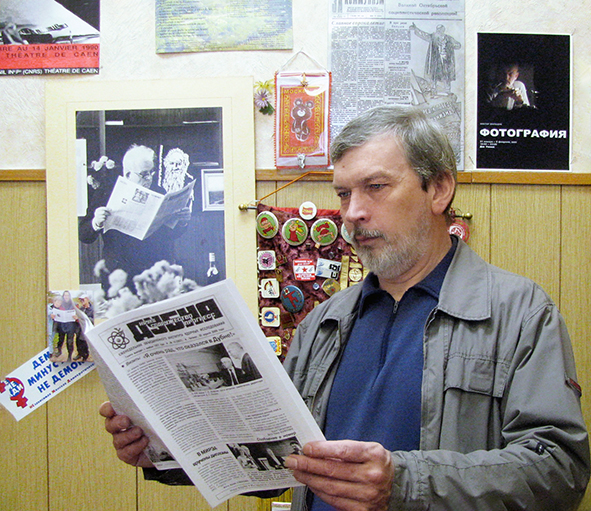
This year, A. A. Leonovich turns 75 years old. 60 of them are inextricably related to the Correspondence Physics and Technology School (CPTS) of the Moscow Institute of Physics and Technology. As a graduate of Phystech, Alexander Anatolievich prepares applicants for admission to alma mater and other best universities in Russia. For the past 25 years, together with colleagues, he has been conducting the City Interschool Physics and Mathematics Elective at School No. 9. This year, he was awarded a JINR grant as one of the best teachers in Dubna. His educational activities were awarded a high award - Medals of the Order of Merit for the Fatherland, II degree.
"In the profession, I am more of a stayer than a sprinter," Alexander Anatolyevich says and continues his long‑term teacher and writer's marathon. His popular science books (Physics without formulas, Physical kaleidoscope, and others) have been published and reprinted in “AST” for decades. Their total circulation is over 400,000 copies. Now, these books are translated into Chinese. And the magazine "Quantum" with Leonovich's publications in the early 2000s, was translated by the Americans into English for 10 years.
But the most interesting thing is not in numbers, but in the fact that the life of Alexander Anatolievich is a real adventure novel that is difficult to correlate with the biography of a school teacher.
Alexander Anatolievich, you have been between teaching and journalism all your life and cannot refuse anything, why?
- Not between, but together. I am nature, apparently, very irrepressible. The star sign - Gemini - is an eternal bifurcation. In addition, I have a lot of blood in me. On the father's line - Poles, Belarusians, Lithuanians, Germans. And my mother is a Cossack. In addition, many cultures were mixed. I was born and raised in Baku, dad was from Tbilisi, and mom was born in Armavir. All this mixture in me wandered and periodically spilled out. And how to live with it? How to do exact sciences?
It was very difficult for me to choose between humanitarian and technical areas, one might say, between intuition and logic, chaos and order. Dad was an engineer, a technically gifted man. My older brother is a philologist. My grandmother is a music teacher, she had a piano at home and all my childhood I was forced to play it. And when I left music classes, I had a huge need for it. I slowly came to my grandmother when she was not at home, and played Rachmaninov's preludes. The most difficult music, it was impossible to get through the notes, but I needed to hear this sound.
What else in your youth manifested your restless nature?
- For example, at the age of 16 I was awarded the badge "Mountaineer of the USSR", although then it was possible to do mountaineering only from 18. And I climbed the rocks without insurance to pick and then present an unusual flower - you can't find such in the city. I will keep silent about the rest.
Why did you still fascinate physics? And how did you get to Phystech in Dolgoprudny if you graduated from school in Baku?
- When I was in the ninth grade, dad still decided that I needed to study technical sciences and found a teacher in physics and mathematics. It was Razmik Oganovich Adibekov - a man without degrees and titles, but a teacher from God. In his youth, he had an unfulfilled dream - to enter Phystech. And he found his calling in preparing applicants from Baku for admission to this university. So, he sent me to the Olympiad that was held by students when they came on vacation in winter. Then I first saw physicists: smart, cheerful, cavaliers - just some aliens, and learnt about the materials of the newly founded CPTS. And at the Olympiad there was a question in physics: why during cooking sausages burst along, and not across? And then all my school fives "shrunk." I could not meet these problems and I really wanted to go to Phystech. I had to rebuild my whole life.
In summer before the graduation class, Razmik Oganovich advised me to rest. But I said that I want to stay with him. He says, "Then take as students those who will enter local universities in August." So, I became a teacher.
That is, you, being a ninth grader, in summer, prepared tenth graders who had already graduated from school for entering the HEI?
- Yes. And they all did! When I came to Razmik Oganovich for classes at the end of August, he says, "I have too many students, take one group, prepare them, it will be useful for you." But I could not tell my parents about it. It was a scary secret. My father told me: "You decided to enter Phystech. But if you are not enrolled, you return home, you have a medal, they take you to Baku to college without exams, and you stay at home." I knew that my parents would not give me a second attempt to enter Moscow.
But you entered the first time.
- Yes. Although the competition was harsh. Then they passed two more issues - both tenth and eleventh grades.
How could you study at Phystech with such a background and eventually not become a scientist?
"Again, my restless soul affected. The first courses at Phystech I terribly lacked art books, music, communication. There was simply no time for that. And then I got into the physics and technology circulation "For Science". It was the best university newspaper, it was supervised by our mathematics teacher Yury Vasilyevich Pukhnachev, who was also the editor of the journal Science and Life, the author of such books as “Mathematics without formulas” and “Mathematics in images”. And fantastic years began, filled with creativity and communication. Life began to play with colors, the newspaper actually gave me another profession.
As a result, I studied four courses in physical chemistry. Then I went to the academy, returned, but transferred to the faculty of aerophysics and space research, space still beckoned. My student body stretched, and in parallel with my studies, I was engaged in a newspaper, became a Komsomol editor.
I had a diploma about navigation systems that can be installed on submarines, ships, airplanes, satellites. While working on my diploma, I went to various research institutes and learned that Moscow is a very interesting city. There are houses and avenues, and between them is hidden a "closed" world, getting there, you begin to do work, sometimes not fully understanding what could be its result. You become part of a huge system. And by that time I had already tasted the freedom of journalistic creativity, where the degree of choice with all the "red lines" for which one cannot stand up, still wasd very large.
How did you come to Dubna?
- The most interesting thing is that I got to Dubna not as a student or graduate of Phystech. After the fourth year, I went to the pioneer camp near Protvino as a counselor to earn a little extra money, and the choir studio of O. N. Ionova from Dubna arrived there, in which my future wife Irina sang, who became a reliable support of my undertakings. And the very first official place of work, although I was still a student, was Dubna school No. 8. Its director M. S. Zhokhov gave me nine classes, each of which had 40 people. After that, nothing was scary. Graduation in several schools, preparatory courses of Moscow State University in Dubna and so on followed...
What was it like after Phystech, after scientific work, to be a teacher at school? There was no dissonance?
"There was no dissonance. I had an example of my teacher and already had my own experience. I knew I could do it. My teaching went in parallel with journalism. During these years, I was very inspired by the founder of Phystech, Nobel winner Petr Leonidovich Kapitsa. My colleague from the Phystech newspaper for Dubna residents Serezha Gromov and I interviewed him, which we tore off with our hands in Komsomolskaya Pravda, because before that Kapitsa had not met journalists for many years. He gave me a book where there were his articles on teaching and gave examples there when it prompted scientists to engage in new topics and, together with students, achieve very important discoveries. And the basis of Phystech was that people from science should have taught, and not just full‑time mentors. Now I understand that Kapitsa blessed me with this book.
How did your journalistic career develop further?
- With the same Serezha Gromov, we did an interview with the rector of Phystech O. M. Belotserkovsky for “Ogonyok”. Then there was an internship in the newspaper “Pravda”. And from there I was sent to the magazine "Knowledge is power". It was 1976. In this edition, I became the author, and later the deputy editor‑in‑chief and, in the end, actually the editor‑in‑chief. In the editorial office I met an amazing person - Karl Levitin. This is the "golden pen" of popular science journalism, a person who has written amazing books, for example, about working with deaf-blind children (there was such a boarding school in Zagorsk). He wrote a magnificent book “Geometric Rhapsody”. I met with teachers who said: "He needs to erect a monument; this book inspires us all." Levitin then published a book of his lectures "Fundamentals of Popular Science Journalism" with graphs, with statistics, because he had a technical education. The fact that I immediately ran into him is providence. And for 10 years Karl and I prepared publications, went on business trips. It was an incredible joy of both professional and human communication.
Then, fate brought you to the magazine “Quantum”.
- The founder and the first editor-in-chief of “Quantum” was an associate of I. V. Kurchatov and the author of physics textbooks I. K. Kikoin. The editorial office needed a person with a good technical education and teaching experience at school. And this is an infrequent combination, because pedagogy also requires humanitarian intentions. And they found such a person in me. Isaac Konstantinovich told me, "It is easier to do scientific work than to make this magazine and write textbooks." I worked there for two years as his deputy, without throwing "Knowledge is power". And I continue my author's column in "Quantum" to this day.
How did your cooperation with the weekly “Dubna: Science, Commonwealth, Progress” develop?
- Thanks to friendship with Zhenya Molchanov, our meetings and conversations, JINR's scientific achievements and topics from the Dubna weekly continued with publications in the magazine “Knowledge is power”. I was, if you will, a kind of bridge between these publications. By the way, over the years of cooperation, articles about JINR have appeared in the journal "Knowledge is power" more than 50 times! We have published many outstanding scientists of Dubna, very actively - Director of JINR Academician A. N. Sissakyan. Glorious people, light feathers work in the weekly, we are joined by years of lively and productive work...
You do a lot with students. How do you trample a path to them, how do you captivate them?
- I encourage them to run at least part of the marathon with me - to the intermediate finish. I listen to them, talk to them about what interests them. A person can have any level of training, the main thing is that he has some kind of motive, an internal "motor," so that something moves them, becoming a need.
What do you think, what is happiness?
- It seems to me, based on our conversation, the answer is obvious. Happiness is the luxury of human communication. If you were a mathematician, you would know what a delta function is. This is when there is nothing, and then in one place an endless jump, and then again nothing happens. This is some kind of splash, a bright flash of light, music, meetings, something else. With me, it has almost always been related to people. At one time I was so saturated with those who were older than me, from my peers, students, that I was overwhelmed with memories. It's a happiness to be so lucky to cross paths with them. And I am infinitely grateful to those who saturated my life so tightly and helped to realize their plans.
When I cut out the time for writing the next magazine material under the heading "Kaleidoscope "Quantum" I can delve into magazines, manuals and collect my mosaic bit by bit - this is also a joy. Because at some point the quantity goes into quality and all parts of the text suddenly line up in the big picture. And you understand - ready, it turned out! And so, imagine - 160 times!
In general, happiness is in work but this is a separate type of happiness.
Anna EPSTEIN
P. S.When Alexander Anatolievich Leonovich taught physics in my 10th humanitarian class at Lyceum No. 6, he surprised by talking about physics, looking out the window and illustrating physical phenomena with what we see on the street. So, physics went beyond the textbook and found a relation with life. Then we accidentally met on the train, and it turned out that one of the two professions both he and I have journalism, that we have the same favorite composer, the same favorite pianist, the same favorite books, the list goes on. It's been 20 years. We met and again "checked the clock": the intersection points remained the same, favorite book, still "The Bead Game" by Hermann Hesse... Apparently, the laws of conservation also apply to metaphysics. Dear Alexander Anatolievich, see you later at different points of space at intersections of culture and new discoveries!