
Vladimir Penev turns 90
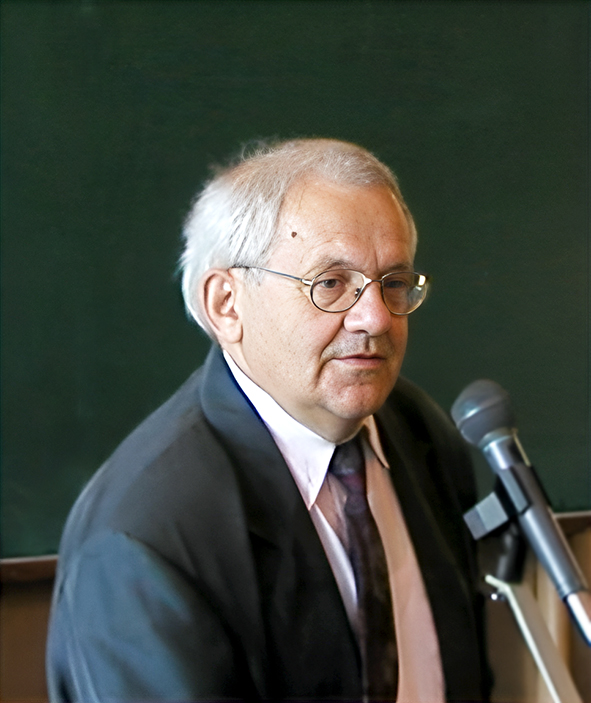
He began his scientific career in 1961 at the Laboratory of High Energy Physics, as a student at Lomonosov Moscow State University. Since then, V. N. Penev has been inextricably united to JINR, where he has been working for more than half of his half-century of scientific activity. He defended his doctoral thesis at JINR in 1976.
Already at the beginning of his career, he, yesterday's student, in 1964, was instructed by V.I. Veksler to make a report on the investigation of resonances at a very large and important international conference in Dubna, the so‑called Rochester Conference.
Since 1965, in Sofia, at the Physics Institute of the Bulgarian Academy of Sciences (BAS) that was then transformed into the Institute for Nuclear Research and Nuclear Energy, V. N Penev organized a capable creative staff and introduced many Bulgarian physicists to work together with JINR scientists. This staff was engaged in processing images from 40‑centimeter hydrogen and later, of 2‑meter propane chambers and in physical interpretation of the results. The number of researchers, laboratory assistants, graduate students in active years exceeded 25 people. Physics teachers from other Sofia institutes were also involved, who practical work with experimental material was interesting, useful and necessary for. The teaching of the basics of New Physics and the assimilation of new techniques was going with great excitement and inspired enthusiasm, in close cooperation with the relevant groups of the Laboratory of High Energy Physics and institutes of other countries.
Participation in the collaboration of a 2‑meter propane chamber irradiated with beams of π mesons at an energy of 40 GeV in IHEP (Protvino) also allowed obtaining a lot of interesting data about the multiple birth of particles, their properties and correlations, especially identical particles and resonances.
The organizational abilities of V.N. Penev successfully served to develop cooperation between Bulgaria and JINR. In 1981, he was awarded the Order of Cyril and Methodius, I degree.
From 1975 to 1979, Vladimir Nikolaevich was Deputy Director for scientific work of LCTA and from 1997 to 2002 - Deputy Director of LHEP. He showed high professionalism and efficiency, a caring attitude to work and an active life position. V.N. Penev made a great contribution to the development of high energy physics both in Bulgaria and at JINR, his work is well known in the world.
V. N. Penev is also engaged in the popularization of science. So, for example, his book "This fictional world" was published. The author of the book invites the reader to discuss with him the knowledge obtained with great difficulty about the structure of matter and entropy, about chance and harmony, about symmetries and their violations.
V. N. Penev spoke in detail about his work at JINR in the article "My life in Russia, Bulgaria, Dubna", published in our newspaper for his 80th birthday in issues 37‑38 of 15 September, 2016 and in the issue 39 of 22 September, 2016 that can be found on the newspaper's website.
JINR Directorate and colleagues cordially congratulate Vladimir Nikolayevich Penev on his anniversary and wish him the strongest health, excellent mood and further success!
Autograph of the hero of the day
About science, about Dubna, about myself
Fragment from the memoirs of V. N. Penev
The first acquaintance with JINR was in 1957, when, as part of a group of students at Moscow State University, I was lucky enough to visit Dubna. The guards in yellow sheepskin coats that opened the gates to the Institute's territory and several more cordons on the way to the "holy of holies" - the hall where the synchrocyclotron was located, crashed into memory. We were so overwhelmed by the magnitude and complexity of the structure that we didn't understand much from physicists' explanations. Then for a long time, V. G. Zubov was "interrogated" about this. "Interrogated" is strongly said. Other students asked questions. I, feeling my phenomenal lack of education, was generally embarrassed to vote.
In 1960, at LHEP JINR, I began working on my diploma. The topic of the thesis was given to me extremely relevant: "Elastic scattering on protons of lambda particles produced in π interactions at an energy of 7‑8 GeV" - based on materials from the first 24‑liter propane bubble chamber in Dubna. Since there was practically no data on this topic in the world (only two events were made public), the results of the research were immediately published and received international recognition that inspired.
In 1961, our daughter was born, my wife still had to graduate from the university, so it became necessary not to return immediately to Bulgaria, but to work for some time at JINR. It should be stated that then, however, like later, after returning to Sofia, I always received support from the famous "pillar" of Bulgarian physics, Academician Georgy Najakov. He followed my work closely and encouraged me.
So, already at that time, it became clear that I would be united to both my wife and JINR and Dubna all my life.
In the late 1950s and early 1960s of the last century, Dubna was a small town, isolated from the worries and problems of everyday life of the country. There was everything necessary for the regular life and scientific work of a mainly young staff of scientists, engineers and technicians. And the care of heads about the situation of engineers and physicists in Dubna was organized in a new way and truly phenomenal. We were not spoiled people, because the conditions of study and life at Moscow State University were also undoubtedly good but here, they seemed even excellent to us. In Dubna, in the field of new science - particle physics at high energies, it was still just beginning: the newly established JINR, the new accelerator, the synchrophasotron and the young international staff. JINR created an atmosphere in which all other problems, except scientific ones, seemed unimportant, insignificant. They were given almost no importance. Somehow, by itself, it was implied that for creative activity a certain amount of asceticism and dedication is required. Scientific and technical support and scientific literature were at a very high level. Western magazines appeared immediately after their release and even (!) in Russian. An abundance of seminars with the obligatory presence of all scientists, with bright speeches by famous scientists and general heated discussions, scientific lectures and reports introduced young people to big science. It was also facilitated by lecture series on various aspects of physics by L. B. Okun, V. I. Ogievetsky, S. M. Bilenky, V. M. Gribov and many others. I remember what reverence I studied with the just out of print book by Moses Alexandrovich Markov "Hyperons and K-mesons". A wonderful organization of cultural leisure with disputes, international evenings, meetings with the Moscow creative intelligentsia - all this created an atmosphere of friendly, creative work and respect for the directorate. In this way, the Institute, the establishment of which at first was mainly a political act, turned into a magnificent example of a creative staff.
JINR Press Office