
Cohesion, good mood and willingness to get involved in the common cause
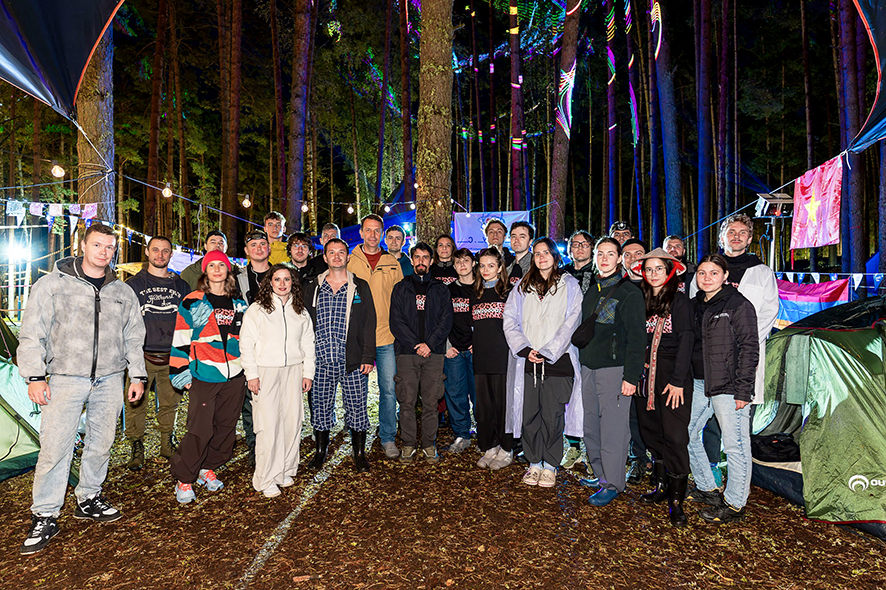
The Forum brought together more than a thousand participants, including specialists, students, everyone who is interested in modern science, as well as their family members. For three days, there were lectures, exhibitions, experiments, creative projects, film screenings and musical performances.
This year, 18 speakers gave reports in the scientific part of the programme, among them Director of JINR, Academician of the Russian Academy of Sciences Grigory Trubnikov that made a report "How fundamental science helps a person". MEPhI Professor Vladimir Reshetov gave a lecture with the ironic title "Courage tames the atom, pride destroys fools - nuclear confrontation and our bright future". Vice-Rector for Science NRNU MEPhI Andrey Kuznetsov presented a reflection on the topic "Science is newer than new". The lecture also raised issues of scientific pop, personal image, artificial intelligence, ecology and others.
One of the key events of the "Nuclear Festival" is the competition for the Nuclear Cup among the councils of young scientists of leading scientific organizations and universities in Russia. The teams of Rosatom, NRNU MEPhI, NIIIF MSU, JINR, SIC Kurchatov Institute, FEFU, MIPT and others fought for the main prize. Teams competed in 16 disciplines: they had to solve logical problems, compete in sports, create videos and perform on stage.
According to the results of all stages, the JINR team took first place with a margin of 200 points. Dubna scientists get the victory for the second year. We asked the team captain, a researcher at DLNP Vladislav Rozhkov to tell us about how the Festival and competitions went.
How many times has JINR taken part in the "Nuclear Festival"?
- JINR is taking part in the Cup for the third time. In the first year of it, I came literally for a day to see what it even is and pretty quickly realized that next time I had to participate.
Then there were many organizational difficulties: schedule, competition regulations, overlaps between competitions. But the main thing was already visible - the Festival develops, becomes stronger and unites more and more teams.
A year ago, we were already really involved: we participated not only in competitions, but also in organizing, developing regulations, drawing up a schedule, cooperating with team captains and Festival headquarters. We began to prepare for our own performances in about two months. This year, we decided to act in the same way - to assemble a team in advance and start training long before the trip.
What kind of team has gathered this year?
- This year, JINR team included 31 people: Alexey Vorontsov, Artem Kublikov, Nikita Fedorov, Daria Shamina, Kirill Petukhov, Dimitar Chereshkov, Nina Bykova, Dmitry Krivenkov, Taupedi Gudani, Victor Baryshnikov, Regina Kozhina, Vladislav Rozhkov, Alexey Kuznetsov, Elizaveta Konstantinova, Nikita Grech, Ksenia Alishina, Diana Al‑Maaita, Olga Korotchik, Kirill Slizhevsky, Dmitry Budkovsky, Yury Korsakov, Lyudmila Kolupaeva, An Mei Kuin, Bulat Khamidullin, Vladislav Shalaev, Alexander Provorov, Maxim Podlesnyy, Dmitry Popov, Polina Filonchik, Lydia Dodonova and Ekaterina Khabarova.
Some participants came with friends and families, so there was a large support group around the main team. The team turned out to be very strong, united and most importantly, purposeful. Roughly a third of this year's participants were newcomers. This is especially nice: judging by their reviews, they really liked the Festival that means that next year, the backbone of the team may become even larger.
Separately, I would like to note people, who many of our results simply would not have been won without. Many thanks to Ekaterina Ovchinnikova for her help in preparing the theatrical performance - without her directing, it would definitely not have turned out so noticeable.
Vladislav Shalaev wrote an excellent song for the musical performance and together with Valentin Pomyakushin and Alexey Kuznetsov (deputy team captain) they organized our camp that was noted by both the participants and the jury members.
Without Regina Kozhina (deputy team captain), it would be almost impossible to coordinate the actions of so many people and distribute them across the competition, taking into account all the overlaps. Her help with informing, training the participants and addressing the ever‑emerging issues was invaluable.
Special thanks to Alexey Vorontsov that for the sake of a common victory abruptly changed his plans, arrived, helped with transport and then shot and edited a video about our team.
I'm actually ready to write some warm words about each contestant but I'm afraid I won't be given as much space in the paper.
What competitions did you go through and were they difficult? Who would you call the main rival?
- All competitions can be roughly divided into three large groups: sports, intellectual and creative. JINR participated in all 16 festival disciplines: theater performance, badminton, volleyball, laser tag, drone competition, problem solving, video competition, music performance, board game, competition for the best presentation of the camp and organization, chess, quiz, relay race, heroes’ race, tug of war and "particle throwing", lectures.
Moreover, we, of course, were not going to give the best presentation of the camp and organization (as it was last year) to anyone - the first place should have remained with JINR! Each tent represented a country - a participant or an associate member, with all the symbols: flag, clothes, country attributes. The participants even cooked traditional dishes in the field. It was beautiful, interesting and tasty!
There were practically no simple competitions. Somewhere, we felt very confident, somewhere, rivals turned out to be stronger. It is impossible to assemble a team that will be the first at the same time in volleyball, chess, theater, drones and intellectual competition.
And probably, therefore, I would not name one main rival. In different disciplines, they became different teams - Moscow State University, MEPhI, Kurchatov Institute and others. This is what makes the Festival interesting: you do not come to confirm the previously known result but to understand where you have become stronger and who you will have to try to get around next year.
For the second year - the first place, this time, with a margin of 200 points. What brought victory?
- Probably, there is no one factor here. The victory was brought by the team.
We tried not to bet on two or three competitions but to participate everywhere and in each competition to show the maximum possible result. It required serious preparation: to gather people in advance, to understand their strengths, to distribute them by discipline, to prepare creative performances, to solve dozens of organizational issues.
But preparation alone is not enough either. A lot was given by cohesion, good mood and the willingness of people to get involved in a common cause – sometimes, to change our own plans, to replace each other and to enter the competition simply because the team needs it now.
And of course, there was a great desire to make the words JINR and "first" stand next to each other as often as possible.
Judging by the final table and a margin of more than 200 points, this time, it became real. And now, I want to understand what we have to come up with next year in order to become the first again.
What do you especially remember: from competitions, scientific part, informal and entertainment events?
- For me, the main impression of the Festival is not even a victory in itself but how quickly several dozen very different people turn into one team.
In ordinary life, we work in different laboratories, we are engaged in different areas of science. And some participants were hardly familiar with each other before this trip. And here in a few days, you are already worried about a person on a chessboard, volleyball court or stage as if you have been performing together for many years.
This is probably why it is difficult to single out one competition. Creative performances are very memorable - especially because you understand how much preparation costs for a few minutes on stage. Sports were also remembered, where the result was often decided literally in the last minutes and sometimes, the difference between the first place and the rest was a fraction of a second. And of course, our camp - at some point, it became not just a place for placing the team, but a real centre of communication.
The scientific part of the Festival is valuable in that it allows seeing colleagues from a completely different side and finding out how other institutions and organizations live. In a regular working environment, we often meet already as specialists in rather narrow areas. Here, you can calmly talk about science, projects, ideas and find that people from completely different organizations have much more common interests than it seems.
And from the informal part, not even individual events are most remembered but the atmosphere: conversations between competitions, acquaintances, jokes, support for each other, people who came with families and friends. It is from such things that the Festival eventually develops.
Victory, Nuclear Cup and 200 breakaway points are very nice. But in a few years, I think, first of all, we will remember not the table of results but the people who we did it all with.
Chairman of the AYSS Council, a junior researcher at LRB Regina Kozhina also shared her impressions of participating in the struggle for the Nuclear Cup,
"I spend all three days at the Festival for the first time. Last year, for certain reasons, I participated only in a theater room and came for one day. Now, I can say with confidence that you can really appreciate the atmosphere of the Festival only after spending all your time here with the team.
It's especially nice for me to see a lot of participants come in for the second year. And it is despite the fact that the living conditions and a rich daily routine at the Volga base are far from the easiest. I think this is one of the main indicators that the Festival really becomes an important part of JINR life.
As the chairman of the AYSS Council, in this Festival, as well as in the events organized by AYSS, I especially appreciate the opportunity for informal communication with colleagues from different divisions of the Institute. We are united by common interests, ideas, joint tasks and of course, the time we spend together. It is such meetings that allow you to get to know each other better, to feel part of the same community and to establish those relationships that exist after the end of the event.
I will gladly remember these three September days and I am going to repeat this experience next year in order to re-experience the taste of victory and hold the Nuclear Cup - 2027 in my hands. We are always waiting for new participants since the Festival is a great opportunity to spend an unforgettable time, to meet colleagues, to find new friends and to become part of a big friendly team."
Maria KARPOVA, Photo by Alexey VORONTSOV
Articles relating to:
Incredible emotions and a test of strength