
Time-tested collaboration
Before the seminar, Jurgen Schreiber said, "I am a theoretical physicist, in 1979, I defended my doctoral thesis, in 1987, I became a professor in the field of theoretical physics. I worked in Dubna from 1975 to 1978. In Dresden, I taught at the university until 1992 and afterwards, I was sent away from there. By a happy coincidence, joint projects in FLNP were still ongoing. My friend, together with whom we collaborated with Professor Viktor Aksenov, proposed my candidacy to the director of the Fraunhofer Institute to maintain these contacts with FLNP. So, I got to the non-destructive testing laboratory and worked there for 20 years. I had to spend 10 years to say goodbye to my theoretical ideas and to move on to meeting applied problems. In 2012, I opened my own company together with Korean specialists, since we worked very closely with them in the field of cancer diagnostics. The collaboration lasted only three years, today, there is my small firm, in which I still deal with non-destructive control and biomedical diagnostics.
I last came to Dubna to the Third International Conference "Research on condensed matter at the IBR‑2 reactor" in 2017. Colleagues then asked if I was ready to become a member of the Expert Committee for evaluating proposals for an experiment on IBR‑2. Why not? I agreed and have been heading the Expert Committee to this day."
As Deputy Director of the Laboratory Norbert Kucerka said at the opening of the seminar, "Many of the participants remember Jurgen extensively working in the Laboratory." "I am very pleased to perform here, thanks for this opportunity," Jurgen emphasized. And at first, he recalled the joint research with V. L. Aksenov on nanodiamond particles carried out in Geestacht. He highlighted the importance of knowledge of how residual stresses and microstructure of a material change under high load. Jurgen told how he uses the Barkhausen method in his research and what problems he has faced. He compared the results of this method with the possibilities of neutron diffraction at the facilities at FLNP and the Laue-Langevin Institute, emphasizing that neutron diffraction also has disadvantages.
The speaker outlined the micromagnetic approach that he began to use in his laboratory in 1995, showed the results, compared them with data from neutron experiments carried out at the Laue-Langevin Institute. The results show that volume effects can be studied using neutrons and surface stress states can be studied with magnetic noise. "It is necessary to unite both methods," Jurgen suggested.
As for the second topic, the gas produced during electrolysis is widely studied in different countries but what it consists of, it is not completely clear. "It is necessary to discuss the possibility of studying it using small-angle scattering or dynamic neutron scattering," the speaker suggested.
The speech raised questions and comments, including from online listeners. Victor Aksenov, a chief researcher at FLNP, also gave his recommendations to the speaker and after the seminar, he answered the questions of the correspondent:
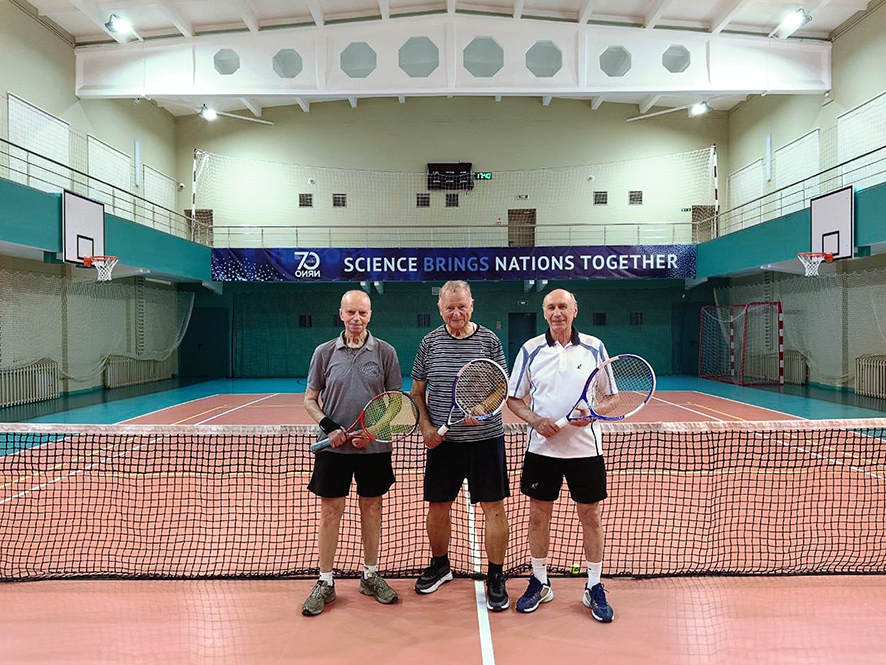
- Jurgen absolutely does not change as a creative person, he simply admires me. The fact is that he is a theorist, for some time he even worked at the Faculty of Mathematics of the Technical University of Dresden. He came to Dubna for the first time in 1972, I was then a graduate student. We started working at BLTP, cooperation developed and we have been cooperating almost all our lives. At the turning point of eras for Germany, his fate changed dramatically. He began working at the Fraunhofer Institute in Saarbrucken. Fraunhofer is a scientific organization in Germany, the budget of whose institutions is only half supported by the state. Moreover, the state gives its half only if the Institute itself has found funding from industry. As a creative person, Jurgen took a leading position at the Institute and although he is already 79 years old, he is still very active. During his visits to Dubna, together with A.M. Balagurov, we hold tennis meetings in our free time. This arrival was no exception.
How do you rate his first sentence? Can an experiment be carried out in FLNP?
- The first part of his report is undoubted. FLNP is a clear leader in the field of diffraction investigations of internal stresses of materials - these are the so‑called engineering sciences. This is an investigation not only of materials, but also of products used in industry. What Jurgen spoke about and the subsequent discussion, when specialists from the Kurchatov Institute Research Centre joined this conversation, shows that this field for cooperation remains and will develop.
Yu. Schreiber was the supervisor of the Ph.D. thesis of Head of the SIM Office Andrey Tamonov. The latter said,
"I met Jurgen at FLNP in the late 1990s in the group of G. D. Bokuchava, where I came as a student. The group was developing a stress scanner on a High-Resolution Fourier Diffractometer on beamline 5 of the IBR‑2 reactor. During these years, Jurgen was Deputy Director of the Institute for Non-Destructive Control Methods of the Fraunhofer Society in Dresden. They used different magnetic, acoustic methods, the Barkhausen noise method to study the internal stresses in industrial samples. The neutron method is additional to the magnetic and acoustic ones. Yu. Schreiber, together with V. L. Aksenov and A. M. Balagurov, decided to develop an IBR‑2 stress scanner at the HRFD on the reactor to analyze the internal residual stresses in structural materials. He, as a user, brought equipment, samples here, set and met problems. When I started writing my thesis, I went to the Institute in Dresden, worked on the tasks of analyzing internal residual voltages, carried out experiments on various European neutron sources and processed their results, both within the framework of his research and within the framework of my thesis. Scientific cooperation grew into friendship, later, he came to visit us in Dubna, we - to him in Dresden."
Jurgen celebrated his 79th birthday in Dubna. We wish him to maintain his activity for many years and still return to our city.
Olga TARANTINA,
Photo from the archive of V. L. Aksenov