
Electronic english version since 2022 |
The newspaper was founded in November 1957
| |
On the threshold of the holiday
When Christmas trees light up
On 13 December, an evening was held at the Blokhintsev Universal Library dedicated to the traditions of celebrating New Year in India, Romania, Cuba and Vietnam. JINR employees spoke about the cultural characteristics of their countries.
What happens in other parts of the world when we dress up a Christmas tree with our favorite toys in Russia and cook an Olivier salad? It turns out that this question is interesting to many and the event was a huge success. The large hall of the library was full of guests, there were not enough seats and part of the audience was ready to listen while standing.
Madelina-Michaela Miloy, a junior researcher at VBLHEP, shared Romania's New Year customs. In order to attract good luck, you need to wear something red. All debts should be distributed before the end of the year. The noise from fireworks drives away evil spirits and misfortune. 31 December and 1 January are days when you should not cry, otherwise, you will cry all year. To avoid misfortune, the plate should not be empty at the festive midnight. Madelina-Michaela called her favorite Romanian superstition "a kiss under the mistletoe" because it brings love for the whole next year. There should be no chicken meat on the New Year's table since it scrapes the ground back with its paws that means it drives away happiness and luck. And on New Year's Eve, there should be only what can bring well-being to life. On 1 January, there is a tradition to stroke the lamb that is called Basilika - in honor of the day of St. Basil. The lamb is a symbol of purity, innocence, rebirth and hope. They believe that touching it will bring peace and prosperity. Also, in the new year, there is a custom of Sorkov - a decorated branch to pat a person, singing songs and wishing happiness, good luck and prosperity.
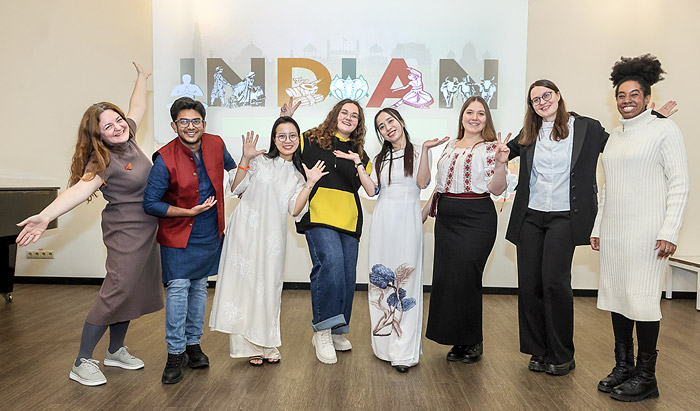
Meeting organizers and participants
An engineer at FLNR Quin An Mai and an engineer at LRB Thi Zuen Pham spoke about the traditions of Vietnam. New Year in Vietnam is called Tet. It comes according to the lunar calendar and is considered the first day of spring. Each year passes under the sign of one of the animals of the zodiac. The next, for example, is the year of the horse. According to beliefs, a person born in the year of a certain animal has similar features or is somehow related to it.
It is easy to find out about the arrival of spring in Vietnam without a calendar - by yellow apricot colors or pink peach colors. They traditionally promise well-being, good luck and a new beginning.
By the new year, the house is carefully cleaned, decorated with flowers and various plants. The graves of ancestors are necessarily visited, so they are invited to the celebration. For ancestors, a separate table with the best treats is set up in the house.
The most important thing on Tet is to get the whole family together. As a rule, everyone who lives and works in the distance goes home. The reunion dinner takes place on the last day of the outgoing year. A lot of national food is prepared. The dishes on the table have symbolic meaning. It doesn't matter what business you have, you have to be at this dinner to spend time with your family.
The fun lasts three whole days. The population of Vietnam consists of 54 ethnic groups, so there are so many ways to spend time on a holiday. Flower markets open, rowing competitions are held, national dances are performed. Friends exchange cards with good luck wishes and sweet gifts.
After the celebration, the ancestors are escorted and given a symbolic gift to the afterlife, burning food and paper replicas of money.
Silvia Maria Fortune Fabregas, a trainee researcher at FLNP, spoke about the New Year's Eve in Cuba. The Catholic country celebrates Christmas on 25 December and New Year on the night of 31 December to 1 January.
The holiday is a lot of fun. From the very morning they turn on incendiary music and dance. Traditionally, a lot of food is prepared, since they are celebrated in large companies with colleagues, friends, family. The New Year's table is a mix of African, Asian and European cuisine. Also, in the morning, they begin to clean the house, after which a bucket of clean water is thrown out of the window. According to legend, it helps to expel evil spirits from the home. Afterwards, a journey is made around the house, fake but with real luggage.
There is a sign of the color of underwear that you need to choose depending on what you want to pull into your life. For example, green linen for good luck, blue for good health. It is worth choosing pink to find love and white to be happy. On New Year's Eve, there is a tradition of creating and burning a doll that symbolizes the enemy, or the person you want to let go.
In order to attract wealth for the next year, Cubans put money in their boots. There is a custom to write a letter to yourself with desires and a promise to live by certain rules. The end of the year starts with fireworks, cannon shots, the president's speech and midnight toast.
A researcher at FLNR Aniruddha Dey shared about how New Year is coming in India. So, it turns out that in India New Year is celebrated in six versions. Depending on the region, there will be its own date and tradition of celebration. Moreover, in India, each region has its own calendar and chronology. For example, in the north of the country, they live in 557, in the west in 2081 and so on. New Year also has several names: Bihu, Baisahi, Gudi Padwa, Vishu, Pohela Boishah. It may seem difficult to find a common language, living in different centuries, but in India, they believe that the differences are just united.
On 31 December, New Year is celebrated, too. The celebration consists of meetings with friends, fireworks, dances, parties all night, delicious food and drinks. It is customary to put on new things, meet relatives, give gifts. Some take stock of the year, make promises to themselves for the next. Quite a few people visit religious places because religion plays a big part in an Indian's life.
Aniruddha Dey called rangoli the main association with the new year - a colorful ornament which they decorate the house together with. Old and young come together to make a bright drawing from a thousand small fragments. It's also a way of greeting guests. Indians believe that the pattern brings good energy and well-being to the house. Evil spirits, seeing it, leave because they are afraid of beautiful flowers.
The unique dish Ugadi Pachadi is prepared for the festive table that combines six flavors: bitter, salty, sweet, sour, well-seasoned and spicy. They symbolize the whole range of human emotions and feelings.
Necessarily, there is an abundance of sweets, as a sign of happiness, well-being and good luck.
On New Year's Day, it is customary to read or retell stories from the traditional books of Panchatantra and Jataka. Children come to their grandparents that pass on life's wisdom to them.
Maria KARPOVA,
photo by Igor LAPENKO
