
On the search for truth and the formula for happiness
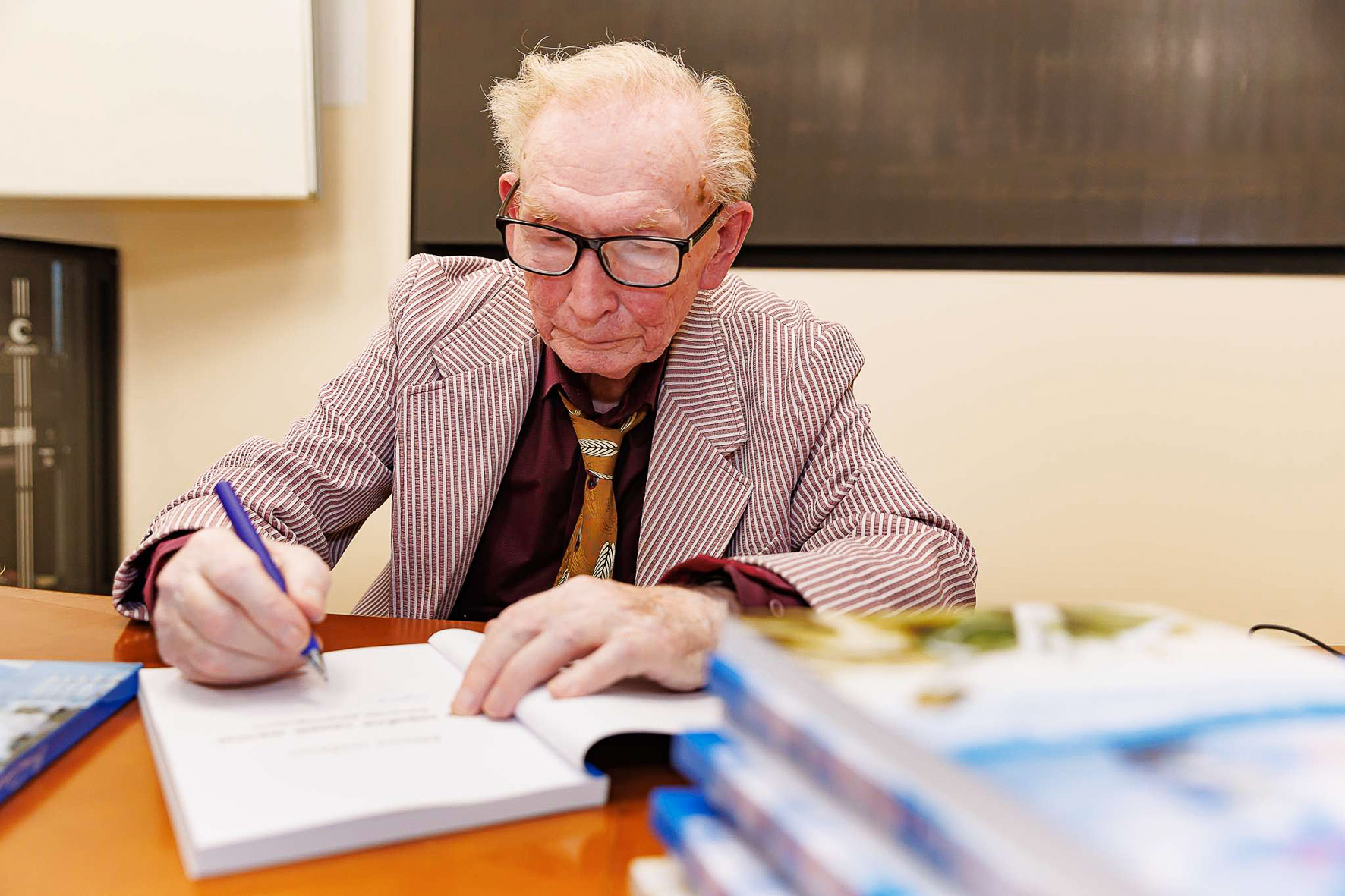
The meeting began not with a traditional speech-report for anniversary seminars, but immediately with answers to questions received in advance by the hero of the day by e‑mail.
Director of the Laboratory Egor Lychagin also emphasized the unusualness of the meeting, calling it not a seminar, but an evening of the hero of the day. The Laboratory has not yet celebrated such a significant anniversary of an actively working employee. On behalf of all colleagues, he warmly congratulated Evgeny Pavlovich on his 90th birthday, wished him to be always cheerful.
As an introduction to the meeting, the hero of the day prepared a recording of the romance of the 1920s "Everything that was" performed by Petr Leshchenko, he sang along slightly, immediately setting everyone up for the atmosphere of a home holiday. And he began to answer the questions received, accompanying the answers with archival photographs. The first was this: "The famous expression says that the truth is in the fault. What if the wine has already been drunk and the truth has not yet been found?" You need to pour more, not forgetting that drinking a lot is harmful, the answer followed. And the hero of the day, by the way, spoke about his last unscientific creation, joint with V. A. Kalitvyansky - the play "Evening in Copenhagen, or Quantum satis". This fantastic tragicomedy is dedicated to the authors of quantum mechanics - N. Bohr, V. Heisenberg and E. Schrodinger, V. Pauli, P. Dirac that joined him. As the speaker emphasized, from the point of view of quantum mechanics, there is no truth at all, like God. God is in a superposition of fields - he is, and he is not at the same time, it all depends on how the experiment is set up. "There is no truth, but you need to drink less," the hero of the day summed up.
Answering the question of how he manages everything as a scientist and as a writer because there are only 24 hours in a day, E. P. Shabalin quoted Chatsky: "When in business - I hide from fun, When to fool around - I fool around, And to mix these two crafts There is a darkness of artisans - I'm not one of them." And he assured everyone that he had never united work with writing fiction and playing in amateur productions. And he had not written off the characters of his books from fellow physicists, only the hero of one novel appropriated the best features of V. L. Lomidze.
When asked who he could call his teachers, firstly, he named Dmitry Ivanovich Blokhintsev. "Although he didn't teach me any reactor formulae," E. P. Shabalin recalled. “He taught me life with the diversity of his personality, the right choice of path. It applies not only to him. Dmitry Ivanovich believed that the "wheel" of the movable reactor reflector would spin and impulses would appear, Fedor Lvovich Shapiro - into ultracold neutrons. They chose the right path." In addition to outstanding teachers, there were colleagues from Obninsk that taught the young Evgeny reactor literacy and friends in Dubna, including Vladimir Dmitrievich Ananiev. All of them are captured in the famous archival photograph of 1959 near the building of the first IBR. As one of the teachers, he named Yu. Ya. Stavissky (IPPE, Obninsk), a human debater, according to the characteristics of Evgeny Pavlovich.
They also asked about plans for the next ten years. The hero of the day spoke about some. For example, he hopes to see the roadmap of the Neptune project with all the necessary approving signatures, to start writing the monograph "Fundamentals of the dynamics of pulsed reactors" that he conceived together with young colleagues, wants to hear the crying and laughter of his great‑grandson.
Answering a question about his main scientific work, he responded with a list of ten serious achievements. Of these, he singled out three main ones - the monograph "Pulsed fast neutron reactors" (1976), the development of the concept of an IBR-2 and heterogeneous movable reflector (which a group of authors was awarded the Prize of the Government of the Russian Federation for in 1997), the theoretical justification of the possibility of the stochastic operating mode of the pulsed reactor (1985). The only award he keeps at home in a prominent place is a special diploma from the American Nuclear Society, awarded for a monograph on pulsed reactors.
The speaker decided not to waste time answering all the questions and suggested asking them from the participants. The first was E. V. Lychagin: "Any creative person experiences a feeling of deep moral satisfaction from meeting a difficult task. You've probably had it more than once but is there a task the solution of which was emotionally particularly striking?" E. P. Shabalin agreed that there were a lot of such moments and the decision usually came to him early in the morning, after waking up. A. M. Balagurov asked if Evgeny Pavlovich knew the reason why Yu. Ya. Stavissky was not included in any award list. As E. P. Shabalin understood, Yury Yakovlevich had never told everything to the end but from the list of 12 laureates of the USSR State Prize of 1971 - the developers of the first IBR, he was deleted at the last moment.
The hero of the day showed a cartoon on him, once made by G. N. Pogodaev, who they together calculated in 1965 the possibilities of the future IBR‑2 with. It turned out that the optimal reactor power is 10 MW, a movable reflector is necessarily needed. And Evgeny Pavlovich was not only not offended by the cartoon, but praised Gena, saying that he hit the mark. No questions were asked about the family and Evgeny Pavlovich himself spoke about his mother, thanks to whom he had entered MEPhI. It was easy for him, a gold medalist, to do this, but he wanted to do a movie. About the father who died in the Vyazemsky cauldron in 1942. We saw photographs of the hero of the day of childhood and youth, 60‑year‑old and 90‑year‑old, with his son and grandson, during the launch of IBR‑2 that captured him on stage and in amateur concerts, with Edward Teller that visited Dubna.
The performance was interrupted many times by laughter and applause. M. M. Podlesnyy, on behalf of the devoted students of the hero of the day, handed him a poster with symbolic images of scientific and creative achievements of E. P. Shabalin and poetic congratulations. Many laboratory employees who love, appreciate and respect Evgeny Pavlovich left their signature on the poster. The congratulation also contains the following words: "We thank you for your experience, invaluable ideas, for inspiring you for bold undertakings, for your loyalty to our work, for your creative scope, for your corporate humor that heats up on weekdays..."
Congratulations and conversations continued over tea. We learned the formula of happiness from Lev Tolstoy and Evgeny Shabalin. It is defined as a fraction in which a person's achievements are in the numerator and his claims are in the denominator. Happiness will be greater the more you achieve or the less your desires. And if you don't want anything, then you can become infinitely happy, the hero of the day joked. He also spoke about his favorite role of God in the play "Satanate" of the JINR KLOP amateur theater: "I was God twice, the third time I refused."
The evening turned out to be warm, chamber, sincere. We can only join all congratulations and wish Evgeny Pavlovich an unquenchable impulse of creativity in science and literature. And let the value of the fraction of his happiness tend to infinity.
Olga TARANTINA, photo by Elena PUZYNINA