
Three jubilees on the "island of stability"
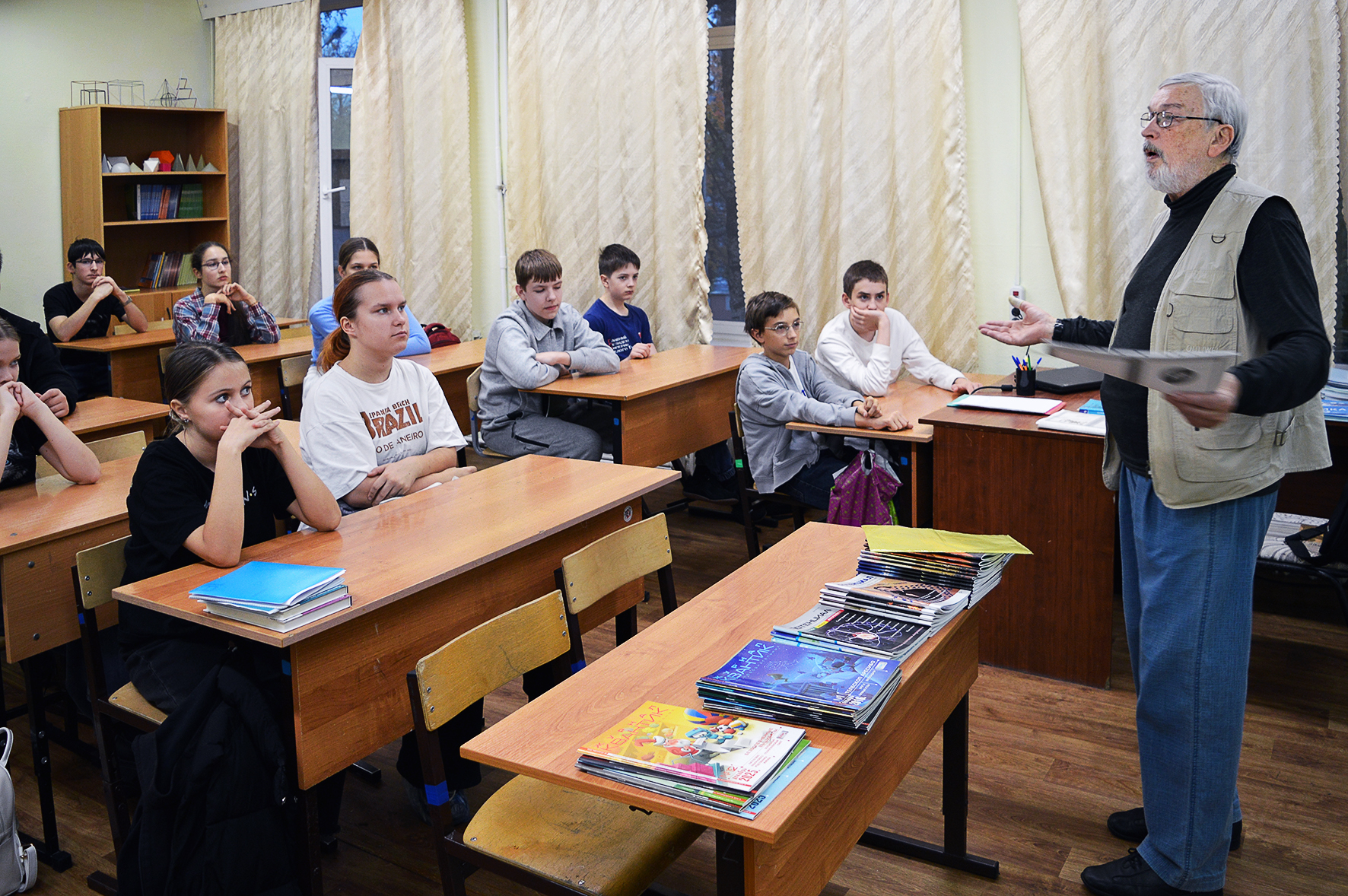
On the elective platform, the educational activities of these organizations are closely intertwined. How did this manifest itself? Graduates and students of the Correspondence School themselves will tell about it best.
Our path to exact sciences began with an interschool elective, the classes of which were held at School № 9. These classes interested us in disciplines such as physics and mathematics. They became a decisive factor in choosing a further path. Why did it happen? Non-trivial tasks, available explanation of material that is not in the school curriculum. Afterwards, we entered CPTS. Here, we were expected by a huge amount of useful work that gives not only knowledge, but also teaches us to be systematic, to properly manage personal time. This was very useful when studying at a university.
Nikita Sivorin, Ruslan Nazarov, Ruslan Aydanov, graduates of MSTU named after N. E. Bauman
Когда я учился в 7-м классе, я узнало существовании межшкольного физико-математического факультатива. Мне очень нравились эти занятия, потому что на них разбиралось множество задач различного уровня и объяснялись природные явления так, что всё становилось понятно.
When I was in the 7th grade, I learned about the interschool physics and mathematics elective. I really liked these classes because at these classes, many tasks of various levels were solved and natural phenomena were explained in such a way that everything became clear.
Starting from the 10th grade, in addition to attending elective classes, I began to study at CPTS that I eventually graduated with honors. All this together helped me a lot to prepare for participation in the final rounds of university Olympiads and successful passing of the exam.
As a result, I entered the Moscow Institute of Physics and Technology at the Faculty of Management and Applied Mathematics.
Alexey Chernenkov, graduate of MIPT
CPTS assignments taught me to independently search for knowledge and to reasonably plan time. At the elective, we solved more complex problems and answered questions on assignments. By the 10th grade, the school for me stopped being a source of new information in physics and mathematics. In many lessons, I knew almost everything that would be told to us, or I could study the school material myself in a short time. In the 11th grade, the main goal of the elective was to prepare for the Olympiads. CPTS physics assignments gave a very good base for most university Olympiads, when mathematics assignments were focused more on MIPT Olympiads. After such a programme, passing the exam with high scores was not very difficult.
Sergey Budyashov, graduate of the Mechanics and Mathematics Department of Moscow State University
For the first time, I came to elective classes in the 7th grade, when physics began in our school. To be honest, in those years, I was not very interested in physics and I did not show much zeal on my part in my studies. But I went to elective classes, participated in city Olympiads (without special results) and it allowed me to effortlessly master the school curriculum in physics and pass the Basic State Exam in the 9th grade for almost the maximum score. Also, studying at CPTS helped in it – their tasks and theory from remarkably compiled manuals. The elective helped me to have an interest in the exact sciences – in the 7th grade, I was interested in robotics and I began to go to an after-school club, also organized by JINR. Even at that age, I decided on my further field of activity and began to participate in various competitions and hackathons in robotics. In the 11th grade, when it came time to prepare for university, attending an elective and studying at CPTS also helped – I did not start from scratch. Thanks to serious theoretical preparation and solving a large number of problems, I became the winner of the Olympiad "Step into the future", received 100 points on the Unified State Exam in Physics and without entrance tests, I entered the Department of Special Robotics and Mechatronics at MSTU.
Ivan Rzyanin, graduate of MSTU named after N. E. Bauman
From the very moment when I finally decided that I want to enter MIPT, the issue arose of how best to prepare in order to enter with the greatest probability. Of course, I began to look for educational materials that make such training possible. The most suitable were the manuals of the Correspondence Physics and Technology School. They helped me a lot and the fact that the physical and mathematical elective uses CPTS materials is a very good solution.
Petr Mattis, Bachelor’s degree, MIPT, Master’s degree, Technical University, Dresden
Immediately after I had entered the Lyceum "Dubna", I began to attend the City Interschool Physics and Mathematics Elective. The situation itself is conducive to study. Despite the fact that there were always enough people in the classroom, I was struck by the fact that schoolchildren do not go to the free elective. In my opinion, it was an omission. On a tip from the teachers, I entered CPTS, the programme of which echoed the elective materials. Regular classes provided an extensive amount of knowledge with which even those who had little knowledge of physics could prepare and score well. I am sure that without these electives I would not have entered the desired university and would not have found friends of interest.
Tatyana Kuznetsova, graduate of MISIS
In the 7th grade, I got information that the city has an elective in physics and mathematics. Since I have been interested in physics and engineering since childhood, I immediately decided to sign up. And I did not regret it. After some time, when the basic knowledge was already mastered, we were offered to enroll in CPTS that I willingly did. The CPTS programme was complex, rich and interesting.
Having entered the university, I was convinced that the completed programme helped a lot and greatly simplified the passage of new courses, since much had already been studied and worked out.
Ilya Kukushin, graduate of Dubna University
I had a chance to learn about elective classes, alas, quite late. I started attending them in the 9th grade in order to start preparing for the exam. I confess, I was surprised because for me physics, as a subject at school, seemed to be nothing more than a set of algorithmic actions, like "substitute-count" and therefore, was not of particular interest. In addition, I still hesitated about the area of my future education. But after a year of attending these classes, I realized that I wanted to do exactly the exact sciences. Thanks to electives, I was able to understand topics that used to be a "dark forest" for me and to improve my knowledge. Each grain of information is "chewed" almost to intuitive things and teachers are always ready to once again speak the material if the student does not understand something. And the classes themselves are lively. I would recommend signing up as early as possible, from the sixth grade because I felt how much I could acquire, learn about these classes early.
Alexey Filippov, MPEI graduate
When I was in the 9th grade, my classmate told me about the elective at School № 9. At that time, I was already interested in physics and decided that additional classes would help me to understand the subject more deeply. It turned out that this elective was aimed at students of CPTS, they analyzed the theory and tasks. The teachers understood the subject deeply and among the students there were very strong ones who I wanted to reach for (as I learned, some of them entered MEPhI, Moscow State University and MIPT). A year later, I entered CPTS in physics and mathematics.
The physics programme served as a good base for the Unified State Exam and institute Olympiads. I liked that the theory is presented compressed but full, structured and immediately with examples. The level tasks were with a margin for the Unified State Exam and roughly coincided with what they give at the Olympiads that helped me to become a prize-winner at one of them (Olympiad "Step into the future").
Mathematics was incredibly useful for the second part of the exam. There were many general techniques of solving in the tasks, some of which I had not met before.
In 2022, I entered the Physics Department of Moscow State University in a general competition but with the privilege of not taking a DWI – I was counted 100 points in the Olympiad. After the 2nd year, I chose a department related to JINR and I plan to continue working in this area.
Kirill Vaganov, 5th year student of the Physics Department of Moscow State University
Thanks to the elective, actively using the programme of the Correspondence Physics and Technology School, I learned to consistently express my thoughts, clearly convey my position to the interlocutor. I strongly recommend that anyone interested in physics and mathematics attend elective classes. This is a great investment in yourself, in your future. I perfectly understand the doubts of those who are just thinking of going to the elective, those who have not yet decided on their profile, who have not yet understood what they like better: physics, biology or mathematics, or, perhaps, Russian language and literature. If you consider yourself to be in this class of people, then I invite you to attend this Physics and Mathematics Elective, on which you will definitely understand whether your soul lies in the exact sciences. These are not just ordinary classes with dry tasks, this is a whole holiday, where each task is good in its own way, you will definitely find something to your taste.
Mikhail Lobanov, graduate of MIPT
In 2025, I graduated from the 11th grade and entered the Physics Department of Moscow State University. The first time I came to the elective in the 5th grade for mathematics and since the 6th grade I have started to go to physics. I went to the elective, prepared for the Basic State Exam, afterwards, for the Olympiads and the Unified State Exam and also entered the Correspondence Physics and Technology School that greatly helped me in preparing for the Olympiads. I became the winner of the Lomonosov Olympiad that allowed me to enter almost any university. Of course, it was hard at times, but such a quality as dedication that the elective revealed in me, helped to achieve high results. The elective not only gave me knowledge, but also introduced me to many interesting people.
Ulyana Savelieva, 2nd-year student of Physics Department of Moscow State University
I studied at CPTS in physics and mathematics from 8th to 11th grades, thanks to it, I entered the Mechanics and Mathematics Department of Moscow State University that I had wanted for a long time and I am already finishing it. In the tasks of CPTS, especially in physics, there was always a very high-quality, detailed theoretical material and complex and diverse tasks. In addition to the fact that all this gives very good knowledge, it also develops the skill of independent learning. This, of course, was especially useful to me already during the first session at the university.
In general, CPTS is a remarkably useful thing that I am ready to recommend with confidence and perseverance to everyone who wants to enter a good technical university, especially, when there is such qualified support in Dubna.
Maxim Kharchenko, Mechanics and Mathematics Department of Moscow State University
For the first time I heard about CPTS from my grandfather Anatoly Vladimirovich Savkov that showed me his manuals, according to which he studied at CPTS, they are still kept by him. But a closer acquaintance and in general, the moment of entering the Correspondence School is associated with my move from Miass. The first year at the Correspondence School seemed to me the easiest. But in the future, the experience of solving problems came in handy for me in physics Olympiads. Compared to the school curriculum, the course at CPTS is more in-depth and therefore interesting.
An important role was played by CPTS in the delivery of the Basic State Exam. Thanks to the tasks that were understood on the course, I was able to pass the Basic State Exam for 38 points. CPTS was quite important in choosing an area and educational institution.
Lev Peshkov, 11th-grade student of the V. G. Kadyshevsky Physics and Mathematics Lyceum
Even such a small part of dozens of reviews from Dubna schoolchildren and students gives an eloquent idea of the peculiarities of studying at CPTS. It once again confirms the evaluation of Rector of the Moscow Institute of Physics and Technology that for many years has headed MIPT, Corresponding Member of the Russian Academy of Sciences N. V. Karlov:
"CPTS is a ray of light in the dark realm of dull schoolwork, a ray of light not only showing the direction of the saving movement, but also supplying a person striving for the knowledge necessary to achieve the goal with skill and energy."
These words are joined by the successor of N. V. Karlov, Rector of MIPT, Academician of the Russian Academy of Sciences N. N. Kudryavtsev: "The establishment of the Correspondence Physics and Technology School in 1966 was a revolutionary decision that for years and decades has determined the organization of work with schoolchildren in our country.
The School became famous almost immediately. More than half of the MIPT's applicants studied at CPTS but this figure did not exceed 10% of the School's graduates. The other 90% entered other universities. Thus, the developed learning system contributed to improving the level of mathematical and physical education throughout the country.
I know a lot of CPTS graduates that have graduated not from MIPT, but from other universities, yet the memory that it was our Correspondence School that gave them the path to a big life was preserved."
Some more statistics. Over the past decade, eight teachers have alternately taught electives. Of these, one Doctor and five Candidates of Physical and Mathematical Sciences, three graduates of MIPT and three – Physics Department of Moscow State University, six themselves went through the CPTS system, two graduated from the basic departments of MIPT and Physics Department of Moscow State University at JINR, five worked or still work at the Joint Institute. This is, among other things, evidence of support for the University Centre in charge of the elective.
Ten years ago, when the 50th anniversary of CPTS was celebrated, the work of the CIPME was awarded an MIPT Certificate of Honor and a grant from the Joint Institute. In the spring of this year, teachers of electives also became winners of the competition for teacher grants from JINR.
In the past academic year, the ranks of CPTS graduates were once again joined by schoolchildren from several educational institutions in Dubna that later became students of MEPhI, Moscow State University and MSTU named after N. E. Bauman. Today, in each parallel of the elective, starting from the 7th grade, the children that have entered the Correspondence School study.
The Dubna-born scientific concept of "island of stability" went beyond its original meaning, also acquiring an enlightenment character. Located in the classrooms of the hospitable school No. 9, the elective became one of such "islands" spread throughout the country of the "archipelago" CPTS. Despite the ocean of pseudo-reformatory educational storms raging around, he provided reliable support for more than one generation of inquisitive Dubna schoolchildren that showed interest in exact disciplines.
The anniversary forum was crowned with the awarding of its participants with physical and mathematical literature – the magazines "Potential", "Quant" and "Quantik", popular science and educational books, as well as printed publications of the Joint Institute.
And another review may well serve as a worthy conclusion to the forum.
"Dear methodologists, organizers and teachers of the Correspondence Physics and Technology School! I thank everyone for the high-quality organization of the educational process and the well-developed programme. Studying at this School has a great positive impact on me: I began to better understand the difficult topics of the main school course, dedicate more time to study and now, I feel the energy to move forward ahead of the programme, as well as not to be afraid of Olympiad tasks. My interest in astronomy received a reliable physical and mathematical support, laid down in elective classes.
I also want to express my special appreciation for the discipline. The deadlines set help me to develop time management skills and to plan my day effectively. Thank you very much for your professionalism!"
Vitalina Shevchenko, 11th-grade student of the V. G. Kadyshevsky Physics and Mathematics Lyceum
Source: City Interschool Physics and Mathematics Elective