
№ 21 May 21, 2026
Far from major cities
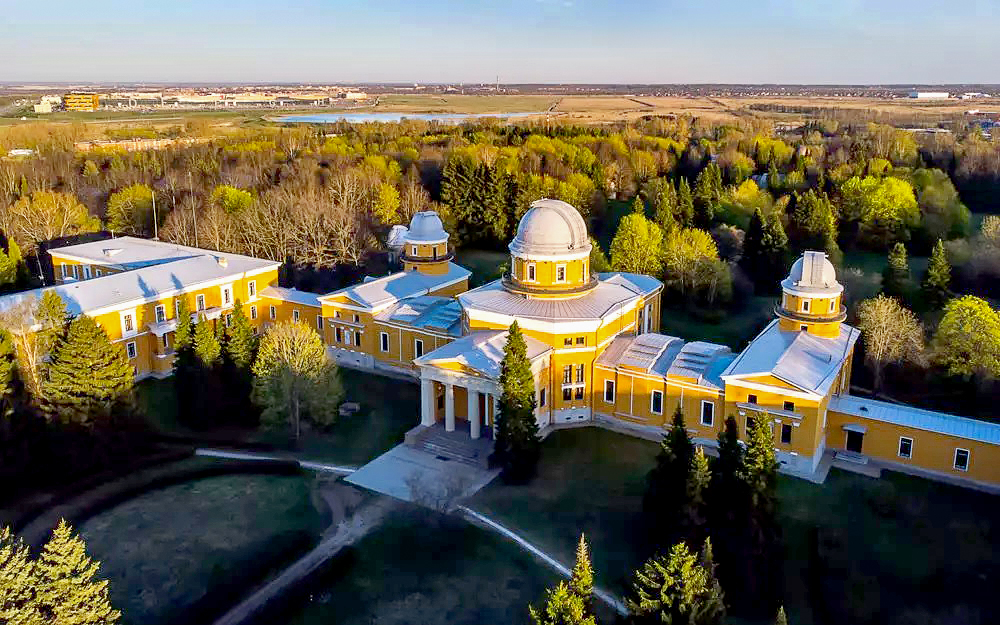
Photo from the VK group "Excursions to the Pulkovo Observatory"
Astronomical observatories are scientific complexes for the systematic investigation of the sky. At the location, they are divided into space, air, ground and underground.
Space observatories receive a signal in the wavelength ranges of the electromagnetic spectrum that do not penetrate the Earth's atmosphere (for example, ultraviolet and X-rays, gamma rays) and therefore, are not available for observation. In space, there is no influence of atmospheric turbulence and daily changes in day and night. If the first on Earth learned to overcome with the help of the so-called adaptive optics, then the second "turn off" is impossible.
Aerial observatories carry out observations in the infrared radiation range. Such an area includes the stratospheric layer that is located above the part of the atmosphere where the water vapor contained in it absorbs radiation.
Ground-based observatories have access to observations in the optical, radio and microwave ranges of the electromagnetic spectrum. Underground complexes investigate streams of high-energy charged particles, neutrinos, as well as neutrons. They are located underground to reduce the impact of natural or artificial background noise.
To date, more than 700 observatories are known, some of them are already closed. About 60 research centres function in Russia. Research is carried out on the position of planets and stars in the sky, the movement of meteorites, the formation of galaxies, stars and exoplanets are studied, the structure of the early Universe and other tasks are analyzed. Historically, most observatories are located in Europe and North America but in recent decades, they have been building large objects in the Southern Hemisphere and near the equator, where both northern and southern skies can be observed from.
Observations of the sky should be carried out in the most favorable conditions to obtain the highest quality results. When choosing a place for the construction of observatories, they rely on several criteria. The first refers to atmospheric conditions. The atmosphere should have minimal turbulence. The ideal place is at an altitude where the air is sparse and more stable. It is also important to take into account the number of clear nights per year and the level of humidity, as high humidity can result in fogging of the optics.
The next criterion: geographical location. The place should be removed from large bodies of water, as they can contribute to increased turbulence and increased humidity levels. Seismically active regions should be avoided, as earthquakes can damage equipment and interrupt observations.
The most important criteria also include the level of light pollution. The observatory should be away from major cities and industrial zones, as excessive artificial lighting makes it difficult to observe faint stars and distant galaxies.
In addition, it is necessary to take into account such criteria as infrastructure and availability. The observatory should be united to transport routes to deliver equipment and to ensure regular maintenance. It is also important to have the energy sources required for the operation of complex astronomical equipment.
A unique place on the planet that meets all of the above requirements is Chile. Chile is a world centre for astronomical research. At the moment, more than half of the world's astronomical infrastructure is located here. This country unites special natural and climatic conditions. The Atacama Desert is considered the driest place on Earth. Humidity here is the lowest on the planet - 0%. It provides exceptional transparency of the atmosphere. The lack of cloud days allows astronomers to carry out observations almost all year round. Observatories in Atacama are located at an altitude of about 2.5 km, optimal for observations.
Another important requirement is a stable and low temperature. Warm air tends to be more turbulent, reducing the accuracy of observations. The cold Peruvian current prevents air heating, in addition to it, the desert is located at a significant altitude above sea level, so it is consistently cold all year round.
Below are the world's largest astronomical centres. One of these bright complexes is the Keck Observatory. It is located in the Hawaiian Islands, on top of the Mauna Kea volcano at an altitude of 4145 m above sea level. This place is recognized as one of the best on the planet for optical observations in the infrared and visible regions of the spectrum, as it is located in isolation from factors that negatively affect observations, in the middle of the Pacific Ocean and at a considerable height. The observatory's largest telescopes are the 10-meter Kek 1 and Kek-2 that detect targets with nanometer accuracy. Each of them weighs 300 tons. Primary mirrors are composed of 36 hexagonal segments that are united into a single structure. In turn, each segment weighs 0.5 tons and has a thickness of about 8 cm. The segments are made of special glass ceramics and are covered with a layer of aluminum. Three high-precision drives controlled by computers constantly position each of the segments, forming a hyperbolic surface with a focal length of 17.5 meters. The telescopes are united by an interferometer that allows them to be used as one, with a diameter of about 85 meters. Most astronomers can expect only two nights to observe and the queue can reach 1.5 years from the date of application.
Some of the most important scientific achievements obtained at the Keck Observatory:
- discovery of the largest number of exoplanets, among them the youngest that is at the stage of formation;
- investigation of the compact radio source Sagittarius A* and proving that it is a supermassive black hole (more than 4 million solar masses) located in the centre of the Milky Way galaxy, was awarded the Nobel Prize in Physics in 2020;
- detection of the first signs of water vapor on one of Jupiter's 79 moons.
On the neighboring highland island of Palma, considered the second highest quality astroclimate in the world after the Mauna Kea Observatory, at the peak of the extinct volcano Muchachos is the Roque de los Muchachos Observatory that has unique research instruments: the Swedish solar telescope with adaptive optics that gives the highest resolution image of the Sun's surface, as well as the Great Canary Telescope, equipped with the largest mirror in the world. Its primary hexagonal mirror, composed of 36 hexagonal segments, measures 10.4 meters in diameter. Today, it is used to study planets orbiting other stars, as well as objects such as neutron stars and black holes.
Located in Chile, on Mount Cerro Paranal at an altitude of 2635 meters above sea level, the Paranal Observatory is the "home" of the Very Large Telescope (VLT). It is a complex of four separate 8.2-meter optical telescopes, equivalent in angular resolution to a telescope with a solid mirror with a diameter of 130 meters. It is Earth's largest terrestrial optical telescope. Using VLT, ultra-clear photographs of Jupiter were obtained. Also, with the help of VLT, it was possible to obtain the first images of exoplanets, track the movement of stars around the black hole and in 2005, see the afterglows of the farthest known gamma-ray bursts.
The Atacama Large Millimeter/submillimeter Array ALMA (Atacama Large Millimeter Array) is located on the Chahnantor Plateau in Chile at an altitude of 5,000 meters. ALMA consists of 66 antennas and is one of the most powerful radio telescopes in the world. It is used to study cold objects in the universe, such as molecular clouds and protostars. The telescope is designed to study the processes that took place during the first hundreds of millions of years after the Big Bang, when the first generation of stars was formed. With its help, it is planned to obtain new data explaining the mechanisms of evolution of the Universe.
The Arecibo Observatory is located in the United States at an altitude of 497 meters above sea level. It has the world's largest radio telescope with a mirror diameter of 304.8 meters. With the help of it, surfaces similar in radio-reflective properties to water ice were found in the circumpolar regions of Mercury and in 2004, the pulsar PSR J1906+0746 was discovered. The surface of the telescope reflector consisted of 38,778 perforated aluminum panels, each measuring about 1 × 2 m, supported by a network of steel cables. In 2020, the telescope collapsed as a result of wear and tear of the supporting structure.
The FAST Spherical Telescope, also known as China's Sky Eye, is a 500 m radio telescope jointly designed by China and Russia. It consists of 4450 small moving triangular panels that allow observations from different angles. The search for a suitable place for construction in southern China took ten years, since the construction required an area similar to a natural crater. The Chinese government resettled 65 villagers in the Dawodang Depression in Guizhou province and another 9,110 within a five-kilometre radius of the telescope's location to clear the space and to establish a radio silence zone. FAST became the world's largest aperture-filled radio telescope.
RATAS (Radio Astronomy Telescope of the Academy of Sciences) is the world's largest radio telescope with a reflector mirror with a diameter of about 600 meters, located in Karachay-Cherkessia, at an altitude of 970 meters above sea level. The telescope allows you to study both close objects: the Sun, the solar wind, planets and satellites and extremely remote ones: radio galaxies, quasars, the cosmic microwave background.
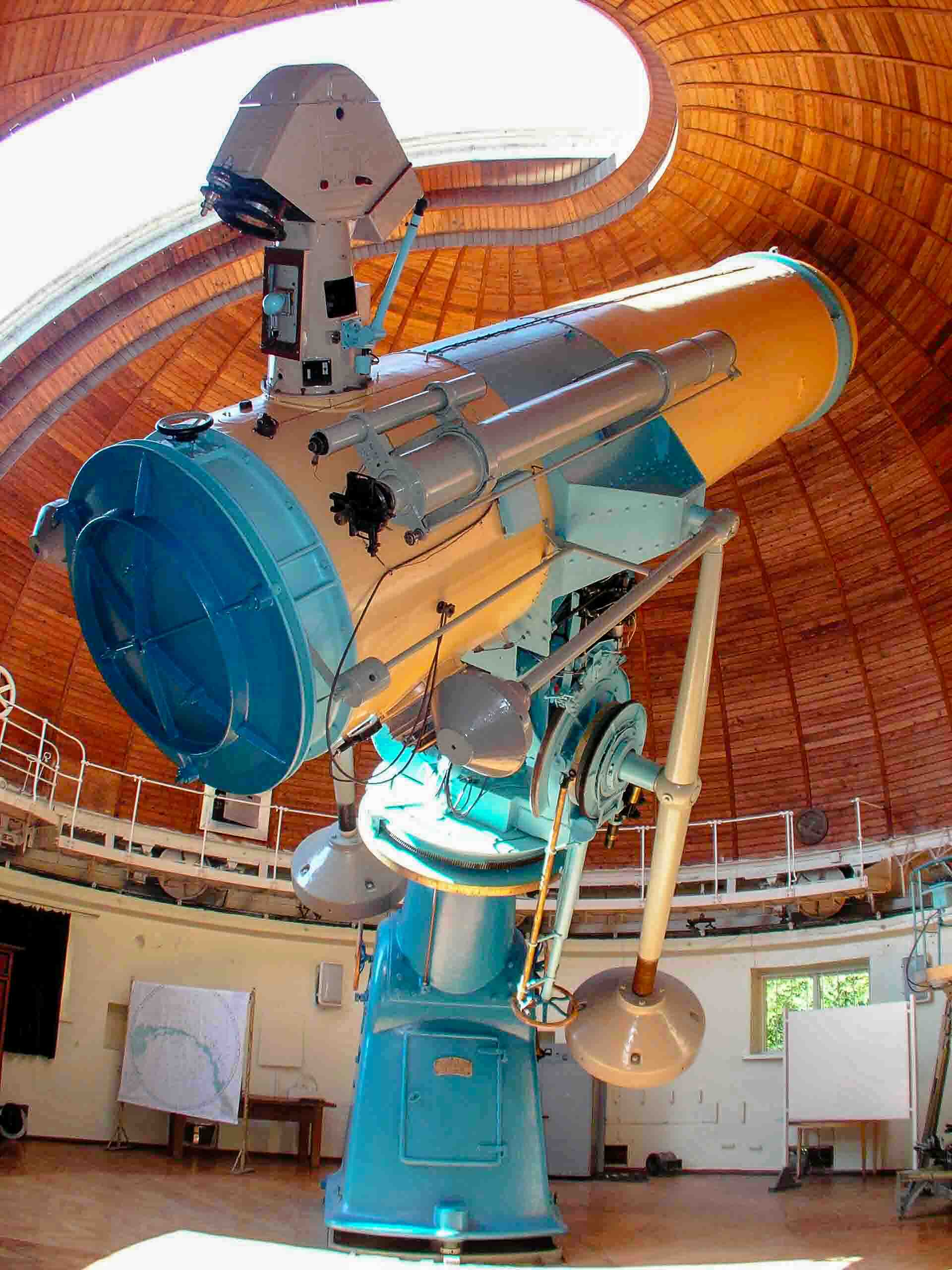
Photo from the official website of the Crimean Observatory crao.ru
The Crimean Astrophysical Observatory is located in the village of Nauchny (about 14 km from Bakhchisaray) at an altitude of 600 m above sea level. It includes 17 optical telescopes. Among them - the second largest optical telescope in Russia - a 2.6-meter telescope, the first in Europe and so far, the only operating gamma-ray telescope of the second generation equipped with a photopolarimeter. It carries out research in a wide spectral range of electromagnetic radiation - from hard gamma rays to meter radio waves - a wide variety of objects in the Universe (from space debris and artificial Earth satellites to extragalactic objects).
Pulkovo Observatory is located in St. Petersburg, equipped with a 26-inch refractor telescope, the Bolshoi Pulkovo radio telescope and the Solar Telescope (one of the largest in Europe) and others. The scientific activity of the observatory covers almost all priority areas of fundamental research in advanced astronomy: celestial mechanics and stellar dynamics, astrometry (geometric and kinematic parameters of the Universe), the Sun and solar-terrestrial communications, physics and evolution of stars, extragalactic astronomy, equipment and methods of astronomical observations.
These are the briefest details about some of the world's largest observatories, in which investigations are carried out aimed at helping to understand how our megaworld, consisting of countless stars and galaxies, works.
Maria KARPOVA