
№ 21 May 21, 2026
City and JINR through the eyes of young designers
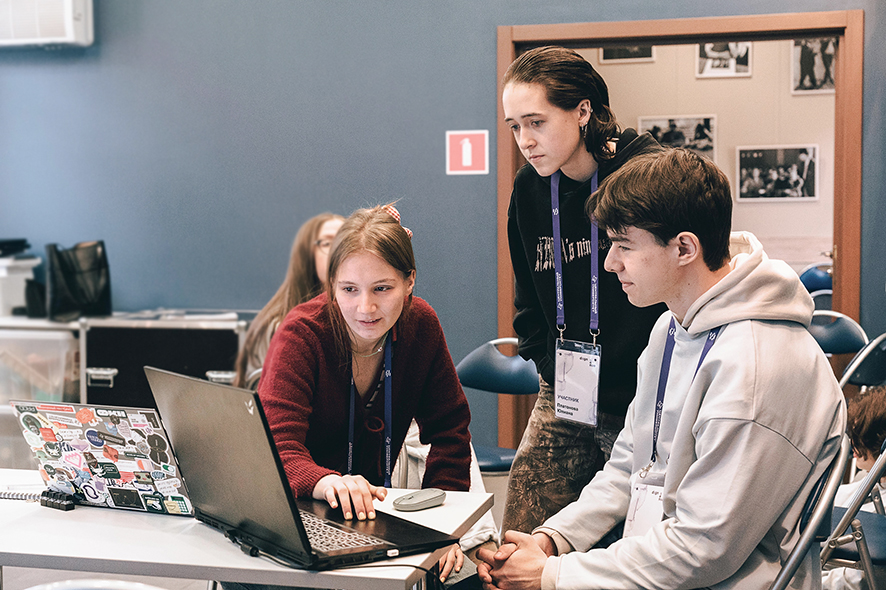
The dsgn sense Olympiad was the first event in Russia dedicated to multisensory design - an area that involves the creation of graphics, objects, interfaces and services, taking into account all channels of human perception: vision, hearing, touch, smell and taste. This approach allows you to form a deeper, emotional and holistic experience of interacting with products and environments.
Interest in the Olympiad turned out to be significant: about 7,000 schoolchildren from all over Russia applied for participation. 118 high school students from 59 cities, including Moscow, St. Petersburg, Novosibirsk, Kazan, Yekaterinburg, Krasnodar, Irkutsk, Vladivostok and others, reached the final, held in Dubna.
For three days, participants worked on practical tasks prepared by nine customers from Dubna. The topics of the projects were directly related to the urban space of the science city and the activities of JINR. The competition tasks covered three areas of multisensory design - smell, hearing and touch.
The winners and prize-winners of the Olympiad were 30 participants. In the team event, three teams won: one worked on the case of the JINR Universal Library, exploring the topic of touch; another proposed a concept for the Atom Sailing Club based on olfactory impressions; the third developed a project for the JINR Gallery, turning to tactile perception.
During the closing ceremony, Rector of the Central University Evgeny Ivashkevich addressed the participants of the Olympics, "When we open any application, not only its functionality is important to us, but also how it "communicates" with the user, how convenient and aesthetically pleasing it is. That is why we develop a multi-touch approach to design. In addition, our Olympiad is multidisciplinary and team: everyone finds a place in it and roles are distributed depending on interests and personal qualities," he said.
Press Secretary of the Institute Natalya Zaikina commented, "JINR, as an international scientific centre, has always offered a universal language of communication, be it science or art. They are based on the desire to comprehend the structure of the world and express its complexity and infinity. That is why we became partners in the final of the Central University Design Olympiad. The participants researched Dubna and the Institute, creating projects based on a multisensory approach. It was important for us to see the science city through the eyes of young designers - their interpretation of the scientific environment, attempts to translate complex ideas into a language that everyone understands. Their look is fresh, free from familiar scenarios, but careful to the details that form the uniqueness of the science city. He shows: Dubna can become livelier and closer to a new generation without losing its scientific depth. Many proposed design solutions have potential for implementation. But the main thing is to maintain the area set by the participants of the Olympiad: the desire for a more attentive, multi-layered interaction with space."
The participants presented a wide range of projects: from brand books to souvenirs, audio accompaniment and even sensory solutions related to odors and tactile perception of space. They contain not only creative potential, but also opportunities for developing a new look at the visual environment of the Institute and the urban environment of the science city.
This is especially valuable today, when the International Park of Science and Technology is developed in Dubna - a project that JINR Director Grigory Trubnikov calls "Anthropolis", from the ancient Greek words "anthropos" - a person and "polis" - a city, that is, a space for a person where conditions have been created for the most effective self-development.
JINR Press Office