
№ 21 May 21, 2026
Meet problems together
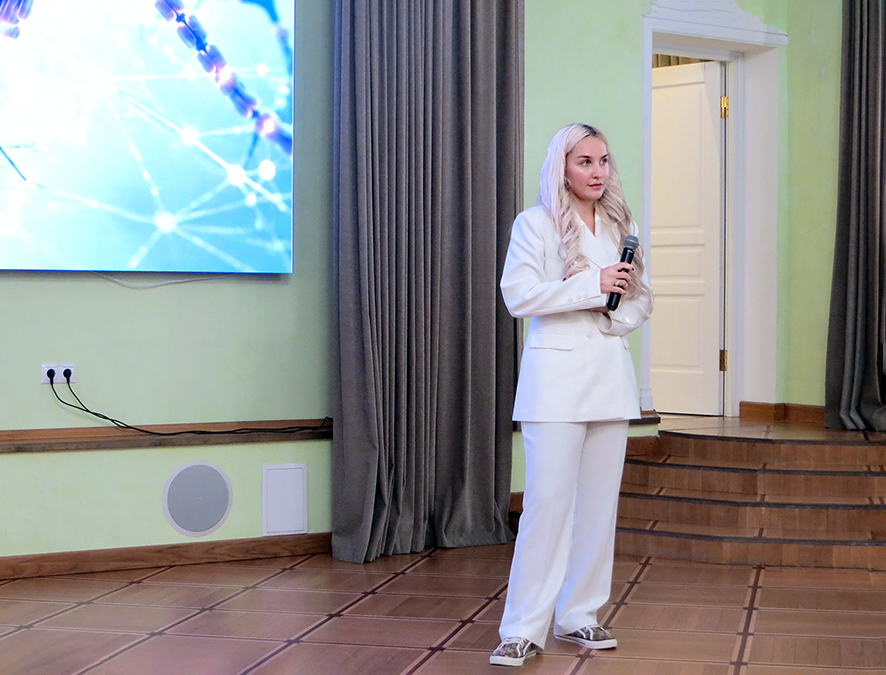
The neurologist of the Medical Unit No. 9 Anastasia Yu. Karulina made a report on the topic "Early diagnosis, prevention and modification of the course of neurodegenerative diseases". She introduced the participants of the seminar to the statistics of neurodegenerative diseases, applied methods of early diagnosis and selective effects on pathologically folded proteins in Alzheimer's, Parkinson's, Creutzfeldt-Jakob and others.
According to some estimates, 1.5-2 million people suffer from Alzheimer's disease in Russia today but only 2-3 percent of cases are diagnosed. The disease manifests itself in the loss not only of memory, but also of familiar skills, the very personality of a person. In the second place is Parkinson's disease that according to estimates, affects from 80 to 200 thousand people. Moreover, the Moscow Region is the leader in prevalence among Russian Regions (130-140 cases per 100 thousand population), in St. Petersburg - 100-120, Moscow - 90-110. According to 2024, over 3.5 million people in our country live with various neurodegenerative diseases. 80 percent of cases occur after age 65 and due to the aging of the population, an increase in incidence by 30-50 percent is predicted by 2030.
According to the estimates given in the report, in Dubna Alzheimer's disease - dementia affects about 900-1500 people, there are also frequent cases of Parkinson's disease (70-110 people) and other neurodegenerative diseases are less common. Talking about Parkinson's disease, the speaker emphasized that it begins unnoticed: headache, signs of depression may indicate various diseases. Until the disease is diagnosed, treatment cannot be started and the first mild symptoms can appear 10-20 years after the molecular changes are triggered. When, after decades, the clinical picture becomes clear but it is too late to treat the underlying cause, because three quarters of the neurons have inevitably died, doctors can only stop the symptoms of the disease. As A. Yu. Karulina highlighted, neurodegeneration is not only a medical, but also a complex biophysical problem. And Dubna can become the centre of technology for its early detection and monitoring.
She spoke about the diagnostic methods that are introduced today in the world and set the scientific and technical tasks of possible cooperation, outlining its global goal: to transfer neurodegeneration from the stage of irreversible loss of neurons to the stage of a controlled molecular process. In Parkinson's disease, you can try to identify prion proteins (proteins with an abnormal structure) by analyzing blood, cerebrospinal fluid, skin biopsy that means the availability of the disease. There are no other methods yet. There are no markers to diagnose neurodegenerative diseases in the early stages.
The speaker answered numerous questions from the LRB, MLIT employees and city residents. We learned that the brain is cleared of emerging "errors", it is done by the lymphatic system. It "cleans" the brain during a person's sleep and only from 11 PM to 3 AM. It is important to sleep during this period and not stay awake. It reduces the likelihood of Parkinson's disease during work, an active lifestyle, the lack of chronic stress, bad habits, loneliness. It is useless to do an MRI of the brain annually - you cannot determine the initial stage of the disease. "We always focus the patients of our neurological department on an active lifestyle," Anastasia Karulina emphasized.
Assistance to doctors in accumulating, analyzing data, modeling with the use of neural networks for earlier diagnosis of the disease was offered by Head of Sector of MLIT O. I. Streltsova.
"We are open to all proposals and are ready to cooperate. Together with you, we could make these investigations personalized so that it is possible to detect the disease earlier than the end stage, when they are already struggling with the consequences," A. Yu. Karulina emphasized. "We have high hopes for cooperation."

Olga TARANTINA,
Photos of the author