
Electronic english version since 2022 |
The newspaper was founded in November 1957
| |
|
Number 18 (4816) |
Veterans of our Institute
"A little less than a century my life goes on..."
On 17 April, a meeting with Doctor of Physical and Mathematical Sciences, Professor, a chief researcher at MLIT Gennady A. Ososkov was held at the JINR Universal Library. Gennady Alekseevich presented an autobiographical book "In the stream of events. Rifts". The first volume of memoirs was the result of the author's writing and the papers of the JINR Historical Archive.
"I am very glad that the historical programme of the archive and the Museum of History of Science and Technology of JINR began precisely with the book of Gennady Alekseevich," Head of the Historical Archive Elena Malaya opened the evening. “I will immediately apologize for the fact that most of those present did not read the book. 50 copies were published in paper form but an additional print run has been planned, there is an electronic version of the publication. The historical archive deals with the oral history of the Institute - memories, stories, anecdotes. Gennady Alekseevich withstood nine interview sessions that were included in the book." Elena invited everyone to the exhibition "The first star: the birth of a new interaction" at the Cultural Centre “Mir”, where among other historical audio recordings, there is a fragment of an interview with G. A. Ososkov.
For Gennady Alekseevich, writing a book began with a talk with the archive employee Anastasia Goldstein during a walk. Later, he met with HSE students that with the curator of the project G. A. Orlova were engaged in the analysis and systematization of archives in the Laboratories of the Institute. "I have memories that I have previously written for my younger sisters and my mother left notes," G. A. Ososkov said. "Anastasia turned all audio and written materials into a book using artificial intelligence." The name for the book was invented by the archive staff when they saw the topic of Gennady Alekseevich's Ph.D. thesis - "Limit theorems for flows of homogeneous events". Why is the first volume called "Rifts"? The author's whole life is associated to water - he learned to swim as a child in Mordovia, in his youth in Dubna, he traveled a lot in a kayak, loves to swim and still swims.
Since not everyone knew about the book, the author briefly, dwelling on the most significant events but very colorfully and humorously retold the main moments of his life from 1936 to 1966. (Our readers could learn about the history of life and work at JINR of G. A. Ososkov, his story about colleagues in the publications of the weekly in 2025, No. 32, 33 - O.T.) Gennady Alekseevich spent the ninth and tenth grades in Kolomna. Talking about these years, he remarked, "Teachers make people of us with meaning." He was an excellent student but he did not know how to perform at all. The teacher of the Russian language and literature Zinaida Grigorievna Yampolskaya helped that in two years made him a speaker. No less important was the influence of the outstanding teacher of mathematics that began his work experience in the tsarist gymnasium, Georgy Mikhailovich Gorshkov (his son became the admiral of the USSR fleet, whose name the frigate of the Russian Navy was named after). He handed out leaflets with tasks that had to be not just met but tried to get ahead of his classmates. As Gennady Alekseevich said, it was interesting and helped him when entering the Mechanics and Mathematics Department of Moscow State University. As a gold medalist, he had only to meet tasks: out of 12 tasks, 8 turned out to be familiar, from those very "tasks on pieces of paper".
Gennady Alekseevich also warmly recalled his scientific supervisors in the graduate school of A. Ya. Khinchin and later, A.N. Kolmogorov that replaced him. For life, he remembered Khinchin's words - "The proof must be elegant" and learned to prove theorems and enjoy it. He described Kolmogorov as "a completely non-standard Academician".
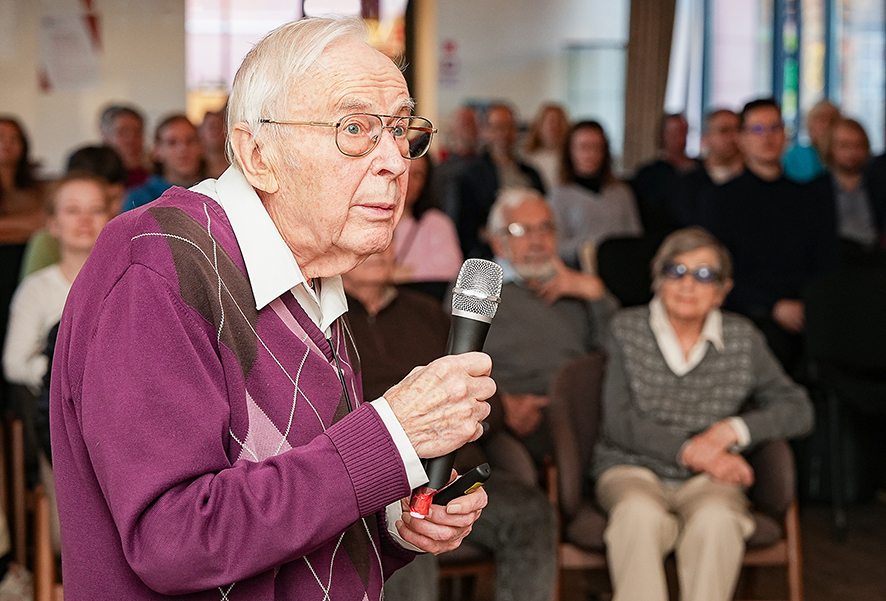
In the life of Gennady Ososkov there has always been a place for sports. It was in the athletics section that he met his future wife Inna Poryadina. In 1956, he got to work in a closed research institute that was engaged in tasks relevant to military aviation. There, he learned to program for BESM-1 and Strela computers and use the Monte Carlo technique that in future, helped him when working at JINR.
As Gennady Alekseevich has recently found out, during the period of work after retirement, he has written more scientific articles to be published than all the years before. The explanation is simple: he began to engage more in exactly what he is very interested in - neural networks.
Answering questions, he said that for several years, he had headed the Dubna Club of optimists. "It turned out that there are many optimists in our city," Gennady Alekseevich said. "The Club was closed but I have always been optimistic!"
When asked about the wall newspaper of LCTA "Impulse", he said that he participated in the release of wall newspapers at school, drew well, then released the wall newspaper of Moscow State University "Student's Voice" and still makes home wall newspapers. In BLTP, where G. A. Ososkov began to work, the editor of the wall newspaper was E. V. Sharapova, as he emphasized, an unusually proactive and intelligent person that later published the wall newspaper “Impulse” together with her colleagues at LCTA. "Sparkling Slava Shirikov took part in it, I also tried to keep up. The bosses listened to “Impulse”. Now, this wall newspaper is no longer there," Gennady Alekseevich sighed.На давно ожидаемый им вопрос об искусственном интеллекте он ответил с профессиональной дотошностью и, кроме того, вспомнил интересный факт. В 1960-х годах на ЭВМ БЭСМ-6 была реализована программа «Элиза», печатавшая ответы на вопросы, которые задавались ей в письменном виде. Ответы были настолько интересными, что операторы ЭВМ даже советовались с ней в решении семейных проблем. А Галина Волчек, приезжавшая с театром «Современник» в Дубну, побеседовала с «Элизой», думая, что общается с человеком. «ИИ может быть полезен, а может быть опасен, – подчеркнул Г. А. Ососков. – Мои студенты в университете «Дубна», несмотря на явно недоброжелательное отношение к ИИ преподавателей, пользуются им. Для студентов это подспорье, но их надо научить, как использовать ИИ для дела».
He answered the long-awaited question about artificial intelligence with professional meticulousness and in addition, remembered an interesting fact. In the 1960s, the programme “Eliza” was implemented on the computer BESM-6, printing answers to questions that were asked in writing. The answers were so interesting that computer operators even consulted with it in meeting family problems. And Galina Volchek that came with the Theater “Sovremennik” to Dubna, talked with “Eliza”, thinking that she was communicating with a person. "AI can be useful, or it can be dangerous," G. A. Ososkov emphasized. "My students at Dubna University, despite the clearly unfriendly attitude towards AI by teachers, use it. For students, it is a help, yet they need to be taught how to use AI for business."
He said that he had sang in amateur performances and the question of his favorite song followed. Gennady Alekseevich began his answer from afar. His parents attended parochial school, sang in church and sang extensively at home. He knew all the folk songs. Once, at CERN in a folk song club, he dared to perform several Russian folk songs and was a success. And on the first date, Inna took him to the Moscow Conservatory for Mozart's Requiem and he fell in love with classical music forever. In the 1960s, while on a business trip in Germany, he first heard the compositions of The Beatles and was shocked. Gennady Alekseevich also knows and loves the bardic song.
And of course, we heard the author's poems - the first poem, born, according to the author, in longing from separation from his beloved wife in 1964 and a very fresh poem "About myself", written for the 95th anniversary. In it, he managed to set out his life, character traits and life principles in four stanzas:
A little less than a century my life goes on,
And I want to live and I don't need fame...
Olga TARANTINA,
Photo by Olesya CHEPURCHENKO
