
Electronic english version since 2022 |
The newspaper was founded in November 1957
| |
AYSS Seminar
Union of science and medicine
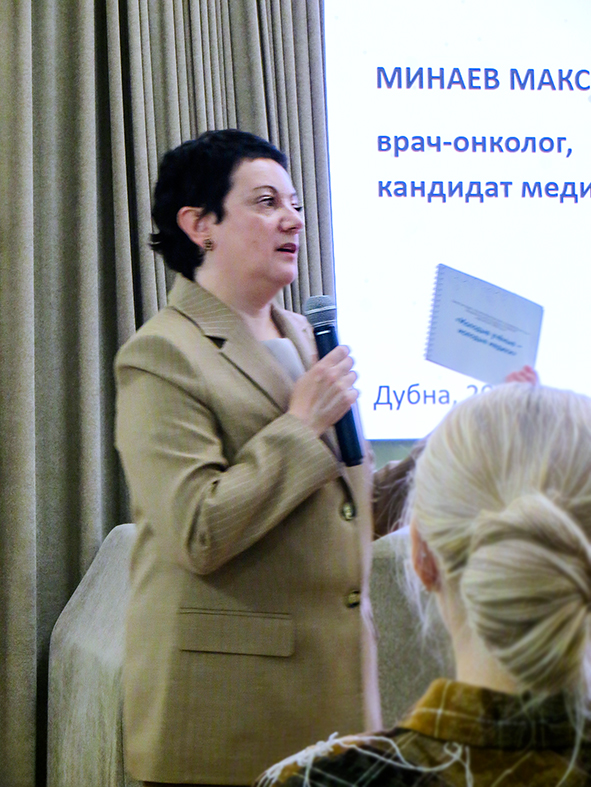
On 15 April, at the JINR Scientists’ Club, at the seminar of the Association of Young Scientists and Specialists, the oncologist Candidate of Medical Sciences M. S. Minaev made a report "Personalized radiation therapy: at the junction of medicine, biology and physics".
The next AYSS seminar was the first event in the joint medical-scientific communication and research project of JINR and the Medical Unit No. 9 of the FMBA of the Russian Federation "Young scientists - young doctors".
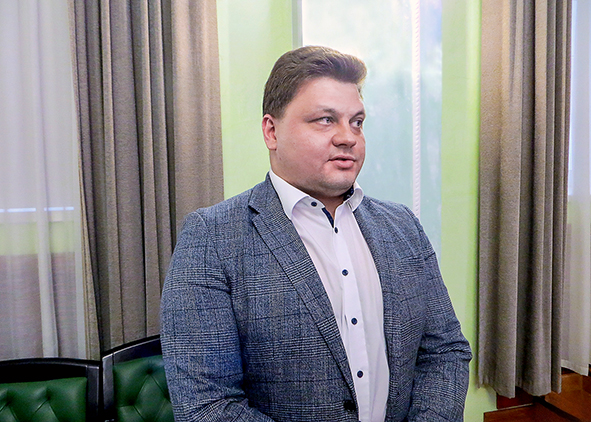
Opening the seminar, Deputy Head of the Medical Unit No. 9 N.V. Balashova emphasized the urgent need to integrate research and practical medicine. She expressed the hope that the project will not become a formality but will ultimately serve to improve the quality of medicine and the lives of patients. "There is a problem of introducing advanced ideas of science into practical medicine," N.V. Balashova said. “We are lucky that there is JINR in Dubna. What is done today in the laboratories of the Institute may become the standard of medical practice tomorrow. The fusion of science and practical medicine today is not a luxury but a practical necessity."
Natalia Balashova
|
Maxim Minaev, as a student, started working in an ambulance, later, delved into science, studying Hodgkin's lymphoma. Having become an oncologist, he defended his thesis on this topic, today, he works in a polyclinic and hospital. According to Maxim Sergeevich, radiobiology at first was not in his area of interest. Acquaintance with E. A. Krasavin and his scientific research expanded the scientific horizons of M. S. Minaev.
In his speech, he considered a theoretical approach to personalized radiotherapy, implemented through interdisciplinary cooperation in the fields of medicine, biology and physics. And he began the report with statistics: in Russia, from 2021 to 2024, cancer incidence increased from 397,900 to 477,600 cases and the number of patients that have been registered with an oncologist for more than five years also increases. Among the reasons are the aging of the population, improved detection of diseases and an increase in patient survival. Oncology ranks first in the proportion of hospitalizations for specialized care, ahead of the costs of medical rehabilitation and cardiovascular surgery. According to the WHO forecast, 35 million new cases of cancer will be detected annually by 2050. All this increases the burden on the health care system, therefore, new approaches need to be sought.
The type of radiation therapy today is chosen based on the physical properties of the beam, without taking into account the molecular properties of the tumor. Its repair profile (occurrence or lack of DNA repair defects) estimates the radiosensitivity of the tumor, it should be taken into account when choosing the type of radiation and dose. It means that classical radiotherapy can be replaced with treatment with small doses of radiation that do not have serious consequences for the body. Another reason to study tumor biology is the abscopal effect, in which local radiation can cause a systemic immune response of the body (mediated suppression of metastases).
Maxim Sergeevich voiced the tasks that he sets for himself and future colleagues on the project: to study the repair profile in specific tumor models; to estimate the difference in radiosensitivity (clonic survival) of these models under photon, proton and ion irradiation; to test the effects of combined use of medicinal products with different types of radiation in vitro and in vivo; to develop a predictive model (biomarkers) to select the optimal treatment trajectory for the tumor profile. According to the speaker, the project will allow to unite the physics of radiation with the molecular biology of the tumor and the union of radiobiology and molecular oncology will allow to develop an algorithm for personalized irradiation. The results of the project will provide an evidence base for the use of molecular genetic screening of tumors in the clinical planning of radiotherapy and the rationale for uniting radiation therapy with various drug agents. For the first time, biological criteria for choosing the type of radiation and dose can be developed that will increase the efficincy of treatment and reduce side effects.
M.S. Maksimov expects that this project will become interdisciplinary. It seems to me, it can be hoped for. At least, the interest of the seminar participants, most of whom were employees of LRB and DLNP, was sincere and Scientific Secretary of LRB I.V. Koshlan, concluding the discussion, expressed the hope that the cooperation would work out.
And it is no coincidence that the Medical Unit No. 9 prepared notebooks and pencils for this project with the Latin saying: Qui quaerit, reperit that means "who seeks, he finds".
Olga TARANTINA
Photo by the author
