
Electronic english version since 2022 |
The newspaper was founded in November 1957
| |
Historical overview
When luck is knocking at your house
Institute Dubna – 1961
To be engaged in basic research
is like shooting an arrow into the sky
and where it sticks, to draw the target.
Homer Adkins
"A new chemical element is urgently needed" - this is how it would be possible to start another historical overview but we will start with the first entry in the diary of Dmitry Ivanovich Blokhintsev, "Here is the pass to the new decade. It looks at us with the gloomy eyes of Kant Europe. Heavy, stubborn thought. Heavy, stony face..." In early February: "Shakespeare's tragedies are trifles compared to the tragedy of our time. Hamlet suffered "to be or not to be?" Only one Hamlet. Now, all of humanity asks this question..."
The planet is storming but the gloomy thoughts of the first Director of JINR are caused not only by alarming events in the world. Signal from Moscow: maybe you are not sitting like that, maybe you should transfer? Give something little... Poles are unhappy: "non-international". The disturbing silence of the Chinese... 5 July entry: "Trishkin kaftan darned today. We discussed how to build a pi-meson tract, how to open 104, others. The secretary of the city committee comes, says it is necessary to send to the collective farm: there is no one to remove hay. So, what: π+→ π0 + e+ decay or hay? This is a difficult task!" In the Sanatorium “Uzkoe”, DI gives birth to the image of a horse that has torn the frames; the horse broke free and stupid thoughts that "freedom is a conscious necessity" do not come to his proudly upturned head. Sometimes, you want to throw everything and to drive somewhere in the taiga, to a new building, away from all these worries... - this is from the diary of Dmitry Ivanovich 1961.
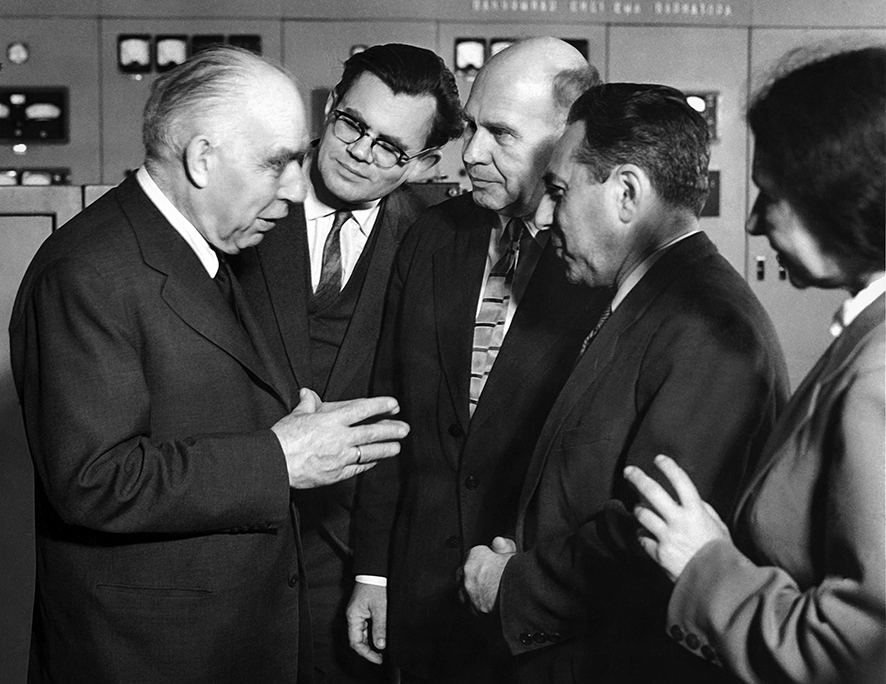
Niels Bohr, I. D. Rozhansky, D. I. Blokhintsev, V. P. Dzhelepov, S. I. Drabkina. 10 May, 1961. Photo by Pavel Zolnikov
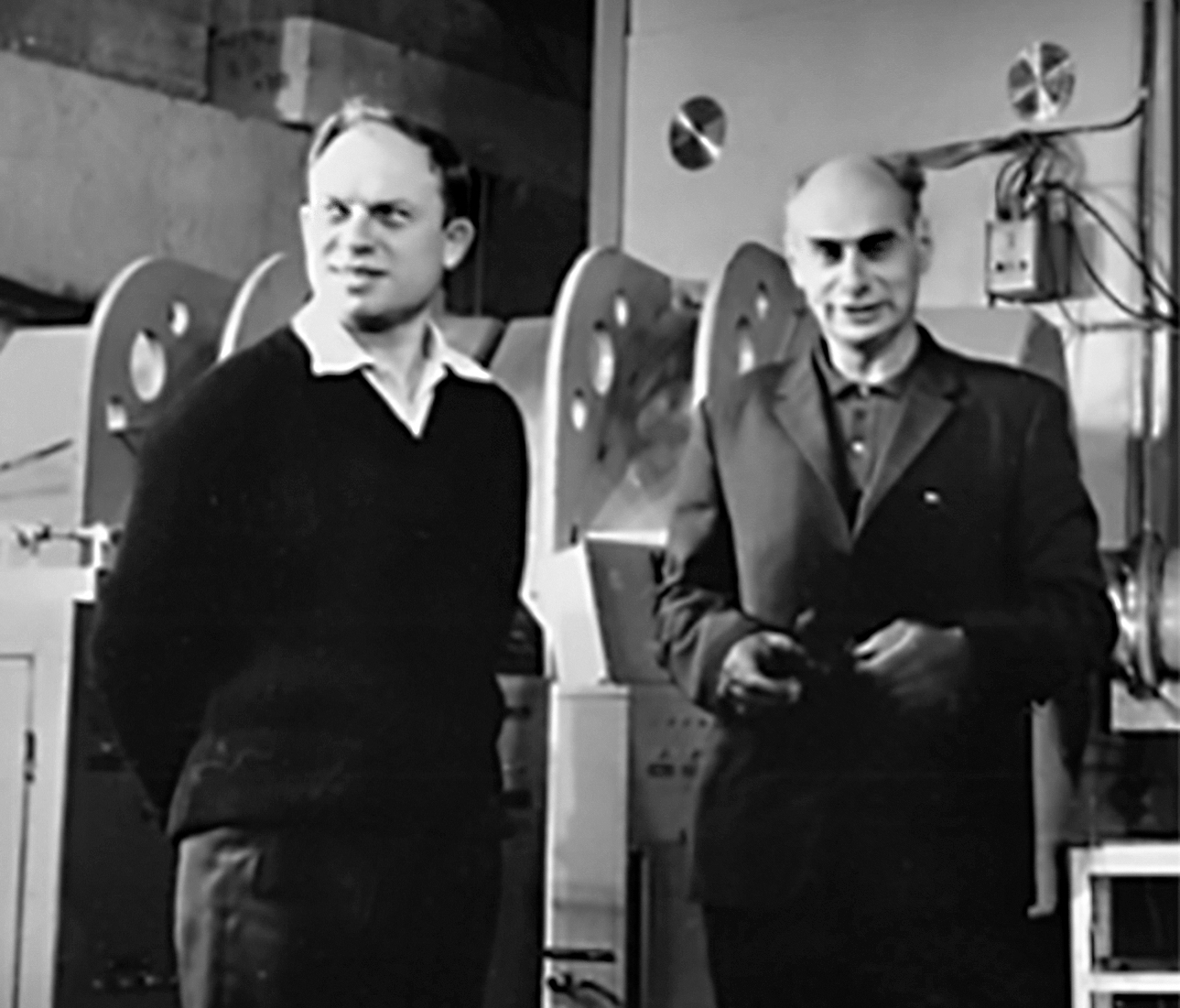
S. M. Polikanov and G. N. Flerov. Shot from Olga Pechenova's documentary "Barrier"
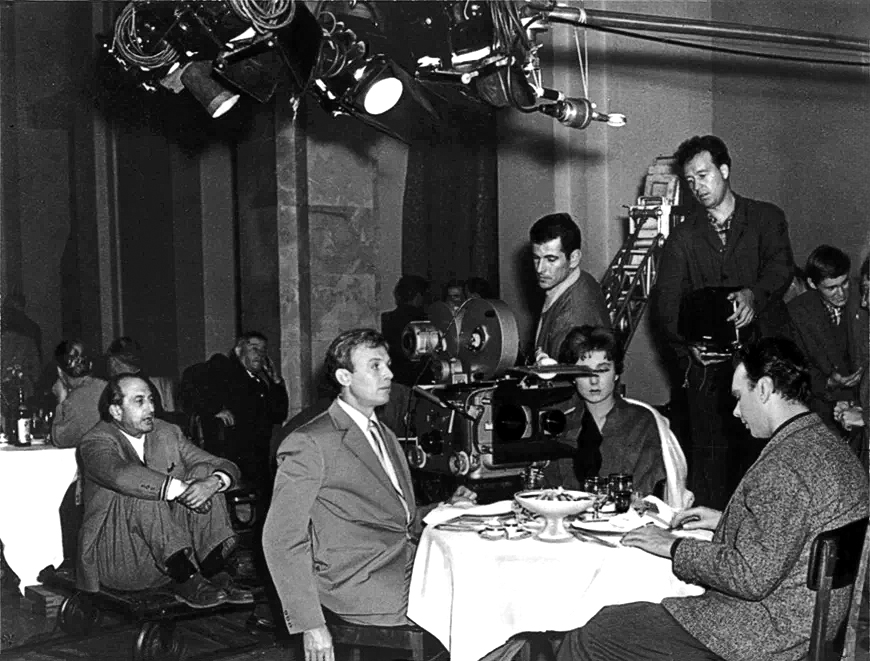
Some episodes of the film about nuclear physicists "Nine days of one year" were shot in Dubna and JINR,
August 1961
But here we take the filing of the city newspaper for this year and see there completely different moods. The first issue begins with the headline, "Another year closer to Communism". The country is on the rise. Its spaceships plow the world's space. Pilot-cosmonaut Lieutenant Yuri Gagarin climbed into space, made a turn around the Earth and returned as a major and Hero of the Soviet Union. In the same year, Lieutenant German Titov took off into space, made 17 turns, was the first to go through the test of daily stay in zero gravity and also returned as a major and Hero. Interplanetary station "Venus-1" went to the "morning star". A new television programme has started on Central Television - "Club of the cheerful and the resourceful” ...
And the Joint Institute, in spite of everything, is still on the rise. The report for the first five-year period has been adopted. International cooperation develops. Three CERN physicists arrived to work at JINR, in accordance with the agreement and three of ours returned from CERN after a six-month business trip and are already keeping a report. As if the problem of mathematical data processing was met: a new powerful M-20 computer was commissioned in the BLTP Computer Department and the Ural-1 slow-moving vehicle was sold "to the other side" - either at DMZ (at that time, plant No. 256), or at the Raduga Design Bureau (at that time, a branch of the Moscow DB-155).
The stream of high-ranking persons slept noticeably but JINR is still in the focus of the whole world and at the highest level: in May, Dubna meets the author of the quasi-classical theory of the atom, Niels Bohr, on whose shoulders stood such authors of quantum mechanics as Werner Heisenberg and (at the suggestion of Louis de Broglie) Erwin Schrodinger. We should not turn our noses up about it, Bor visited not only us - he was both at the Kurchatov Institute and at the Lebedev Physical Institute and on the Lenin Hills he watched the physics opera Archimedes that was presented by students of the Physics Department of Moscow State University and later, when asked what he remembered the most in Moscow, Bor answered very briefly, "Archimedes". At the Institute of Physical Problems at Kapitsa, Bor also mentioned his impression of Dubna, "Yesterday, my son and I were in Dubna. I met many wonderful physicists there and saw those magnificent, powerful devices which they work with. Fifty years ago, when I started working for Rutherford, the largest device did not exceed the size of a shoe box..." It is well known what Bohr said after being shown our synchrophasotron, "I admire the courage of the people who ventured..." – and so on. Duty phrase, standard politeness formula. But what he said after meeting IBR-1, the world's first pulsed nuclear reactor, is much less known; already pretty tired, the third laboratory in a row, Bor limited himself to the phrase, "What a simple and elegant machine" - this phrase was remembered and preserved for history by a young specialist Evgeny Shabalin, the future chief researcher of FLNP.
And yet, the main event of the scientific Dubna of that year was not the visit of the patriarch of quantum theory, no matter how significant, but the discovery of the spontaneously fissionable isomer of americium-242 that was accidentally reached in the Laboratory of Nuclear Reactions, at the very end of the year and at first, it was perceived as a failure and only over time, did it become clear how much this discovery affected all nuclear physics.
So, autumn, 1961. Georgy Nikolaevich and his young team, having lost half of their composition (almost all Moscow students stayed in Moscow), moved to Dubna. Behind is the installation of the U-300, its adjustment and finally, the exciting moment when the target, as physicists poetically express, "saw the beam". New, the world's best heavy ion accelerator, 100 times the intensity of the Berkeley accelerator, is a huge advantage over the Americans. Sergey Polikanov, the first student of Georgy Nikolaevich and his right hand in the laboratory, together with yesterday's graduates of the Leningrad Polytechnic Institute A. Pleve and V. Fomichev, is preparing an experiment on the synthesis and identification of the element 104. The bulky facility, dubbed "Elephant" for its clumsy look, has already been tested for interference resistance. Other physicists of the laboratory are engaged in the work. And here, contrary to the expectation that now new elements and isotopes will sprinkle from the U-300, the miracle accelerator begins to produce completely different results.
From the book "Break", written by Sergey Polikanov in exile:
"After the November holidays, we start the experience. If now our "Elephant" speaks, it means that we have discovered the element 104... Finally! The nose of one cone swayed and slowly crawled to the left, crossed the ribbon and returned to its original place. There was a division of some atomic nucleus. Is this really element 104? Half an hour passes and again the nose of the same recorder crawls again to the very edge of the tape. Several hours pass and we see fifteen signals on the tape of the first recorder and not a single one on the other. Irradiation continues. Together with Flerov, I walk along the corridor. Flerov rubs his hands with pleasure: "Well, Seryozha, I'm ready to bet you on a bottle of cognac that this is element 104..."
We interrupt the irradiation and move our "Elephant" to a new position. The signals must disappear. To our surprise, there were twice as many of them! What does it mean? Flerov darkens. He is clearly disappointed and there is no longer any conversation about cognac... So, the opening of the element 104 did not take place. But what do we observe in this case? We are sure of one thing. This is not electrical interference but decay by fission of some unknown atomic nucleus."
Georgy Nikolaevich once uttered a wonderful phrase, "In science, it is very important to go your own way, albeit risky and difficult, but only on this path real victories can be won." This is exactly what his first student Sergey Polikanov did. From the book "Break", "How to be next? Once again, having gathered in Flerov's office, we argue. Two paths open before us. One is to forget for a while about the element 104 and fully engage in the hunt for the "mysterious stranger". It looks like it has been present for several months and we tried to "kill" it, mistaking it for electrical interference. The second way is to remake the equipment so that it is not sensitive to the "stranger", forget about it, to get rid of it and to continue the search for the element 104. Well, this option is also possible but I don't like it..."
Sergey Mikhailovich was a gentle man, so said everyone who knew him. But there was a core in him and Flerov was convinced of it. With two like-minded people, A. Pleve and V. Fomichev, Polikanov went to Moscow and continued research on the 1.5-meter cyclotron of the Kurchatov Institute, realizing that he would not be allowed to do it on the U-300.
For Flerov, the "mysterious stranger" that his first student undertook to study, was an annoying hindrance on the way to 104, Flerov believed that this was an insignificant result for science and made it clear in every possible way. He even took off his last name in the first publication about the discovery of a spontaneously fissile isomer. And he offered to do it to everyone whom he attracted at the verification stage: let those who prepared the experiment remain on the list of authors. And I came across, as V. A. Karnaukhov said, silent resistance. For what reason? We abandoned our work, worked hard... What was Georgy Nikolaevich guided by? Even people who knew him for many years could not answer this question. V. A. Shchegolev that thought a lot about Georgy Nikolaevich, writes in the book "In the past through thoughts", "I go through the episodes associated with Gahan but his image slips away - he, like mercury, scatters between the lines, this person was so diverse and non-standard." And at a lecture on the first discoveries of FLNR, when asked why Flerov took off his last name, Vladislav Aleksandrovich chopped, "Do you want to find a reason? Don't look!" Another student of Georgy Nikolaevich, V. A. Karnaukhov, thoughtfully added, "He had some kind of logic..."
Intuition rarely failed Georgy Nikolaevich. It was just that rare case. Interest in spontaneously fissile isomers, contrary to his expectations, did not fade, on the contrary, the frequency of references to the first publication about an isomer with an abnormally short half-life only increased over time, "As Polikanov showed...," "The Polikanov group established..." And Georgy Nikolaevich, as one of his students of the third draft, Yu. P. Gangrsky, was sad. He instructed one of his employees to look for new spontaneously dividing isomers* but time was lost. Meanwhile, the cracks in the relationship between the teacher and his first ("and dearly beloved", as V. A. Karnaukhov added) student grew, grew and in 1970, Sergey Polikanov left the Laboratory.
* N.K. Skobelev, who Georgy Nikolaevich gave this task to, during the search discovered the phenomenon of delayed fission of atomic nuclei.
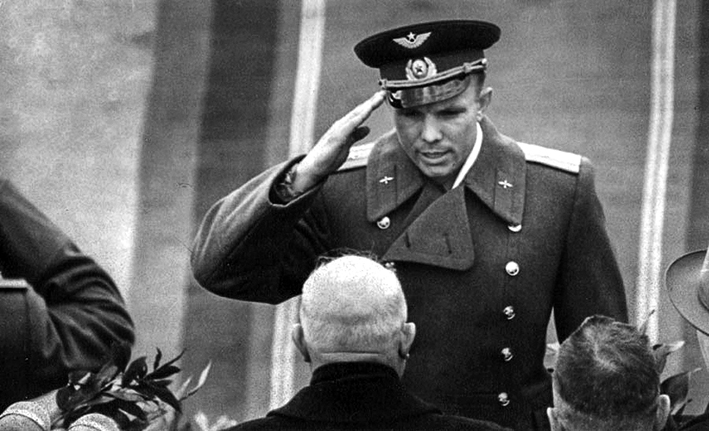
Yu. A. Gagarin is reporting to N. S. Khrushchev about the successful return from space flight during the solemn meeting at Vnukovo Airport. 14 April, 1961. Photo by RGASPI
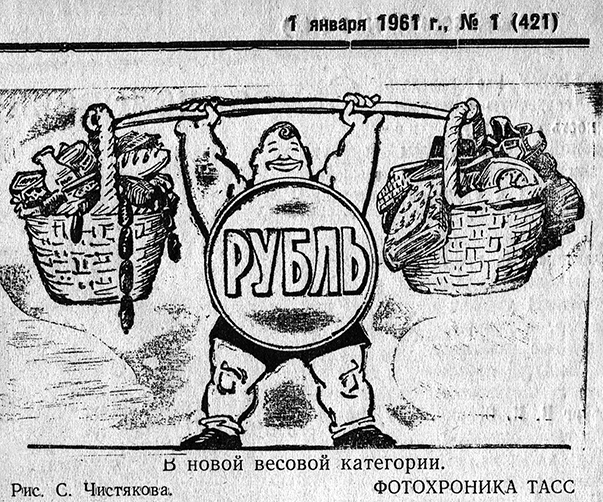
Operation “Denomination”. I will teach you to bend over a penny, the First Secretary of the CPSU Central Committee N. S. Khrushchev promised the citizens of the USSR
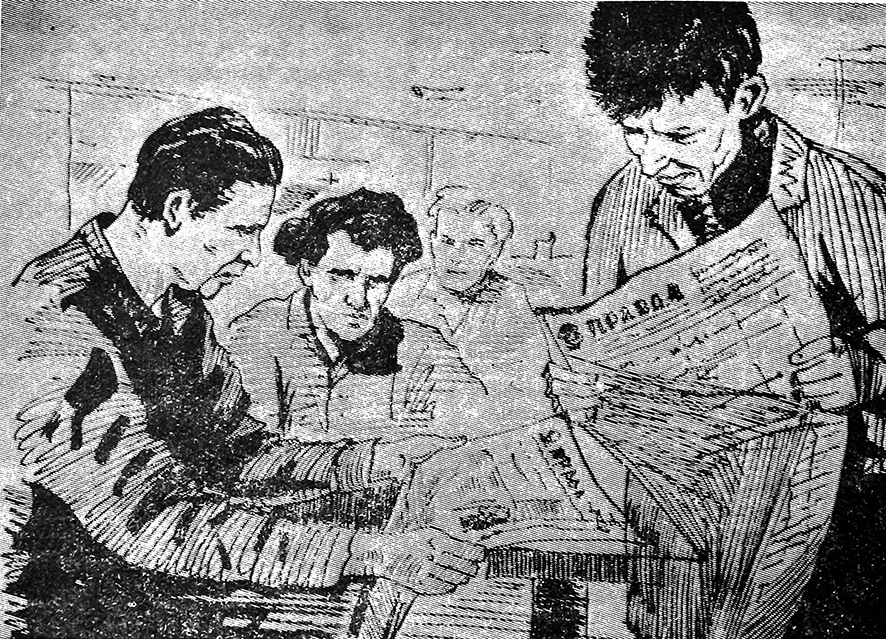
The working people of our city show great interest in the materials of the 22nd Congress of the CPSU. During lunch breaks, after work in workshops, departments, at construction sites, readings of N. S. Khrushchev's reports and speeches by speakers at the congress are held. Drawing by Vyacheslav Bochkarev. From the newspaper "For Communism"
Alexander RASTORGUEV
