
Electronic english version since 2022 |
The newspaper was founded in November 1957
| |
|
Number 13 (4811) |
Youth and science
Meet the first LRB scholarship winner
Last year, a scholarship named after Corresponding Member of the Russian Academy of Sciences, an organizer and LRB Scientific Leader E. A. Krasavin was established at the Laboratory of Radiation Biology to stimulate young scientists. The first winner of the scholarship was the employee of the Molecular Radiobiology Sector, Leader of Group of Immunocytochemistry and Cytometry Tatyana KHRAMKO. Today, we’re introducing her to our readers.
Why have you chosen biology?
– At school, I was fond of physics and mathematics, I wanted to enter the specialty "Nuclear Physics". In the tenth grade, I came across a textbook by A. V. Boreyko, "Introduction to Radiation Biophysics", published for students of Dubna University. I was very interested in the effects of radiation on living organisms, especially, damage occurring in DNA. We weren't told about it at school. I decided to enter the Department of Biophysics at Dubna University. When I came to apply, I got into the lunch break of the selection committee. I managed to take the necessary forms, sat down to fill them out next to two consultants. Having learned where I want to go, they said not to wait for the end of the break and helped to submit documents. I entered and what was my surprise when one of these consultants turned out to be a lecturer at the very first lecture and it was Alla Vladimirovna Boreyko!
The Department of Biophysics of the University is directly related to LRB JINR. Many graduates of the Department, while still students, begin to work in the Laboratory and I was no exception and seriously became interested in radiobiology. Moreover, the theoretical base at the university is given a good one but practice in the biological field is always lacking. After five and a half years of study, I entered graduate school, studied there for four years and currently prepare a Ph.D. At the same time, I work with students and always tell them that the sooner they come to the Laboratory, the sooner they will get the necessary skills in working with equipments, master techniques and learn to work in a team. The result is a knowledge base above average that greatly contributes to successful employment. Very good specialists grow out of such students.
Currently, there are six employees and three students in our Group of Immunocytochemistry and Cytometry: two undergraduate students of our Department of Biophysics and a specialist student in nuclear physics at Moscow State University. Students work together with researchers, gaining experience and knowledge, as well as widely helping them during experiments.
And later, in the Laboratory, did you communicate with A.V. Boreyko?
- Of course, Alla Vladimirovna was the supervisor of my diploma paper and then, became the supervisor of my thesis. She has headed the Sector of Molecular Radiobiology for many years and today, she is Deputy Director of the Laboratory for research, so we constantly work together. I appreciate her expert opinion, since Alla Vladimirovna is Doctor of Biological Sciences and a professor that has dedicated many years to research. I find especially valuable recommendations in the practical nuances of the experiments carried out in the Group, exceptional attention to detail is a huge help in our work. When we started to study the classic technique of macrocolonies, Alla Vladimirovna gave a lot of valuable advice on how to properly approach their analysis, construction and interpretation of survival curves. We also often discuss various concepts for a thorough understanding of the fundamental ideas inherent in experiments and the correct interpretation of the results obtained; this is very valuable to me.
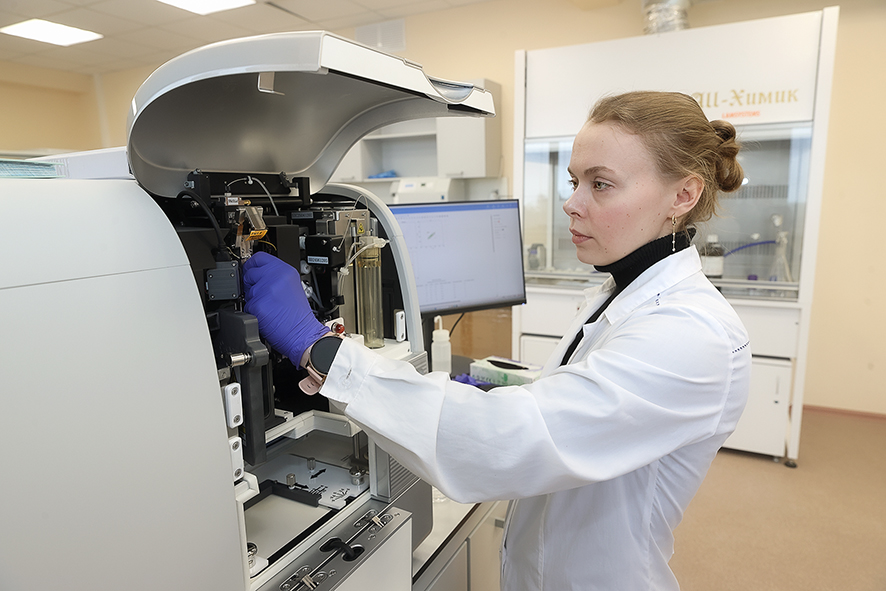
But biology as a science is vast...
- I followed radiobiology. I am interested in how ionizing radiation affects biological objects, what properties of radiation affect the effect, how it can manifest itself at different levels of organization and in different tissues. When I was in my last years of university, LRB started extensive research in the field of cosmic radiobiology, related to the investigation of the effect of accelerated heavy ions on the structure and functions of the central nervous system. I asked Evgeny Alexandrovich if I could study this topic? He answered in the affirmative and I began to work on this topic with animals and later, with primary cultures of hippocampal and cerebellar cells. My thesis is related to the investigation of the formation and elimination of molecular damage in various parts of the rat brain. Radiation and the brain are an inexhaustible topic for research and if we consider that the methodological and instrument base is constantly improved, then it is endless.
At present, while we are looking forward to the launch of accelerators, we mainly use X-ray tools to study the effect of DNA repair inhibitors that can enhance the effect of radiation. The key task of research is to study the modifying effect of arabinoside cytosine (AraC) on the radiosensitivity of tumor and normal cells. This DNA repair inhibitor is able to enhance the effect of radiation on tumor cells, thereby increasing the effectiveness of radiation therapy. We have at our disposal several X-ray units that allow one to irradiate both small laboratory animals and cell cultures. To a greater extent, the investigation focuses on the culture of mouse melanoma cells of the B-16 line, provided by colleagues from the A.F. Tsyba MRNC (Obninsk). We work closely with colleagues from Obninsk. Previously, they obtained good results with the joint use of an AraC inhibitor and proton irradiation in the therapy of mouse tumors that was highly appreciated by the Russian Academy of Sciences.
We also work on improving analysis techniques together with MLIT. The joint project is based on the use of machine learning algorithms developed by a group of colleagues under O. I. Streltsova to analyze fluorescent images obtained in LRB using immunocytochemical staining and visualization of proteins of markers of double-strand DNA breaks (radiation-induced foci).
You have talked about animal experiments but do not you feel sorry for mice?
– Of course, it is a pity but it is necessary to make difficult choices - either they or another biological object. In fact, we often argue about the ethical background of biological research. But so far, unfortunately, without the use of laboratory animals, it is impossible to fully study the effect of radiation at the organizational level or how a tumor is produced and lives and this is an amazing object. It is able to grow blood vessels, forcing the body to supply itself with oxygen and nutrients, changes the entire immune reaction of the body - it cannot be simulated in a petri dish.
If we refuse to experiment on animals, then what, to carry out them on humans? Without a preliminary investigation of the possible side effects of radiation or use in animal experiments, drugs can cause irreparable harm to health and this is contrary to all ethical standards. Clinical trials of the drug in humans begin only after it has already passed several stages of clinical investigations, first, in vitro and then, in vivo, in animals, including, mice. In addition, any science requires adequate statistics and repeatability of the result obtained, which specially bred laboratory animals are used for. Therefore, although it is a pity for animals, such investigations are justified and so that experiments are not dictated by banal curiosity, all animal experiments have to be coordinated with the laboratory ethics committee that officially gives permission or a ban on work. Everything is taken into account, including the suffering that animals can experience from the actions of experimenters. If the objectives of the experiment are found to be unreasonable, then it will either not be carried out at all, or it may be recommended to make changes in order to minimize the suffering of animals.
Do you use artificial intelligence, in addition to machine learning capabilities?
- We use it but with great caution, rather we use it as an extended version of the search engine. Any AI response is generated but it does not mean that it refers to a specific scientific publication and scientists need specific work with all the output data. We also warn our students against using AI without looking back - you cannot take its answer at face value. AI owns a huge amount of information but it generates a response. Such generation is not a direct retelling of the publication text and may contain errors and even the source indication itself may not be adequate. You start looking for a job and it does not exist, so everything needs to be checked. AI "finds" information, it simplifies life but you need to understand how to form a request and approach the result very critically. Composing a query is a whole art. From my point of view, it is necessary to conduct a kind of dialogue with AI, whenever possible pointing out errors and rechecking its answer with several different requests. Often, when you indicate where it was mistaken, the AI agrees.
And the last question... How do you remember Evgeny Alexandrovich Krasavin?
- Evgeny Alexandrovich reverently, carefully treated students, supported interest and desire for science. We loved his lectures, he never harshly "drove" us to the exam, but at the same time, he did not indulge. He continued to lecture almost until his death. He had extensive experience in various fields and when we wrote articles or prepared reports, we always consulted with him. For me and I think, for our Laboratory as a whole, he has always been, is and will be a person with unique knowledge, an ideological inspirer and a banner that personifies the desire for science.
Olga TARANTINA, photo by Igor LAPENKO
