
Electronic english version since 2022 |
The newspaper was founded in November 1957
| |
|
Number 13 (4811) |
Newspaper chronicles
Roll call of anniversary years
On the foundation day of the Joint Institute for Nuclear Research, we considered it quite appropriate to remind readers of the milestones of the long journey traveled by the international staff, to turn over the pages of the anniversary issues of our newspaper.
MARCH 1966
"Ten years of the Joint Institute for Nuclear Research" - in this article, JINR Director Academician N. N. Bogolyubov named dozens of famous scientists, under whom outstanding results had been obtained in the Institute's Laboratories over the first decade. "The great international experiment that began in Dubna ten years ago," N. N. Bogolyubov concluded his review, "brilliantly confirmed the truth of the idea of uniting the efforts of scientists from socialist countries. The successes of the first decade... inspire scientists to fight even harder to master knowledge for a better future for humanity."
JINR Vice Director Erwin Fenves spoke about the work on the new JINR five-year plan, the three most important areas of which were discussed at numerous scientific meetings. These are automation of experimental data processing, cooperation with IHEP in Serpukhov and the development of a relativistic cyclotron based on the DLNP accelerator.
Answers to one of the interview questions in the anniversary issue, "What investigations of JINR do you consider the most interesting?” were given by the scientists and specialists from the Member States.
Jiri Kvitek (Czechoslovakia), "Interesting work on the polarization of nuclei and neutrons in LNP and also delights in the discovery of proton radioactivity in LNR".
Jerzy Schwabe (Poland), "Scientific papers that relate to the nodal problems of particle physics require unique expensive physical facilities to ensure the promising development of the Institute."
Baatariin Chadraa (MPR), "Research related to high energy physics, such as the investigation of the structure of nucleons, the search for new resonance particles, others."
Imre Mihul (VNR), "The conditions for nuclear spectroscopic research in Dubna are ideal and if they are used even more fully, then I would consider these investigations to be the most interesting and important. (Don't be surprised, I do them!). "
Zhelyu Zhelev (NRB), "As interesting theoretical research carried out at JINR, the following can be highlighted: the investigation of the properties of symmetry of elementary particles, the investigation of fundamental issues of quantum field theory and research on the theory of the atomic nucleus."
MARCH 1976
"In 1976, a new - fifth five-year development plan for the Joint Institute began... The main idea of the plan is development of an advanced first-class experimental base and of scientific research in relevant areas of physics," says the article by Director of the Institute, Academician N. N. Bogolyubov, "An Act of great scientific and political importance," published in the anniversary issue on 26 March, 1976.
The lists of papers performed at JINR that were awarded the Lenin Prizes (1958, 1959, 1963, 1967) and the USSR State Prizes (1971, 1972, 1973, 1975) and the authors of these papers, as well as a list of discoveries of JINR employees registered in the state register of the USSR were also published in the newspaper.
Vice-Directors of the Institute formulated in their articles the role and significance of JINR for the development of international scientific cooperation.
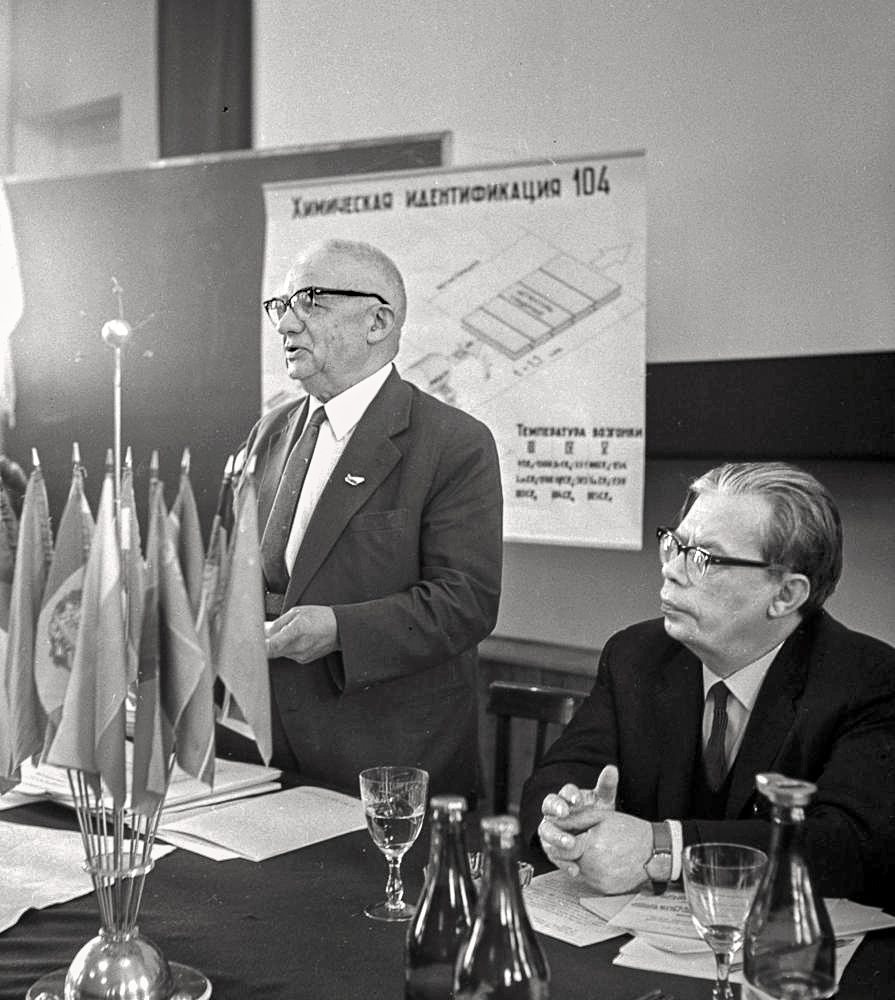
G. Nadzhakov and N. N. Bogolyubov at the session of the CP on 23 March, 1966. Photo by Pavel Zolnikov
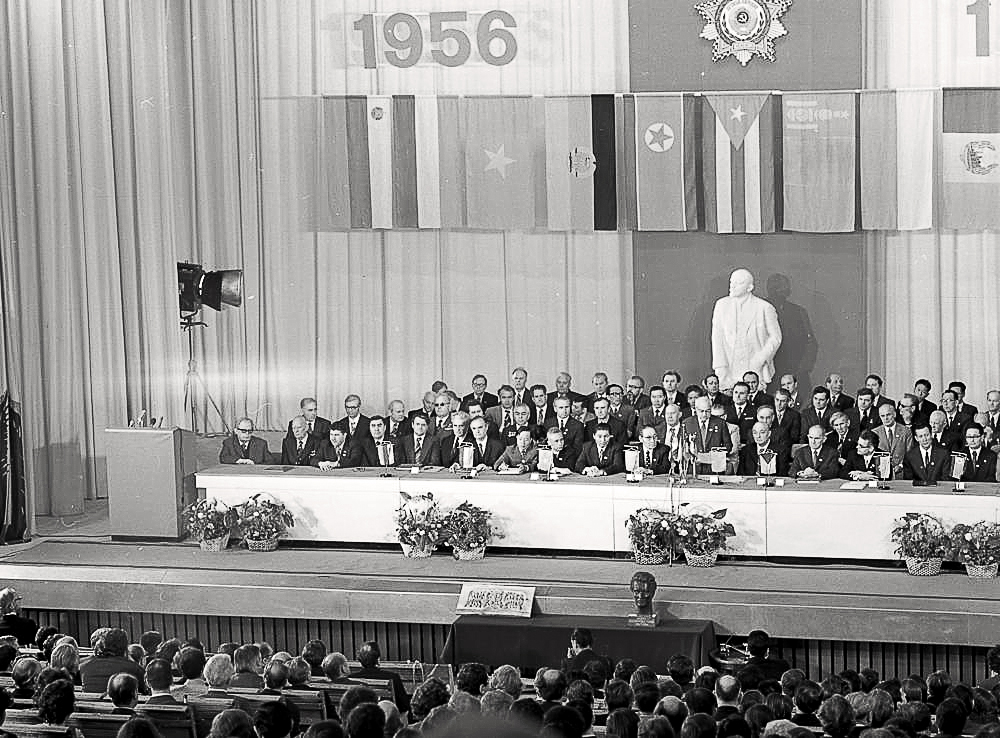
Presidium of the anniversary meeting of the Committee of Plenipotentiaries and the Scientific Council of JINR that was attended by guests of honor: extraordinary and plenipotentiary ambassadors of the embassies of the JINR Member States, prominent scientists and veterans of the Institute. Photo by Yury Tumanov
Academician Karl Lanius, "The Joint Institute played a large role in training scientific personnel for the Member States. Many scientists defended their candidate and doctoral theses here. Those who came to study here in the early years of the Institute became major scientists..."
Professor Chestmir Shimane, "For the first time in JINR, it was necessary to meet many new practical problems related to the joint work of international teams, with the residence of foreign specialists in Dubna, with cooperation with Member States on a joint topical plan, with the exchange of information... JINR increasingly starts to act as an unofficial coordination centre for research in the institutes of the Member States."
Under the heading "Words addressed to the hero of the day", Leaders of National Groups Matei Mateev and Tsvetan Vylov (Bulgaria), Laszlo Cher (Hungary), Nguyen Man Shat (Vietnam), Arnold Mayer (GDR), Pak Hong Cher (DPRK), Darjaagiin Chultham (Mongolia), Marek Sudnik (Poland), Laurenziu Aldea (Romania), Ivo Zvara (Czechoslovakia) made reports. "JINR's 20th anniversary is a worker's anniversary," Ivo Zvara emphasized. “A new unique pulsed reactor is under construction, a powerful cyclotron of heavy ions is born, other facilities are next in line. And the Institute has to sum up and analyze the accumulated experience "on the march", among many important things... Dubna has become more than just a famous geographical name. It has become a concept in world science, a concept in the minds of the public... The years lived in Dubna with its unique atmosphere of everyday life, permeated with science and the spirit of international friendship, is the most important stage in the lives of hundreds of scientists and specialists from many countries."
In several issues, the newspaper published detailed interviews with leading scientists of the Member States, plenipotentiaries and members of the Scientific Council in the 1976 anniversary year. Probably, from the standpoint of today, their opinions on the future of JINR, the prospects for its development are especially interesting.
Academician Hristo Hristov - Vice-President of the Bulgarian Academy of Sciences, Director of the Institute for Nuclear Research and Nuclear Energy of the Bulgarian Academy of Sciences, "The situation today is characterized by the fact that a large amount of experimental material has been accumulated, a number of important theoretical generalizations have been achieved but we still do not have a unified understanding of the whole picture of the microcosm. It gives reason to believe that we are on the eve of discovering new principles and creating new theories... Therefore, the influx of new young forces into science is so important."
Corresponding Member of the Polish Academy of Sciences Andrzej Hrynkiewicz - Director of the Institute of Nuclear Physics in Krakow, Professor of the Jagiellonian University, "I think that for the further successful development of our Institute, two important conditions should be met. One thing is the constant improvement of equipment. We have many unique basic facilities of very high quality and good class but if we do not take care that all equipment - electronic measuring instruments, computer equipment, others, is at a high level, it can negatively affect the future of Dubna. That's one condition. And the second is the "channel" of frames. This is a difficult task, since nowhere is there a well-established mechanism for the "channel" of scientists, the rejuvenation of the team, especially in such a field of science as nuclear physics. Here are two conditions we need to think about."
Professor Norbert Kroo - Head of the Laboratory of the Central Institute of Physical Research of the Hungarian Academy of Sciences, "I apologize if I answer this question too subjectively but the most rosy prospects for me lie in the possibilities hidden in the IBR-2 reactor that will be the world's only high-flow cyclic pulsed neutron source. I am encouraged by the future of the heavy ion accelerator and the prospects opening up in high energy physics concerning cooperation with the largest centres of the world and many more... And if you will, I would like to wish that in 20 years I, as an active researcher, could again congratulate the Joint Institute on its anniversary."
On June 2, 1976, a joint solemn meeting of the Committee of Plenipotentiaries and the Scientific Council was held, dedicated to the 20th anniversary of the Institute. Academician N. N. Bogolyubov made a report on the activities and international relations of the Institute. President of the USSR Academy of Sciences Academician A.P. Alexandrov presented Director of JINR with the Order of Friendship of Peoples. The Institute was awarded this high award by decision of the Presidium of the Supreme Soviet of the USSR on the anniversary. With greetings to Directorate and the international staff of the Institute, plenipotentiary representatives of the governments of the Member States addressed. The day before this event, the Republic of Cuba was accepted as a Member State of JINR at the CP meeting. A large group of scientists of the Institute was awarded honorary medals and signs of the Member States on the anniversary.
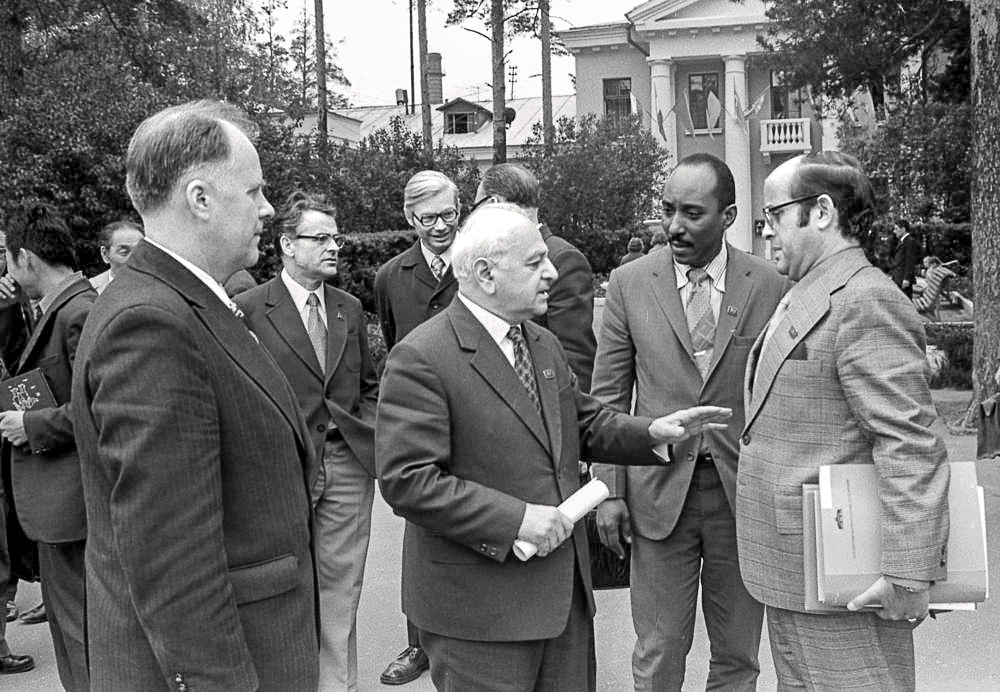
During the break of the CP session, A. A. Vasiliev (representative of the USSR State Committee for Atomic Energy), Academician A. M. Petrosyants (Chairman of the State Committee for Nuclear Energy), representative of the Republic of Cuba Tirse Saens. 2 June, 1976. Photo by Yury Tumanov
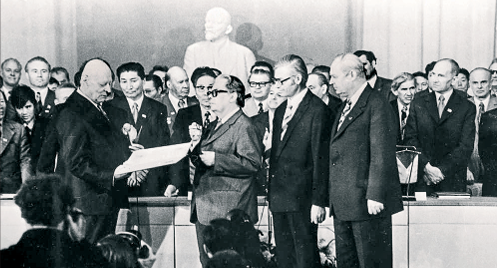
Awarding Order of Friendship of Peoples to the Joint Institute for Nuclear Research. From left to right: President of the USSR Academy of Sciences A.P. Alexandrov, Academician N.N. Bogolyubov, Academician K. Lanius, Professor C. Shimane. 2 June, 1976
MARCH 1986
In the anniversary issue of the newspaper, published on 26 March, a greeting to the JINR staff from the USSR Council of Ministers was published on the front page.
On the anniversary of JINR, physicists of the Member States adopted at a solemn meeting of the Committee of Plenipotentiaries and the Scientific Council of the Institute An appeal to the scientific community of the world for the complete and widespread elimination of nuclear weapons by the end of the twentieth century.
The editorial board of the newspaper appealed to the members of the Scientific Council of the Institute, representatives of different countries, with a request to tell about their first meeting with Dubna, about the most significant events in the history of the Institute, share their thoughts on the prospects for its development and express wishes to young employees. Professor Ivan Zlatev (Bulgaria), Academician I.M. Frank, Corresponding Member of the Hungarian Academy of Sciences Norbert Kroo, Professor Karl-Heinz Kaun (GDR), Academician of the Academy of Sciences of the MPR Namsrain Sodnom, Corresponding Member of the Polish Academy of Sciences Rishard Sosnowski responded to this request.
Continuing the column of the anniversary year "History of the Institute in the biographies of its veterans", the newspaper introduced the readers of the festive issue to the memories of LCTA veterans Henrietta Tentyukova and Lyudmila Kulyukina. And throughout the anniversary year, about twenty memoirs were published.
To the high awards that the JINR staff was previously awarded - the Soviet Order of Friendship of Peoples and the Vietnamese Order of Friendship - new ones were added: the Hungarian Order of the Red Banner of Labor and the Czechoslovak Order of Labor.
MARCH 1996
Two issues of the newspaper, dated 20 and 29 March, reflected a wide programme of celebrating the 40th anniversary of the Institute.
On 25-27 March, anniversary meetings of the Committee of Plenipotentiaries and the Scientific Council of JINR were held. On 28-29 March, anniversary events with the participation of veterans were held in the laboratories and divisions of the Institute.
At the 80th session of the Scientific Council, famous scientists and organizers of science V.P. Dzhelepov and A.M. Petrosyants spoke. Scientists from the Member States addressed the staff of the Institute with greetings on the occasion of the anniversary.
Director of JINR V. G. Kadyshevsky received congratulations from the President of the European Physical Society Herwig Shopper that emphasized that JINR was a pioneer in the development of international scientific cooperation.
In their interviews with the newspaper, members of the Scientific Council of Academicians Venceslav Andreichev (Bulgaria), Norbert Kroo (Hungary), Professor Ivan Wilhelm (Czech Republic), that began their work in Dubna in the late 1960s and early 1970s, talked about responsibility for the fate of the Institute, the desire to preserve its best traditions and transfer the accumulated experience to the young.
The JINR staff was congratulated by the President of the Russian Federation Boris Yeltsin and the Prime Minister of the Russian Federation Viktor Chernomyrdin. The welcoming messages of the state leaders were read out at a solemn meeting in Dubna by the Plenipotentiary Representative of the Russian Government at JINR, Minister of Science and Technical Policy Boris Saltykov.
The welcoming message of His Holiness Patriarch Alexy II of Moscow and All Russia was conveyed to the participants of the solemn meeting by Bishop Innocent of Dmitrov.
Leading JINR scientists were awarded state awards of Russia and other Member States.
The city, rich in talents, was brilliantly represented by its best creative teams on the stage of the Cultural Centre “Mir”.
MARCH 2006
The issue of the newspaper dedicated to the anniversary opened with "A word to readers", "Spring equinox, March sun, bird chirp... Natural symmetry seems to prevail over the chaos of winter. And half a century later, it already seems symbolic that the birth of our Institute is related to the first spring month.
"This is our Institute, on the banks of the Volga!" the phrase of Academician Andrzej Khrynkevich that has become winged. It can be joined by thousands of scientists and specialists from all Member States, who Dubna has become a second home for. This is what the largest scientists of the Member States that stood at the origins of JINR, had in mind.
"Ours" is broader than just united. This is more sincere, more heartfelt. The sincere words of recognition and congratulations published in today's issue are evidence of it. As well as parting words from the "founding fathers" that left indelible traces not only in the history of science, but also in the grateful memory of man. And the fate of the peers of the Institute, inextricably united to its fate. And biographies of veterans that vividly reflected the history of JINR. And many events of these March days - official and unofficial - also left their mark on the pages of our anniversary issue.
On these holidays, guests will gather in Dubna - statesmen and public figures, leading scientists of scientific centres of the Member States and other countries of the world who JINR cooperates with. And maybe more than once the catch phrase will sound at official and friendly meetings, "This is our Institute, on the banks of the Volga!"
MARCH 2016
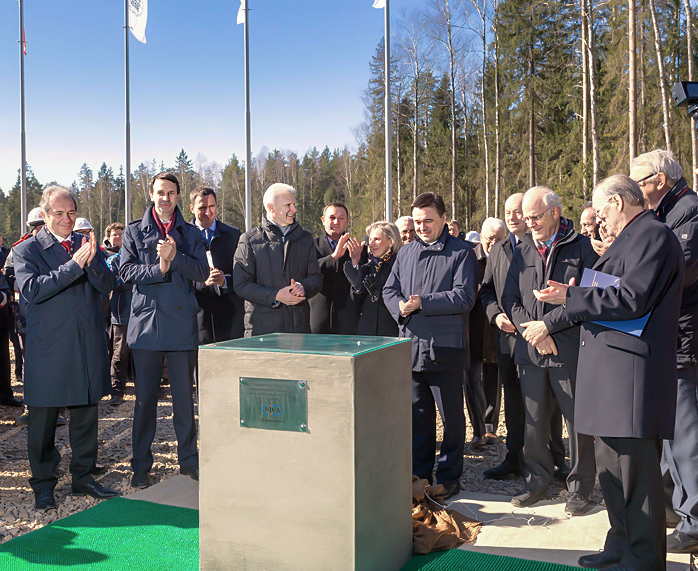
On 25 March, a solemn ceremony of opening a plate in honor of the start of construction of the NICA complex (pictured) was held at the Laboratory of High Energy Physics. It was attended by Assistant to the President of the Russian Federation A. A. Fursenko, Governor of the Moscow Region A. Yu. Vorobev, Deputy Minister of Education and Science of the Russian Federation L. M. Ogorodova, member of the Council for Physical Culture and Sports under the President of the Russian Federation I. K. Rodnina, as well as well-known scientists: President of the Russian Academy of Sciences Academician V. E. Fortov and Nobel winner American theoretical physicist D. Gronov ss. On the part of JINR, the ceremony was attended by Director of the Institute Academician V. A. Matveev, Vice Director of JINR G. V. Trubnikov, Director of VBLHEP V. D. Kekelidze, Chairman of the Committee of Plenipotentiary Representatives of the Governments of the JINR Member States L. Kostov.
After the symbolic opening of the construction, a tour of the laboratory departments in which the NICA megascience project is implemented was conducted for guests. Then, in the VBLHEP Conference Hall, the Governor of the Moscow Region A. Yu. Vorobev and Director of JINR Academician V. A. Matveev signed a cooperation agreement between the Government of the Moscow Region and JINR. Academician V.E. Fortov was awarded a diploma and the mantle of an Honorary Doctor of JINR. David Gross was awarded the JINR Medal of Merit. The Nobel winner gave a lecture "Quantum chromodynamics - a true and beautiful theory".
The article was prepared using the pages of the anniversary issues of the weekly
