
Electronic english version since 2022 |
The newspaper was founded in November 1957
| |
|
Number 13 (4811) 26 dated March 2026: |
Projects of the 21st century
JINR neutrino programme: ghost particle and major experiments
Neutrinos are one of the nature's most mysterious particles. These particles almost do not interact with matter: trillions of neutrinos born in the heart of the Sun pierce the reader's palm while he’s reading this sentence, leaving no traces. That is why they are sometimes called "ghost particles".

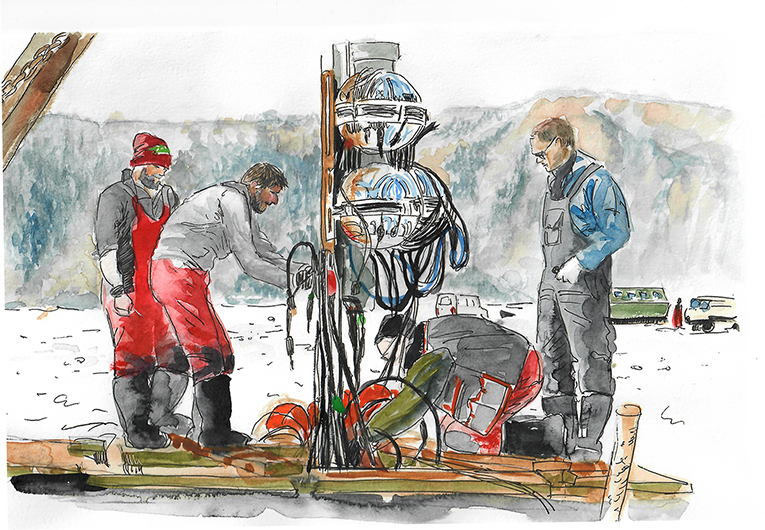
Baikal-GVD
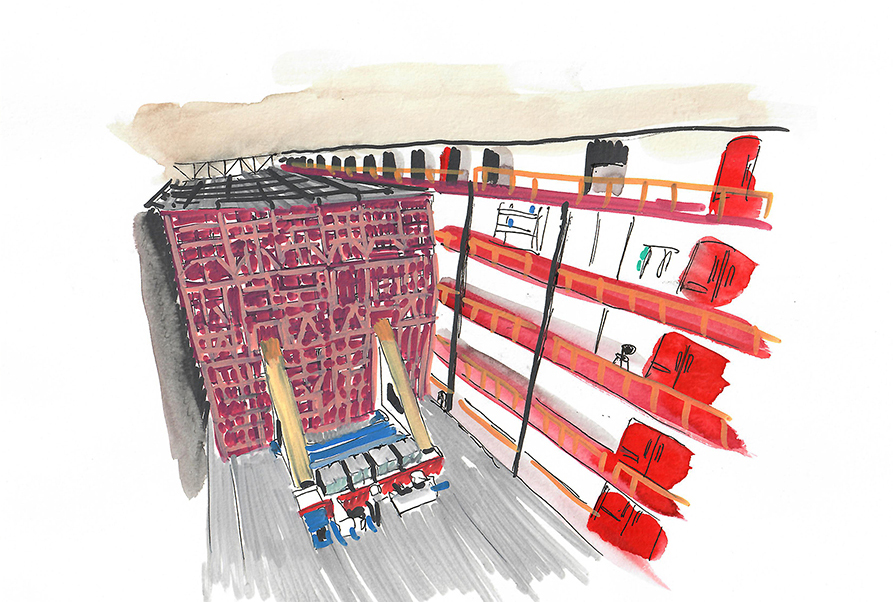
NOvA
The story of neutrinos is a story of amazing discoveries. The particle was theoretically proposed by Wolfgang Pauli in 1930 but it was experimentally registered only a quarter of a century later. In 1956, Frederick Reines and Clyde Cowan discovered an electronic antineutrino in an experiment with an atomic reactor. In 1962, Leon Lederman, Melvin Schwartz and Jack Steinberger discovered muon neutrinos on a particle accelerator. The third type - tau neutrinos was discovered only in 2000 in the DONUT experiment.
It turned out that neutrinos of a certain type cyclically turn into each other in the process of motion. This phenomenon is called neutrino oscillations and is one of the key discoveries of physics today.
The outstanding physicist, Russian-Italian scientist Bruno Pontecorvo that had worked for more than forty years at the Joint Institute for Nuclear Research in Dubna, played a key role in the development of neutrino physics. It was he who proposed many fundamental ideas for neutrino registration techniques and was the first to hypothesize neutrino oscillations. Pontecorvo's investigations laid the groundwork for the JINR neutrino school that is one of the most famous in the world today.
Today, the JINR Neutrino Programme is one of the largest scientific programmes of the Institute. It involves about 150 physicists and engineers, including young researchers. The programme covers a wide range of tasks: from the fundamental properties of neutrinos to astrophysics and applied technologies. Neutrinos of various energies and origins are studied - from reactor and accelerator to space and astrophysical.
Neutrinos can be considered not only as an object of research, but also as a unique tool for studying the universe. These particles are capable of carrying information from the depths of stars, from the bowels of the Earth, atomic reactors and even from the most extreme astrophysical objects.
Today, JINR physicists participate in a number of major international experiments.
One of the flagship projects is the giant neutrino detector JUNO (Jiangming Underground Neutrino Observatory), constructed in China. This is one of the most sensitive neutrino experiments in the world. The detector contains about 20 thousand tons of liquid scintillator and tens of thousands of photodetectors.
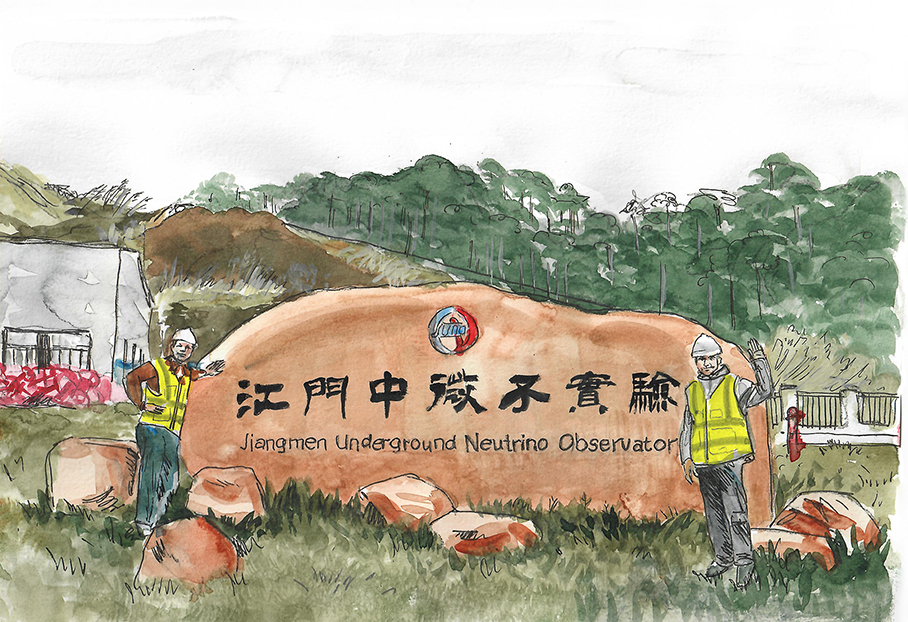
JUNO
Just the first data obtained after the launch of the facility in 2025 gave a record accuracy of measuring one of the parameters of neutrino oscillations - the difference in the squares of neutrino masses that estimate the neutrino oscillations in the Sun. In just two months of investigations, the experiment improved the world accuracy result by about 1.6 times. What previously took years and even decades of accumulation of statistics, JUNO, thanks to its sizes and technology, does in a matter of weeks and months.
A significant role in this experiment is played by the JINR team: the Institute's specialists participate in the development of detectors, data analysis, development and support of a computing infrastructure and scientific interpretation of the results.
The crawn jewel of the JINR Neutrino Programme is the Baikal-GVD Deep Underwater Neutrino Telescope on Lake Baikal - a megascience project in our country. It is the largest neutrino detector in the Northern Hemisphere. It is a giant three-dimensional lattice of light-sensitive modules located at a depth of more than a kilometer.
By 2026, the telescope has 14 clusters and about 4300 optical modules viewing a volume of water of about 0.7 cubic kilometers.
This unique instrument is designed to register ultrahigh-energy neutrinos that come from space. Such particles are born in the most powerful astrophysical objects - active galactic nuclei, supernova explosions and other extreme sources.
Analysis of six years of data of the telescope allowed establishing restrictions on the flux of cosmic neutrinos and carrying out joint analysis with international IceCube and KM3NeT experiments. In addition, Baikal-GVD data indicate the possible contribution of our galaxy to the birth of ultrahigh-energy neutrinos.
A major area of the neutrino programme concerns reactor antineutrinos. Such particles are produced in huge quantities in nuclear reactors. Their investigation allows not only studying the fundamental properties of neutrinos, but also developing new techniques for control of the operation of nuclear facilities.
In the experiment DANSS carried out at the Kalinin Nuclear Power Plant, physicists from JINR developed techniques for observing reactor antineutrinos and showed the ability to monitor reactor power with an accuracy of about one percent. At the same nuclear power plant, a scientific group from DLNP currently carries out the experiment nuGeN aimed at searching for coherent neutrino scattering at atomic nuclei and rare processes using a low-threshold germanium detector in special protection. In addition to fundamental tasks, ongoing research can become the basis for developing compact antineutrino detectors.

DANSS
Also, according to the anti-neutron signal, measurements of isotopic nuclear fuel were carried out directly during the operation of the reactor. This is an essential result for both fundamental physics and nuclear applications.
JINR physicists are extensively involved in acceleration experiments. One of them is the international NOvA experiment in the United States, where neutrino oscillations over long distances are studied. Joint analysis of data from NOvA and T2K experiments allowed clarifying the parameters of neutrino mixing and investigating a possible violation of CP symmetry in the lepton sector. If such a violation is finally confirmed, it could help to explain one of the main mysteries of cosmology - why there is an excess of matter over antimatter in the universe.
Another fundamental issue is related to the very nature of neutrinos: are neutrinos and antineutrinos the same particles or are they different particles. The search for an answer to it is carried out in experiments to search for neutrinoless double beta decay of atomic nuclei.
The leading international experiments GERDA and LEGEND, aimed at studying the neutrinoless double beta decay of the germanium-76 isotope, play a key role in these investigations. JINR specialists have made a significant contribution to these investigations and widely participate in their development.
JINR's neutrino programme also includes investigations of rare processes, the search for neutrino-free double beta decay, the development of new types of detectors and techniques of radiochemical analysis. Dozens of young scientists and engineers are involved in these investigations.
It is especially important that neutrino physics is still one of the fastest developing areas of science. In the coming years, major new experiments are expected to estimate the neutrino mass hierarchy, to investigate neutrinos from supernova flares and possibly to discover new particles and interactions.
Over the seven decades of its history, the Joint Institute for Nuclear Research has become one of the world's centres of neutrino physics. And today, supporting the traditions founded by Bruno Pontecorvo, Dubna scientists explore one of the nature's most mysterious particles - neutrinos.
Head of the JINR Neutrino Programme,
DLNP Deputy Director Dmitry NAUMOV
Artist - Anastasia ZLOBINA
